

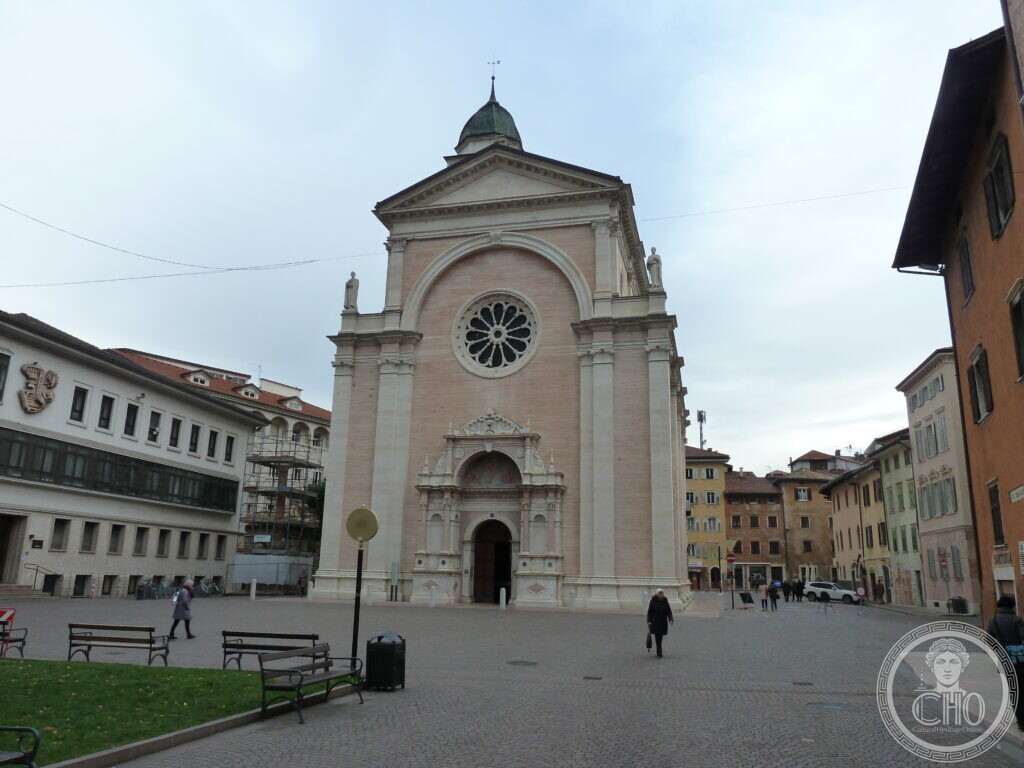
A 16th-century church in central Trento, built over Roman and early Christian remains and known for hosting the concluding phase of the Council of Trent.
At a glance
The basilica stands on Piazza Santa Maria Maggiore in Trento. It is a Renaissance church commissioned by Prince-Bishop Bernardo Clesio, and the published sources describe it as a place of high historical value because of its connection to the Council of Trent and the archaeological layers beneath it.
Key facts
- Where: Piazza Santa Maria Maggiore, 38122 Trento
- What: Basilica
- When: 1520–1524
- GPS: 46.0687, 11.1194 · Open in Google Maps
History
The church was erected between 1520 and 1524 at the wish of Prince-Bishop Bernardo Clesio, to a design by the Comacine architect Antonio Medaglia. It replaced the medieval church of Santa Maria ad Nives, itself an early Christian ecclesia, on a site that had yielded extensive evidence of the Roman city of Tridentum. Under the present building, archaeologists have found remains of Roman public baths from the first century AD and the foundations of a late fifth- or sixth-century Christian basilica that preceded the cathedral. From 13 April 1562 the congregations of the third and final phase of the Council of Trent were held here, in a wooden hemicycle tribune set up in the nave. In 1902 the Marche painter Sigismondo Nardi decorated the vault with scenes and figures from the Tridentine synod. The church was raised to the rank of minor basilica in 1973 by Pope Paul VI.
What you see
The photograph shows the facade facing a paved square with benches and a lawn, with small figures of people in front. The facade is of pink and white local limestone and evokes a classical temple, with a rose window and a dome above. Inside, the sources describe a wide single nave with lateral chapels, a white marble organ gallery with Renaissance bas-reliefs by Vincenzo and Girolamo Grandi, altarpieces by Giovanni Battista Moroni, Pietro Ricchi, Francesco Unterperger and Giambettino Cignaroli, and large organ doors painted by Giovanni Maria Falconetto in 1508. The white limestone bell tower is recorded as 53 metres high and the tallest in Trento.
Do you know more about this place?
If you know a date, a name, a document, a plaque or a photograph that tells its story, write to Sofia at sofia@culturalheritageonline.com or through the contact page. What arrives with a source goes into this page, with your name as the contributor.
Nearby
- Roman Villa of Orpheus — archaeological remains close by
- Mart – Civic Gallery of Trento — civic gallery a short walk away
- Church of San Francesco Saverio, Trento — nearby church in the same area
Sources
- Comune di Trento, Basilica di Santa Maria Maggiore: construction date, architect, patron, Council of Trent, 1902 frescoes, address
- Visit Trento, Church of Santa Maria Maggiore: building history, Council assemblies, artworks, opening hours
- Ciceru, Basilica di Santa Maria Maggiore in Trento: Roman baths, paleochristian basilica, bell tower height, minor basilica status
- Trentino Cultura, Santa Maria Maggiore: Roman public baths beneath the site, architectural decoration, early church
- Stefano Vigolo, photographs and notes to the editorial staff (2026): identification of the subject and GPS coordinates. Not a published source
Find it on the map
See this place and what’s around it →📷 Become a Cultural Heritage Online photographer
Share your photos of places: they stay published under your name as the author. The more they're seen, the more you get noticed — and soon a contest will reward the most appreciated photos.
Log in or sign up free to add a photo