

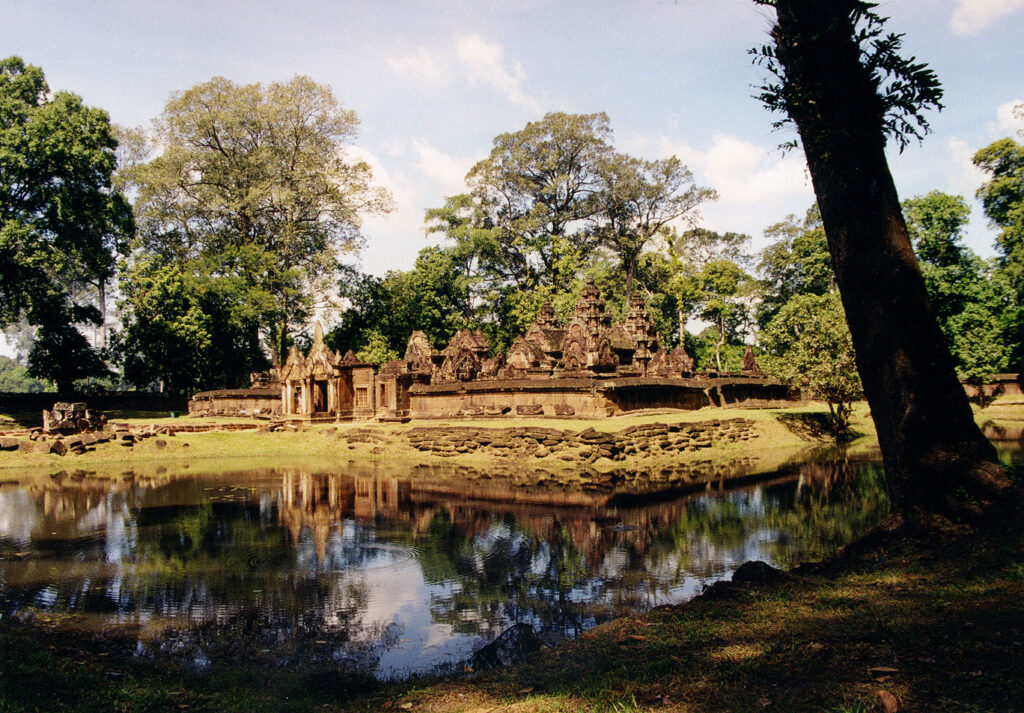
A jewel of Khmer art, this intimate 10th-century temple dedicated to Shiva and Parvati showcases the refinement of Cambodian craftsmanship through its distinctive red sandstone and intricate decorative carving.
At a glance
Banteay Srei stands apart from Angkor’s monumental temples through its miniature scale and exceptional artistry. Built primarily of red sandstone, the complex lies 25 kilometres north-east of Angkor Thom, near Phnom Dei hill. Its elaborate wall carvings remain remarkably well preserved.
History
Constructed in the 10th century, Banteay Srei was dedicated to the Hindu deities Shiva and Parvati during the height of Khmer temple-building. The temple emerged during the period of Yaśodharapura and Angkor Thom, the great medieval capitals of the Khmer Empire.
What you see
The temple’s distinguishing feature is its intimate proportions—unusually small by Angkorian standards. Red sandstone, the primary building material, has proven ideal for detailed decorative work. The surviving wall carvings demonstrate sophisticated ornamental techniques and remain visible across the complex’s structures.
Cultural significance
Banteay Srei represents a pinnacle of Khmer artistic achievement. Its refined scale, intricate ornamentation, and exceptional state of preservation have earned it widespread recognition as the jewel of Khmer art. The temple exemplifies the technical and aesthetic sophistication of 10th-century Cambodian craftsmanship.
Key facts
- Country: Cambodia
- Location: Angkor region, 25 km north-east of Angkor Thom
- Date: 10th century CE
- Dedication: Shiva and Parvati (Hindu)
- Primary material: Red sandstone
- Coordinates: 13.5989° N, 103.9628° E
Practical information & getting there
Banteay Srei is accessible from Siem Reap, the nearest major city. You will need transport to reach the temple, situated north-east of the central Angkor temples. The site welcomes visitors year-round; inquire locally about current access conditions and hours.
Sources & resources
Find it on the map
See this place and what’s around it →📷 Become a Cultural Heritage Online photographer
Share your photos of places: they stay published under your name as the author. The more they're seen, the more you get noticed — and soon a contest will reward the most appreciated photos.
Log in or sign up free to add a photoIs this page about you?
This page is read by travellers and heritage enthusiasts who find it on Google. Tell us how you are connected to this place and we will take it from there.