
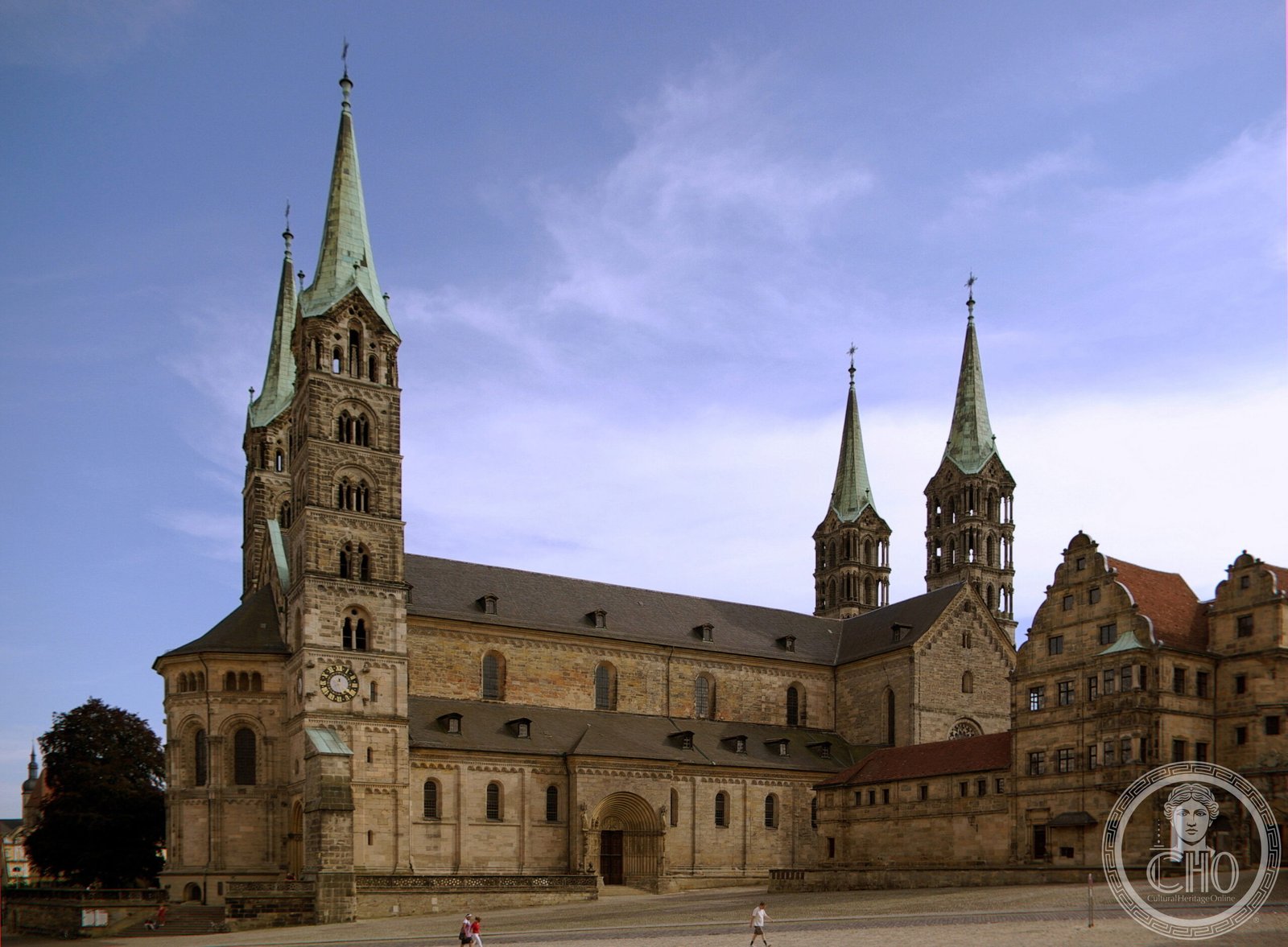
Founded by King Heinrich II in 1002 and consecrated a decade later, Bamberg Cathedral holds an extraordinary distinction: it is the burial place of the only imperial couple ever canonized, and contains Germany’s sole papal grave.
At a glance
This late Romanesque cathedral, completed in the 13th century after two earlier structures burned, rises from Bamberg’s medieval town center with four commanding towers each 81 meters high. The building measures approximately 94 meters long, 28 meters wide, and 26 meters high. Since 1993 it has formed part of the UNESCO World Heritage Site designation of the Town of Bamberg.
History
King Heinrich II (later Emperor Henry II) founded the cathedral in 1002 and saw it consecrated in 1012, establishing it as the seat of the Archdiocese of Bamberg. Two predecessor cathedrals were destroyed by fire in the 11th and 12th centuries. The current structure rose during the 13th century as a late Romanesque replacement, anchored by its four massive towers that define the city’s skyline.
What you see
The cathedral’s interior contains outstanding artworks spanning centuries. Most celebrated is the marble tomb of Henry II and his wife Cunigunde, carved between 1499 and 1513 by sculptor Tilman Riemenschneider—a work regarded as a masterpiece. The Bamberg Horseman, an equestrian statue dated most likely between 1225 and 1237, possibly depicts the Hungarian king Stephen I and represents the first sculpture of its kind since antiquity. The cathedral also displays the tomb of Pope Clement II, whose reign lasted from 1005 to 1047.
Cultural significance
Bamberg Cathedral’s historical and spiritual importance rests on its unique burials. Henry II and Cunigunde remain the only imperial couple to be canonized by the Catholic Church. Pope Clement II is the only pope buried in Germany and north of the Alps—a consequence of medieval papal politics rather than choice. The Bamberg Horseman stands as a bridge between classical sculpture and medieval innovation, influencing equestrian monument tradition across Europe.
Key facts
- Country: Germany
- City: Bamberg
- Completed: 13th century
- Founded: 1002
- Consecrated: 1012
- UNESCO World Heritage Site: Town of Bamberg (since 1993)
- Coordinates: 49.8908, 10.8825
Practical information & getting there
The cathedral remains under the administration of the Archdiocese of Bamberg and serves as the seat of its archbishop. Bamberg’s compact medieval center is accessible by train from major German cities. For current opening hours, admission fees, and guided tour availability, consult the Bamberg tourism office or the cathedral’s official website.
Sources & resources
Find it on the map
See this place and what’s around it →📷 Become a Cultural Heritage Online photographer
Share your photos of places: they stay published under your name as the author. The more they're seen, the more you get noticed — and soon a contest will reward the most appreciated photos.
Log in or sign up free to add a photoIs this page about you?
This page is read by travellers and heritage enthusiasts who find it on Google. Tell us how you are connected to this place and we will take it from there.