
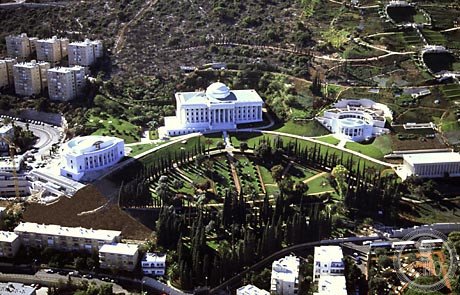
Spanning three cities across northern Israel, the Baháʼí World Centre comprises over 20 administrative offices, shrines, and pilgrim buildings set within more than 30 landscaped gardens. In 2008, these sites became the first World Heritage-designated places associated with a relatively new religious faith.
At a glance
The Baháʼí World Centre is a sprawling international religious and administrative complex anchored by two major shrines: the Shrine of the Báb on Mount Carmel in Haifa, and the Shrine of Baháʼu’lláh in Bahjí. The ensemble integrates pilgrimage sites, historical residences, libraries, archives, and administrative headquarters across a deliberately designed landscape of terraces and gardens.
History
The site’s significance stems from Baháʼu’lláh’s imprisonment in Acre by the Ottoman Empire during the nineteenth century. What began as a place of exile became sacred ground for Baháʼí pilgrims, eventually developing into the faith’s spiritual and organizational center. The complex evolved gradually, combining historic structures with purpose-built facilities designed to serve both pilgrimage and governance.
What you see
The Shrine of the Báb dominates the north slope of Mount Carmel, its golden dome visible across Haifa’s harbor. The Shrine of Baháʼu’lláh, the Mansion of Bahji, and the Mansion at Mazra’ih are located near Acre. Throughout the complex, carefully engineered terraces and gardens create a unified landscape linking dispersed buildings across steep terrain. Historical residences sit alongside modern administrative structures, all arranged to facilitate pilgrimage and function.
Cultural significance
These sites hold profound meaning for Baháʼís worldwide, embodying the faith’s strong pilgrimage tradition and spiritual aspirations. The UNESCO World Heritage Committee recognized them as possessing outstanding universal value—a watershed moment for newer religious movements gaining international heritage recognition. The centers represent a unique fusion of sacred space, administrative infrastructure, and landscape design.
Key facts
- Location: Haifa, Acre, and Bahjí, Israel
- Coordinates: 32.81°N, 34.99°E
- UNESCO World Heritage List: Inscribed July 2008
- Comprises: 20+ buildings including shrines, administrative offices, libraries, and archives
- Setting: 30+ gardens and terraces
Practical information & getting there
The Baháʼí shrines in Haifa are accessible to visitors; contact the Baháʼí community for current visiting information and hours. The terraces and Mount Carmel gardens are part of the urban landscape and viewable from multiple vantage points. Haifa is served by rail and road connections from Tel Aviv and other Israeli cities. Specific visiting protocols for all sites should be confirmed in advance.
Sources & resources
Find it on the map
See this place and what’s around it →📷 Become a Cultural Heritage Online photographer
Share your photos of places: they stay published under your name as the author. The more they're seen, the more you get noticed — and soon a contest will reward the most appreciated photos.
Log in or sign up free to add a photo