

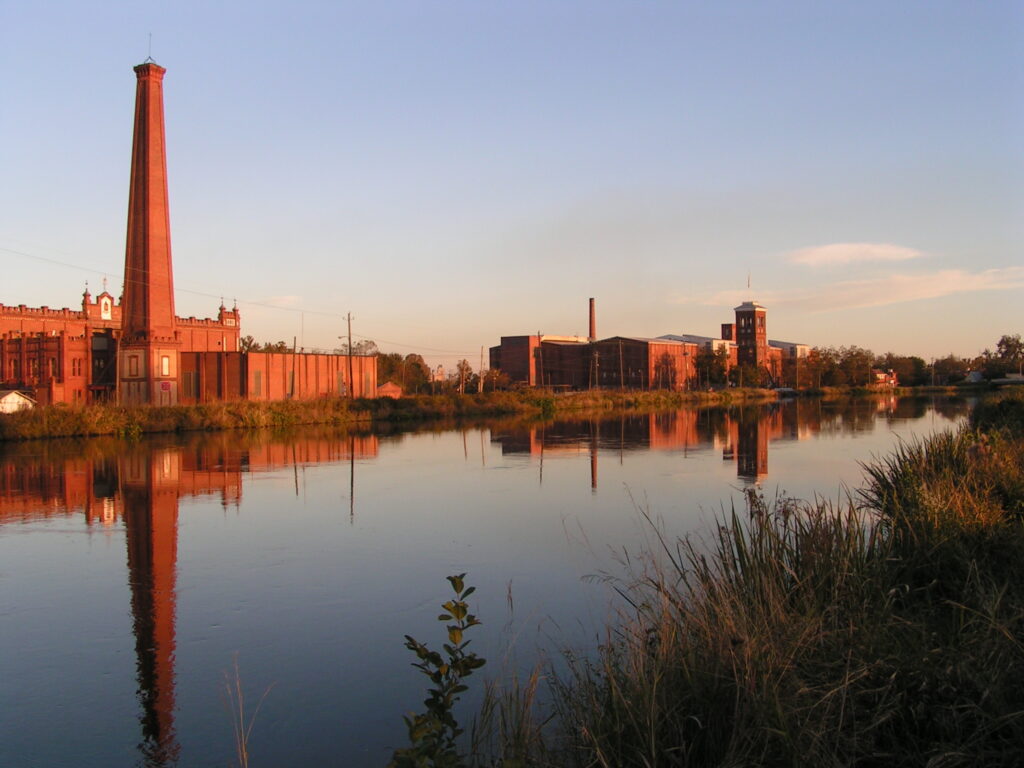
The Augusta Canal carries Savannah River water through Augusta in three levels, and it does the same three jobs it was dug for in 1845: power, transport and the city’s water supply.
At a glance
The canal takes water from the Savannah River at the fall line and returns it to the river. Mills lined it within a few years, and the channel still generates hydroelectric power and fills Augusta taps. The National Park Service calls it the only fully intact American industrial canal in continuous operation. The Augusta Canal Authority was established in 1989, and the canal became a National Heritage Area in 1996, the first in Georgia.
Key facts
- Built: 1845, for power, water and transport
- Headgates opened: 23 November 1846
- First factories: by 1847
- Levels: three, the third carrying water back to the river
- Mills: Enterprise (1877), Sibley (1880), John P. King (1882)
- National Heritage Area: 1996, the first in Georgia
- Discovery Center: Enterprise Mill, 1450 Greene Street, Suite 400
- Towpath: wide and level, once used by mules
History
Work began in May 1845 on twelve sections at once. Henry H. Cumming, who wanted Augusta to become “the Lowell of the South”, led the project. The first headgates opened on 23 November 1846 and flooded the first level. By 1847 a saw and grist mill and the Augusta Factory had been built, the first of many factories on the bank. Black labour, enslaved and free, finished the channel.
By the Civil War the canal had made Augusta a manufacturing centre, and the Confederate States Powder Works was built along it. After the war the channel was expanded to reduce flooding, a feat accomplished by 1875. Enterprise, Sibley and John P. King mills followed, and electric streetcars and street lighting came by 1892.
Floods brought Works Progress Administration crews, who raised the banks, built a new spillway and straightened the canal. In 1960 urban renewal demolished the Augusta Factory; the second and third levels dried up. In 1971 Joseph B. Cumming placed the canal on the National Register of Historic Places. In 1989 the Augusta Canal Authority was established. President Bill Clinton signed the bill that made the canal a National Heritage Area on 12 November 1996, the first in Georgia.
What you see
The first level carries a wide, level towpath, once used by mules to pull canal boats up to the headgates. It is now a trail for walkers and cyclists. The Discovery Center at Enterprise Mill occupies a former textile mill and is the starting point for guided history and nature tours in replica canal cargo boats. The headgates and the fall line are at the top of the canal.
Practical information
- Discovery Center: 1450 Greene Street, Suite 400, Augusta, GA 30901; telephone 706-823-0440
- Towpath: open to walkers and cyclists
- Tours: guided history and nature tours from the Discovery Center
- Heritage area sites: the Fall Line and Headgates, Savannah Rapids Park
Getting there
The Discovery Center is at Enterprise Mill, 1450 Greene Street, in Augusta. The headgates are upstream at the fall line, at Savannah Rapids Park.
Nearby
- The headgates and the fall line
- Savannah Rapids Park and its visitor information centre
- Enterprise Mill
Sources
Find it on the map
See this place and what’s around it →📷 Become a Cultural Heritage Online photographer
Share your photos of places: they stay published under your name as the author. The more they're seen, the more you get noticed — and soon a contest will reward the most appreciated photos.
Log in or sign up free to add a photo