

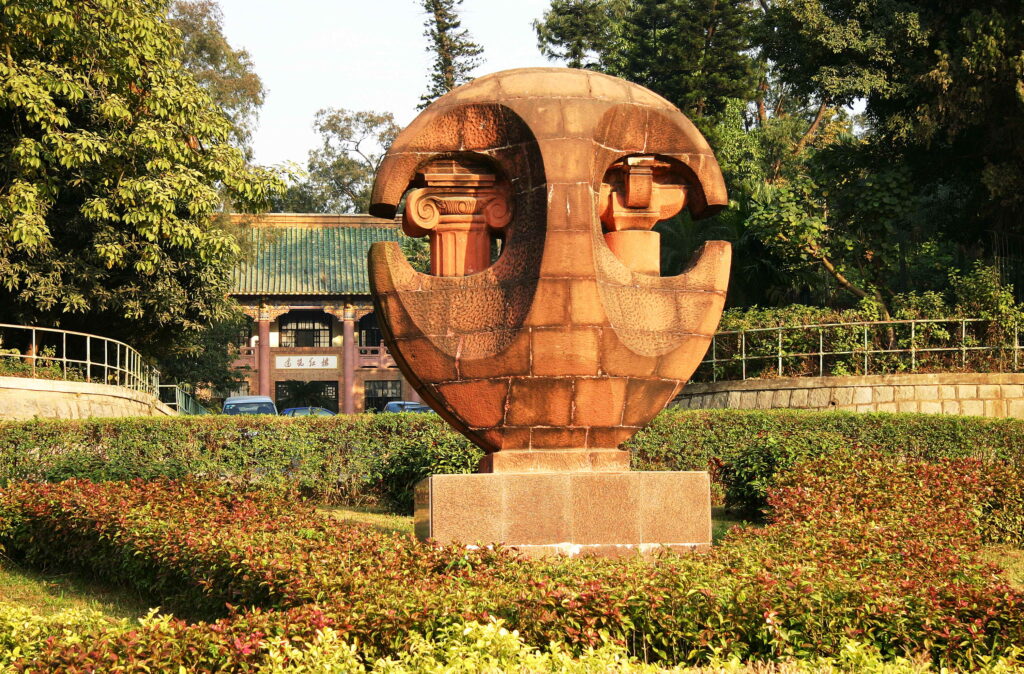
The Architecture Red Building is a two-storey block of 1934 on the Wushan campus of the South China University of Technology. Red brick, green tiles and a granite base, it has taught architects for seventy years.
At a glance
Building No. 6 stands east of Lushan Road on the Wushan campus, in the Tianhe district of Guangzhou. The Lingnan architect Yang Xizong designed it, and the Guangzhou Hongyi Construction Company built it between November 1933 and September 1934. Two storeys on a frame, it was dressed in what the university's own account calls the Chinese national style. The architecture school has worked here since the 1950s.
Key facts
- Designed by the Lingnan architect Yang Xizong
- Built between November 1933 and September 1934
- Two storeys, 2,363.2 square metres, frame structure
- Green glazed tiles, red brick walls, granite base, Italian terrazzo columns
- Named Architecture Red Building in 1958
- Listed among Guangzhou's protected cultural relics in July 2002
- Address: Building No. 6, 381 Wushan Road, Tianhe, Guangzhou
History
The building went up quickly. Work started in November 1933 and the block was finished in September 1934, on a frame of two storeys with 2,363.2 square metres of floor.
It opened as classrooms for the chemical engineering department of the engineering college of National Sun Yat-sen University. Around 1936 the chemists of the science college took it over. When the war ended in 1945 it became the seat of the university's general office, the room where the institution was run.
From October 1952 it held the library and the university offices for a time. Both moved out within a couple of years, and the building passed to the department of architecture. In 1958 the first party secretary, Zhang Jin, wrote the name over the door: Architecture Red Building. The name stayed, and the architecture school has used the block ever since.
The teaching that goes on inside is older than the building. The discipline began in 1932 with the architecture department of Xiangqin University, a department set up with the university itself and called the first of its kind in the southern provinces. Lin Keming, who had studied in Lyon, was its first head. The department moved to Sun Yat-sen University in 1938 and into the South China Institute of Technology in 1952. A department of architecture followed in 1980, and a school of architecture in 1998.
In July 2002 the city listed the building in the sixth batch of Guangzhou's protected cultural relics. In November 2003 it entered the university's ten campus views under the name Red Building amid Greenery.
What you see
The outside is the argument. Green glazed tiles run along the ridges and the eaves, the walls are red brick, the base is granite, and painted tilework decorates the walls. Two rows of red Italian terrazzo columns run the full height inside, with a gallery around them. The plan is a broad bracket, and the building faces west. The two wings carry hipped roofs, the middle a gable.
The school inside teaches architecture, urban planning and landscape architecture. It holds the national key laboratory of subtropical building and urban science, and its work leans on the climate and the building habits of Lingnan. The building itself is a case study for the school: a 1930s attempt at a modern Chinese architecture, still in daily use.
Practical information
- Address: Building No. 6, 381 Wushan Road, Tianhe, Guangzhou
- A working school of architecture: studios and offices, entered on university business
- A protected municipal cultural relic since July 2002
- The exterior is best read from the campus paths east of Lushan Road
- The campus is open to visitors on ordinary university terms
Getting there
The building stands on the Wushan campus of the South China University of Technology, in the Tianhe district of Guangzhou, east of Lushan Road. The campus is reached by metro and by bus from the city centre.
Nearby
- The Sun Yat-sen statue on the Wushan campus
- The university library
- The Wushan campus axis and its older teaching blocks
- Tianhe district, Guangzhou
Sources
Find it on the map
See this place and what’s around it →📷 Become a Cultural Heritage Online photographer
Share your photos of places: they stay published under your name as the author. The more they're seen, the more you get noticed — and soon a contest will reward the most appreciated photos.
Log in or sign up free to add a photoIs this page about you?
This page is read by travellers and heritage enthusiasts who find it on Google. Tell us how you are connected to this place and we will take it from there.
This entry stays online and free either way — and a free account lets you add to it yourself.