
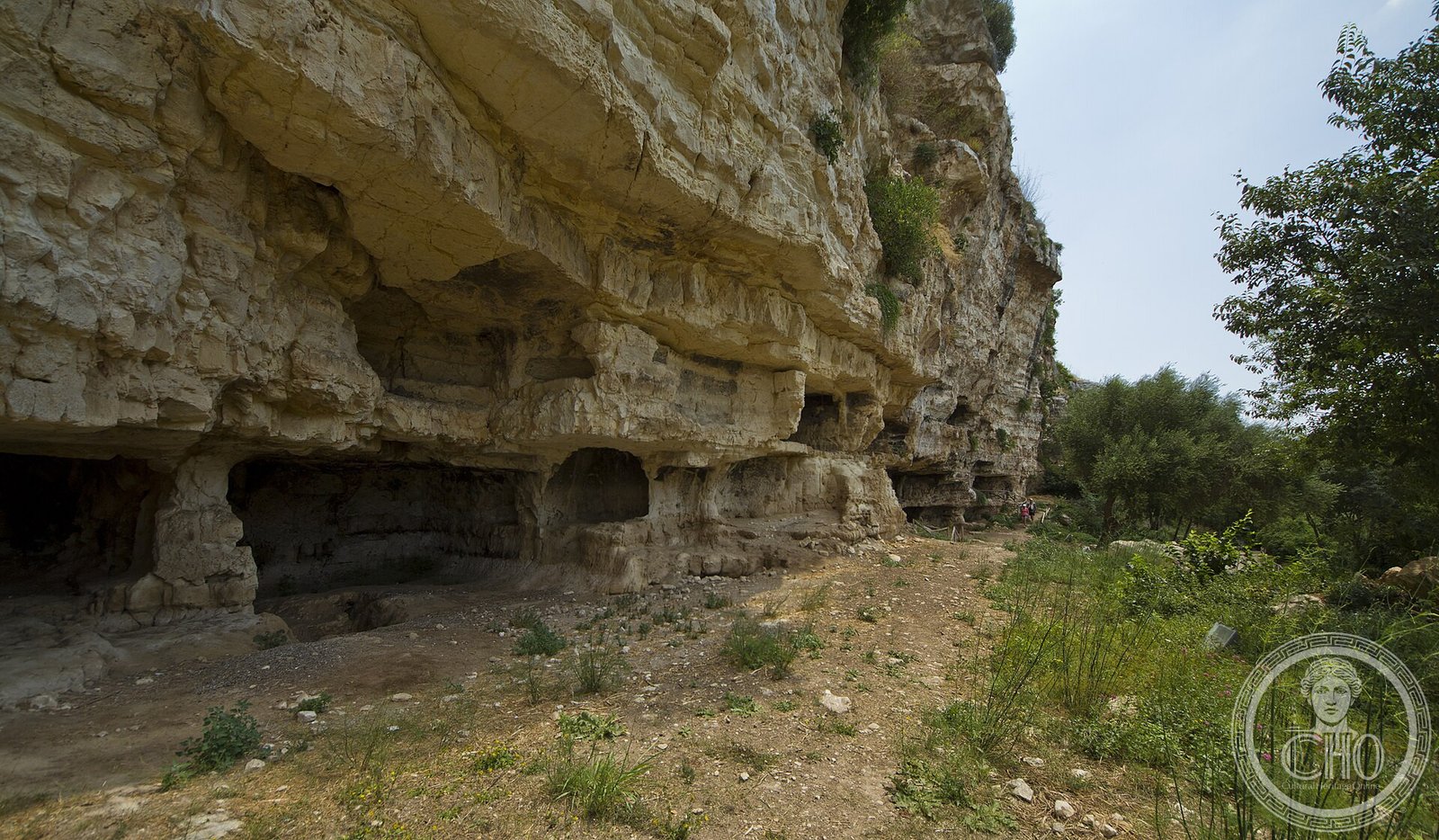
Cava d’Ispica is a deep limestone gorge in south-eastern Sicily, stretching approximately thirteen kilometres between the municipalities of Ispica and Modica, whose walls are honeeycombed with thousands of rock-cut tombs, catacombs, cave dwellings and Christian oratories spanning from the Chalcolithic period through the late Byzantine era. At its southern end stands the medieval castle that gives the archaeological area its full name. One of the most dramatically layered archaeological landscapes in Sicily, the gorge has been inhabited and reused almost continuously for over four millennia.
At a glance
- Type
- Archaeological gorge — rock-cut necropolis, catacombs, cave settlements, medieval castle
- Period
- Chalcolithic (c. 3rd millennium BC) through late Byzantine and medieval (17th century)
- Style
- Prehistoric, Sicilian Bronze Age, Greek-period, early Christian, Byzantine, Norman-Aragonese
- Location
- Between Ispica and Modica, Free municipal consortium of Ragusa, Sicily, Italy
- Coordinates
- 36.8502° N, 14.8379° E
Overview
The Cava d’Ispica gorge is one of Sicily’s most extraordinary natural and archaeological settings, a kilometres-long ravine whose soft limestone walls were exploited by every culture that inhabited south-eastern Sicily over four thousand years. Prehistoric communities cut chamber tombs into the rock during the Chalcolithic and Bronze Age; Greek-period settlers added their own burials; early Christians created catacombs and oratories with frescoed walls; Byzantine communities sheltered in the natural caves; and medieval lords built a castle commanding the gorge’s entrance. The site forms part of the broader Val di Noto landscape, a UNESCO World Heritage region celebrated for its late-Baroque towns.
History
The earliest interventions in the gorge date to the Chalcolithic period, with prehistoric chamber tombs clustered in the necropolis zones. During the Sicilian Bronze Age (Castelluccio culture) and the subsequent Greek colonial period, the gorge continued to serve as a burial ground and occasional refuge settlement. Christian communities from the fourth century AD onward transformed caves into oratories and cut catacomb complexes, some preserving fragments of Byzantine fresco painting. The gorge’s role as a living settlement intensified in the medieval period, when the Ispica castle was constructed to control the valley. A catastrophic earthquake in 1693 — the same disaster that obliterated much of Val di Noto and prompted the famous Baroque rebuilding — brought permanent abandonment of the gorge settlements.
What you see
The northern section of the archaeological park, accessible near Modica, includes the most impressive prehistoric necropolis zones and the early Christian catacomb of Larderia, with its carved chambers and fragmentary frescoes. The southern section near Ispica preserves the Forza castle ruins and additional cave complexes. Throughout the gorge, cut-rock doorways, niches, tomb chambers and occasional rock-hewn cisterns punctuate the cliff faces, creating a visually striking palimpsest of human use across the millennia.
Cultural significance
Cava d’Ispica is one of the key sites for understanding the deep prehistory and early Christian heritage of south-eastern Sicily, a territory whose overlapping cultural layers — prehistoric, Greek, Roman, Byzantine, Arab-Norman — define the island’s unique heritage identity. Its location within the Val di Noto landscape, and its proximity to the late-Baroque cities of Ispica, Modica and Ragusa Ibla, makes it an essential counterpoint to the region’s better-known post-1693 architectural heritage.
Practical information
- Address
- SP3, between Ispica and Modica, 97014 RG, Sicily
- Admission
- Paid entry; check current tariffs; two entrance points (Ispica side and Modica side)
Getting there
Ispica and Modica are in the province of Ragusa in south-eastern Sicily. Modica has a railway station on the Siracusa–Gela line; Ispica station is also on the same line. By car from Ragusa, take the SS115 southbound and follow signs for Ispica or Modica. The gorge entrances are accessible from the SP3 provincial road between the two towns.
Sources & resources
Find it on the map
See this place and what’s around it →📷 Become a Cultural Heritage Online photographer
Share your photos of places: they stay published under your name as the author. The more they're seen, the more you get noticed — and soon a contest will reward the most appreciated photos.
Log in or sign up free to add a photo