
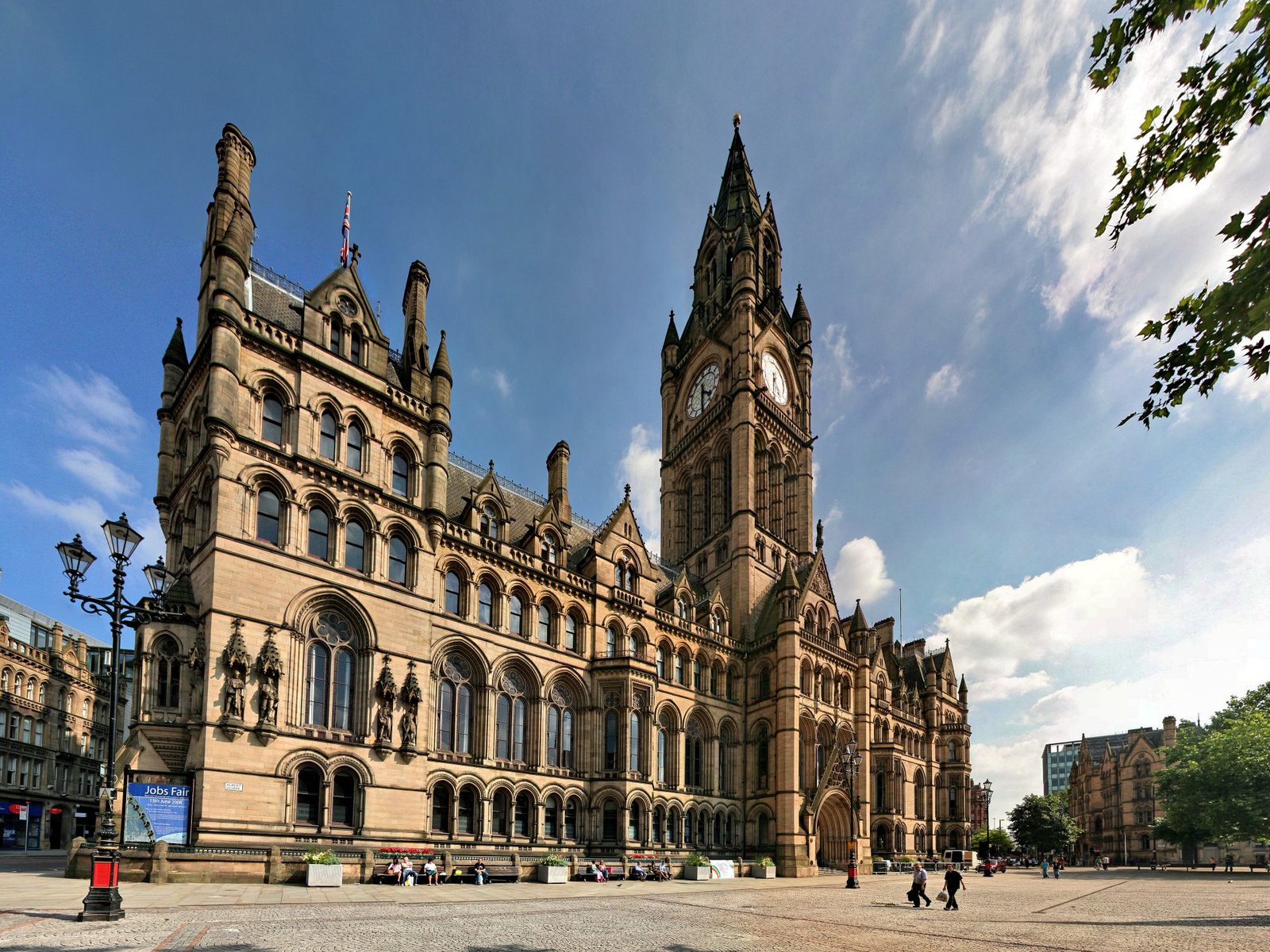
A Victorian civic space anchored by Alfred Waterhouse’s Gothic Town Hall, Albert Square stands as Manchester’s architectural and ceremonial heart, dominated by monuments to Prince Albert and ringed by period buildings of enduring grandeur.
At a glance
Albert Square is a public square in the centre of Manchester, dominated by the Grade I listed Manchester Town Hall. The square contains several monuments and statues, with the largest being the Albert Memorial, dedicated to Prince Albert, Prince Consort of Queen Victoria. Period buildings, many listed, surround the square on all sides.
History
The square was conceived and laid out between 1863 and 1867 expressly to provide a fitting setting for the Albert Memorial. Construction of the Town Hall began in 1868 and concluded in 1877, establishing the square as Manchester’s principal civic precinct during the height of the Industrial Revolution.
What you see
Manchester Town Hall, designed by architect Alfred Waterhouse, dominates the square with its assured Victorian Gothic style. Smaller listed buildings from the same era encircle the space, with those on the north side situated along Princess Street. The Albert Memorial serves as the square’s ceremonial focal point, a major sculptural monument within the public realm.
Cultural significance
Albert Square epitomizes Manchester’s civic confidence during the nineteenth century, when the city was a global centre of commerce and industry. The square’s layout, architecture, and monuments reflect Victorian values of progress, commemoration, and public grandeur. The Town Hall remains one of Britain’s finest examples of Victorian Gothic municipal architecture.
Key facts
- Location: Manchester, United Kingdom
- Coordinates: 53.4794, -2.245
- Period: 1863–1877
- Architect: Alfred Waterhouse (Town Hall)
- Town Hall designation: Grade I listed
Practical information & getting there
Albert Square is located in the city centre and is accessible on foot from Manchester Piccadilly railway station. The surrounding streets provide pedestrian access from all directions. The square remains a public space open year-round.
Sources & resources
Find it on the map
See this place and what’s around it →📷 Become a Cultural Heritage Online photographer
Share your photos of places: they stay published under your name as the author. The more they're seen, the more you get noticed — and soon a contest will reward the most appreciated photos.
Log in or sign up free to add a photoIs this page about you?
This page is read by travellers and heritage enthusiasts who find it on Google. Tell us how you are connected to this place and we will take it from there.