
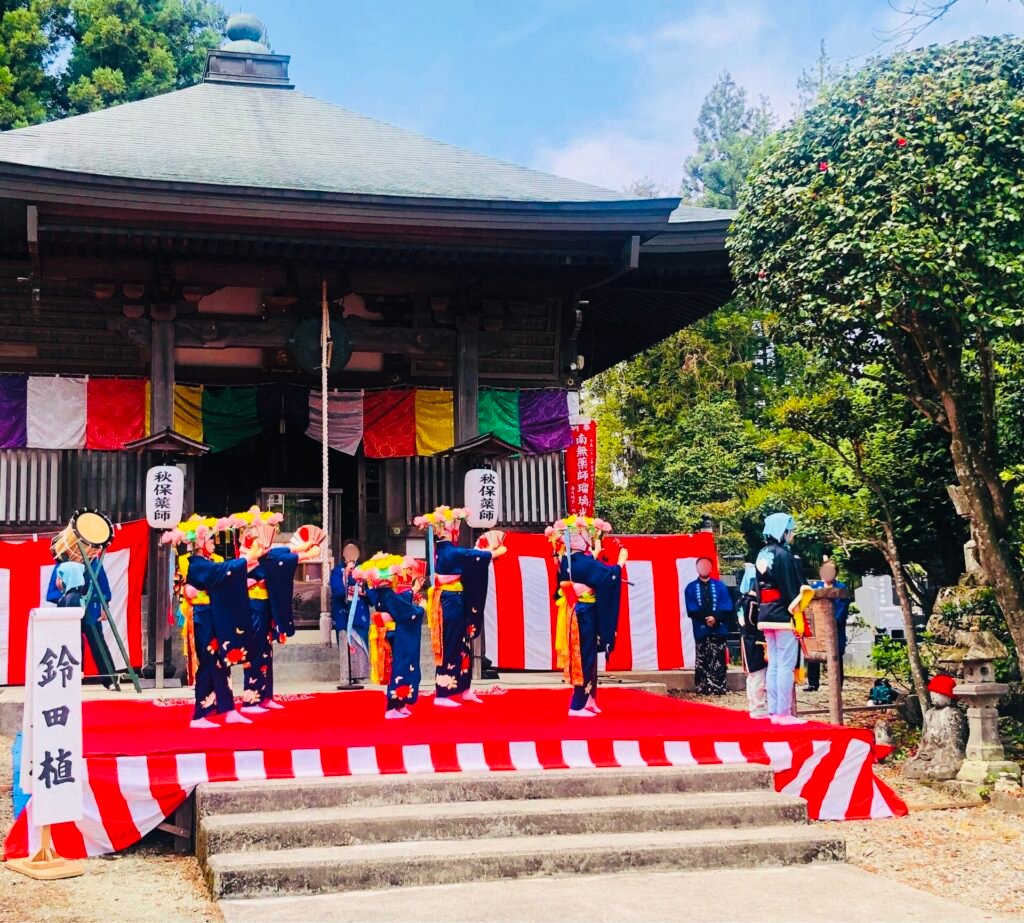
A centuries-old rice-planting dance in which ten female performers and two to four male dancers enact the agricultural cycle through synchronized movement, drums, flute and bells.
At a glance
Akiu no taue odori is a traditional ensemble dance performed to celebrate and enact the rice-planting season. Ten female dancers take the lead, supported by two or four male performers, moving through a repertoire of six to ten distinct dances. The performance combines rhythmic footwork with the sounds of flute, drums and bells, creating a ceremony that bridges labor and festivity.
Origins & history
The dance has been performed in Akiu—now a district of Sendai, Miyagi Prefecture—since the seventeenth century. It belongs to a broader tradition of taue odori (rice-planting dances) found across Japan, though each region developed its own distinct choreography and musical accompaniment. In 1970, formal documentation efforts began. Six years later, in 1976, the Japanese government recognized Akiu no taue odori as an Important Intangible Folk Cultural Property, acknowledging its historical and cultural significance.
The practice
The dance unfolds as a sequence of movements tied to the agricultural calendar. Ten female dancers, dressed in traditional costume, perform the central choreography. Two to four male dancers provide accompaniment and support. The ensemble moves to the rhythmic pulse of drums and the melodic lines of flute, with bells marking time and emphasizing key moments. The six to ten dances that compose the full performance each carry symbolic weight, representing different stages of rice cultivation from planting to harvest.
Cultural significance
Akiu no taue odori embodies the deep connection between Japan’s agricultural heritage and its performing traditions. The dance was born from labor—a way to synchronize the heavy work of planting while celebrating fertility and community. It represents the transformation of utilitarian movement into an art form, preserving knowledge of historical farming practices while affirming communal identity and continuity across generations.
Key facts
- Performed continuously since the seventeenth century
- Ensemble of ten female dancers and two to four male dancers
- Repertoire of six to ten distinct dances
- Accompanied by flute, drums and bells
- Designated an Important Intangible Folk Cultural Property of Japan in 1976
- Inscribed on the UNESCO Representative List of the Intangible Cultural Heritage of Humanity in 2009
Where to experience it
Sendai remains the heartland of Akiu no taue odori. The dance continues to be performed by local practitioners who carry forward the tradition. For current performance dates and venues, consult UNESCO’s ICH documentation or local Sendai cultural organizations.
Sources & resources
- Akiu no Taue Odori – Wikipedia
- Akiu no Taue Odori – UNESCO Intangible Cultural Heritage
- Cultural Heritage Online
Find it on the map
See this place and what’s around it →📷 Become a Cultural Heritage Online photographer
Share your photos of places: they stay published under your name as the author. The more they're seen, the more you get noticed — and soon a contest will reward the most appreciated photos.
Log in or sign up free to add a photo