
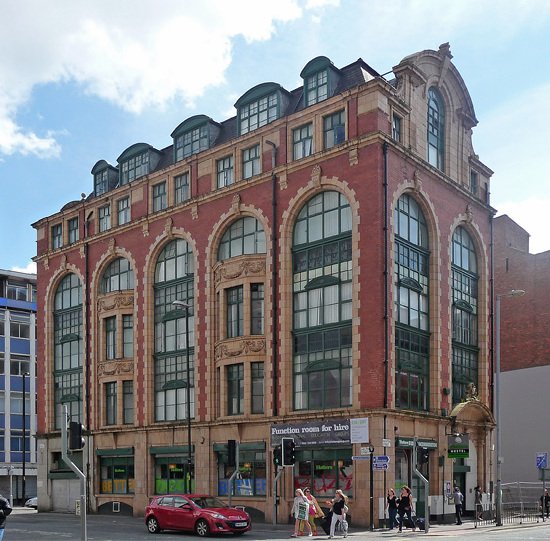
A Grade II listed warehouse in Manchester’s Northern Quarter, designed by Charles Clegg & Son and celebrated for its exuberant Free Baroque detailing.
At a glance
Built 1906–1908 on the site of a hat factory destroyed by fire. Architecturally ambitious commercial warehouse in the Northern Quarter. English Heritage recognizes it as a notable example of Free Baroque design in Manchester.
History
The building replaced a hat factory that burned down in 1906, prompting the construction of this new warehouse. Designed by Charles Clegg & Son, it was completed by 1908. The structure has since been listed as Grade II, affirming its architectural importance to the city’s heritage. As of 2024, the building is planned for full renovation.
What you see
The warehouse displays pronounced Free Baroque features—a style that applies baroque ornamentation to functional industrial architecture. The design balances commercial utility with considerable decorative flair and panache, unusual for the warehouse typology of its period.
Cultural significance
50 Newton Street exemplifies how Manchester’s turn-of-the-century architects elevated the vernacular warehouse form. Its Free Baroque vocabulary reflects the city’s confidence and prosperity during the Edwardian era, marking the Northern Quarter as a district where commerce and aesthetic ambition intersected.
Key facts
- Designed by Charles Clegg & Son, 1906–1908
- Location: Newton Street, Northern Quarter, Manchester
- Grade II listed building
- Coordinates: 53.4819, -2.2327
- Architectural style: Free Baroque
Practical information & getting there
50 Newton Street is located in Manchester’s Northern Quarter, an accessible district in the city centre. The building is visible from the street. Check ahead before visiting, as renovation work may be underway or upcoming.
Sources & resources
Find it on the map
See this place and what’s around it →📷 Become a Cultural Heritage Online photographer
Share your photos of places: they stay published under your name as the author. The more they're seen, the more you get noticed — and soon a contest will reward the most appreciated photos.
Log in or sign up free to add a photoIs this page about you?
This page is read by travellers and heritage enthusiasts who find it on Google. Tell us how you are connected to this place and we will take it from there.