
Mongolia’s ancient vocal tradition stretches syllables into pure meditation. A single word can float across minutes; a song of ten words may unfold for hours.
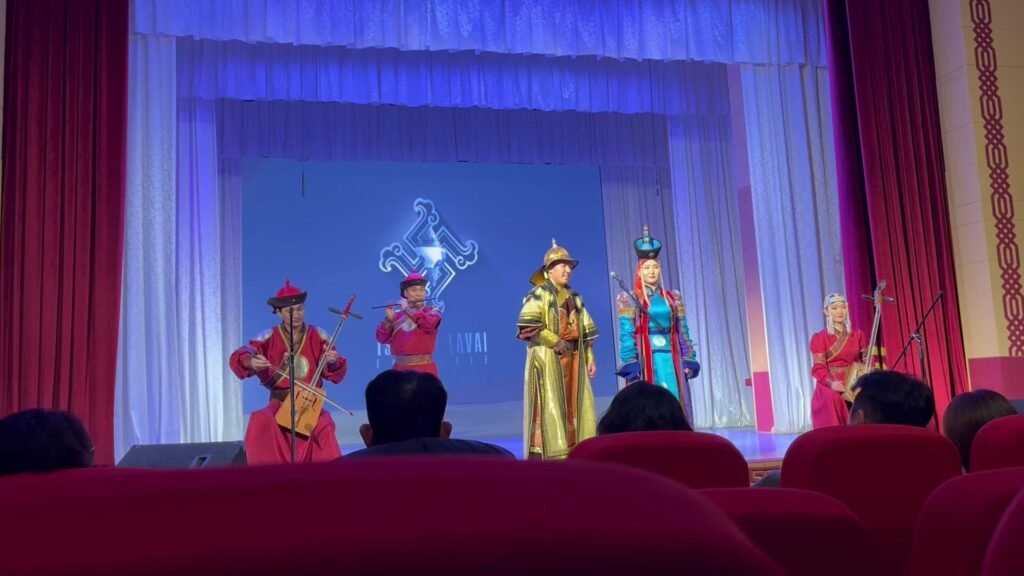
In UNESCO’s words
The Urtiin duu or “long song” is one of the two major forms of Mongolian songs, the other being the short song” (bogino duu). As a ritual form of expression associated with important celebrations and festivities, Urtiin duu plays a distinct and honoured role in Mongolian society. It is performed at weddings, the inauguration of a new home, the birth of a child, the branding of foals and other social events celebrated by Mongolia’s nomadic communities.The Urtiin duu can also be heard at the naadam, a festivity featuring wrestling, archery and horseracing competitions. The Urtiin duu is a lyrical chant, which is characterized by an abundance of ornamentation, falsetto, an extremely wide vocal range and a free compositional form. The rising melody is slow and steady while the falling melody is often intercepted with a lively rhythm. Performances and compositions of Urtiin duu are closely linked to the pastoral way of life of the Mongolian nomads on their ancestral grasslands. Widely believed to have originated 2,000 years ago, the Urtiin duu has been recorded in literary works since the thirteenth century. A rich variety of regional styles has been preserved until today, and performances as well as contemporary compositions still play a major role in the social and cultural life of nomads living in Mongolia and in the Inner Mongolia Autonomous Republic, located in the northern part of the People’s Republic of China. Since the 1950s, urbanization and industrialization have increasingly superseded traditional nomadic lifestyles, leading to the loss of many traditional practices and expressions. Parts of the grasslands where tradition-bearers used to live as nomads have fallen victim to desertification, causing many families to shift to a sedentary way of life where many classical themes of Urtiin duu, such as the praise of typical nomads’ virtues and experiences, lose their relevance.
Official description, UNESCO Intangible Cultural Heritage List — Urtiin Duu, traditional folk long song
At a glance
Urtiin duu, or "long song," is one of two major forms of Mongolian song. A lyrical chant distinguished by elaborate ornamentation, falsetto singing, and an extremely wide vocal range, it unfolds in free compositional form with a slow, steady rising melody and a falling melody often interspersed with lively rhythm. Performed at weddings, the inauguration of new homes, births, foal brandings, and other social celebrations, Urtiin duu holds a distinct and honoured place in Mongolian society.
Origins & history
Widely believed to have originated 2,000 years ago, Urtiin duu has been documented in literary works since the thirteenth century. A rich variety of regional styles has endured to the present day, and the tradition remains central to the social and cultural life of nomads in Mongolia and in the Inner Mongolia Autonomous Republic. Performances and compositions are closely tied to the pastoral way of life of Mongolian nomads on their ancestral grasslands.
The practice
Urtiin duu performances and new compositions continue among nomadic communities today. The singing is characterized by abundance of ornamentation, falsetto, and an extremely wide vocal range delivered through free compositional form. The rising melody moves slowly and steadily, while the falling melody is often interrupted by lively rhythm. Different regional styles have preserved distinct musical characteristics and performance conventions.
Cultural significance
Since the 1950s, urbanization and industrialization have increasingly replaced traditional nomadic lifestyles. Desertification of grasslands where tradition-bearers once lived has forced many families toward sedentary ways of life, causing classical themes of Urtiin duu—such as praise of nomadic virtues and experiences—to lose relevance. The tradition faces the challenge of remaining meaningful as the pastoral context that shaped it continues to diminish.
Key facts
- Country: China, Mongolia
- Inscribed: 2008
- UNESCO list: Representative List of the Intangible Cultural Heritage of Humanity
- UNESCO reference: 00115
- UNESCO vocabulary: Instrumental music; Vocal music
- Map: not shown — UNESCO’s official description of this element names no locality, and a living tradition is practised across a community, not at one address.
Where to experience it
Urtiin duu remains central to the social and cultural life of nomadic communities across Mongolia and the Inner Mongolia Autonomous Republic in northern China. Visitors encounter the long song at weddings, home inaugurations, births, foal brandings, and the naadam festival featuring wrestling, archery and horseracing. Though urbanization has challenged traditional nomadic lifestyles, contemporary performances and compositions continue to play a vital role among communities preserving this ancient vocal form and its rich regional variations on the ancestral grasslands.
Sources & resources
- UNESCO — official element page: Urtiin Duu, traditional folk long song
- UNESCO — open data record: Intangible Heritage List, reference 00115
- UNESCO — official video: UNESCO film on this element — embedded on this page
- UNESCO — official photograph: Photograph of this element — Sonom-Ish Yundenbat
- Reference — Wikipedia (secondary): Long song — consulted as a secondary reference, not as confirmation
- Cultural Heritage Online: Our archive and city guides

Sources
- S1 — Pegg, Carole. Mongolian Music, Dance, & Oral Narrative. University of Washington Press, 2001. ISBN 978-0-295-98030-0.
- S2 — Humphrey, Caroline. The Unmaking of Soviet Life. Cornell University Press, 2002. ISBN 978-0-8014-8773-6.
Spotted an error? Write to editorial@culturalheritageonline.com and we correct it the same day.