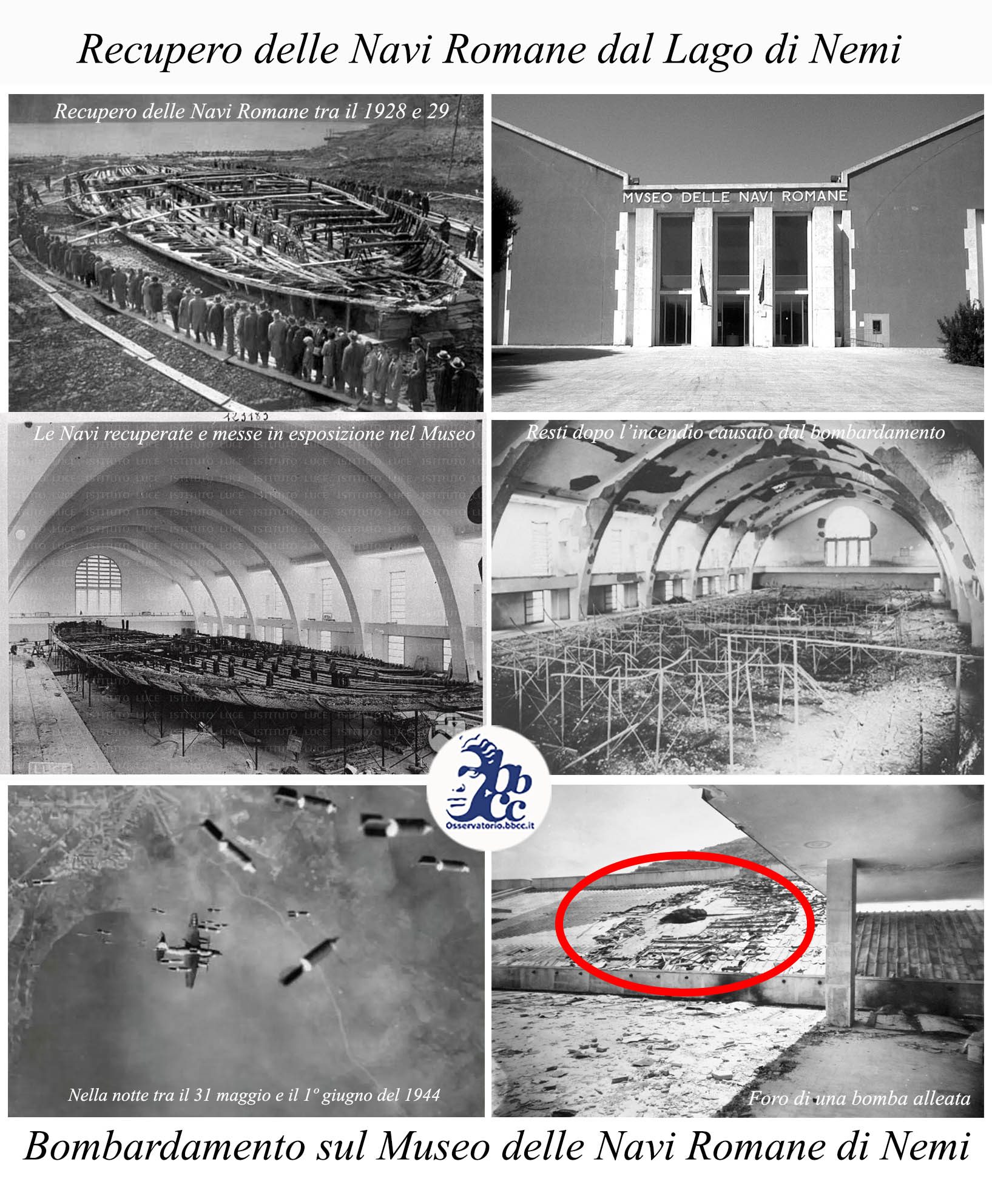
In the night of 31 May to 1 June 1944, a major fire swept through the Museum of Roman Ships at Nemi, Italy, destroying two imperial vessels irretrievably. Nearly eighty years later, the cause of the blaze remains disputed and continues to divide historians and researchers.
The German Sabotage Theory
For decades, the official account held that retreating German soldiers deliberately set the fire to prevent the ships from falling into Allied hands or as an act of revenge. This version was supported by several pieces of evidence: the presence of a German artillery battery positioned near the museum in the days before the fire, deliberate damage to other archaeological artefacts, and the failure to activate fire-suppression systems. The museum custodians, as direct witnesses, reported that German soldiers had occupied the building, removed the custodians and their families, and that a light was seen moving inside the structure after dark on the evening of 31 May.
The Allied Bombardment Hypothesis
Recent scholarship has challenged this narrative. On 31 May, the area had experienced intense Anglo-American bombing throughout the day and early evening, with artillery bombardment ending around 20:15. The fire broke out nearly two hours later, around 22:00. Analysis by historians Flavio Altamura and Stefano Paolucci concludes that sparks from Allied shells ignited the fire. Additional evidence supports this view: several Nemi residents reported seeing Allied aircraft drop incendiary bombs that evening, damage patterns at the museum are consistent with bombing rather than deliberate arson, and unexploded incendiary bomb fragments were found in the surrounding area. The removal of custodians and their families by German forces before the bombardment also suggests the Germans anticipated an air raid.
A Lost Treasure
Regardless of the cause, the loss represents an immeasurable tragedy for world archaeological heritage. The two imperial vessels were unique in their kind and provided invaluable testimony to Roman naval construction techniques. The destruction of the Nemi Ships has sparked broader discussion about protecting cultural property during wartime. The National Roman Museum of the Nemi Ships at Acilia in Rome now holds the surviving archaeological remains and artefacts related to their history.
On video
Frequently asked questions
When exactly did the Nemi Ships fire occur?
The fire broke out during the night of 31 May to 1 June 1944, nearly two hours after an artillery bombardment of the area ended at approximately 20:15.
What were the two main causes proposed?
The official version attributed the fire to deliberate arson by retreating German soldiers, while recent research by Altamura and Paolucci argues that Allied incendiary bomb sparks caused the blaze.
Where can the surviving remains be seen today?
The National Roman Museum of the Nemi Ships at Acilia in Rome houses the surviving archaeological remains and a rich collection of artefacts related to the vessels’ history.
Sources
- S1 — Claridge, Amanda. Rome: An Oxford Archaeological Guide. Oxford University Press, 2010. ISBN 978-0-19-954107-2.
- S2 — Coarelli, Filippo. Rome and Environs: An Archaeological Guide. University of California Press, 2014. ISBN 978-0-520-28209-4.
Spotted an error? Write to editorial@culturalheritageonline.com and we correct it the same day.