
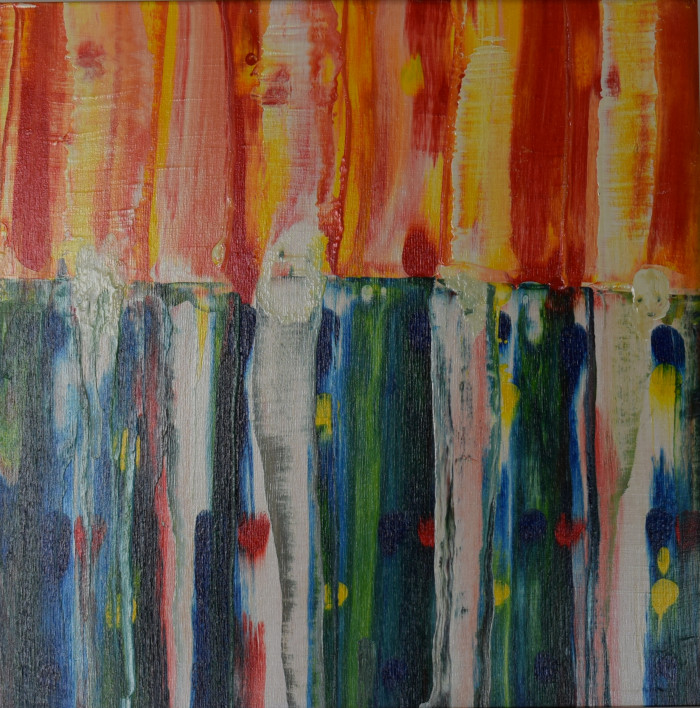
Presented in December 2019, this critical assessment examines the artistic practice of Renzo Gianella, a Venetian painter born in Codevigo, Padova, in 1947, who has lived in Camponogara, Venice, since beginning to paint in 1965. Over more than four decades, Gianella has collaborated with artists, decorators and restorers to decorate churches, Venetian villas and private residences across the region, while developing a personal artistic language that now encompasses figuration, abstraction and surrealism.
Artistic Development and Influences
Gianella’s career began approximately 50 years before this article with predominantly figurative works—portraits and Madonnas—that reveal his early interest in capturing inner psychological and spiritual dimensions. His engagement with Venetian landscape traditions draws from the colour harmonies of Titian and the dramatic contrasts of Giorgione, though he moves beyond impressionism, expressionism and surrealism toward his own synthesis. His artistic impulses derive from historical currents, daily observation and philosophical meditation on existence, resulting in works that combine visual landscape with existential metaphor.
Gianella’s depictions of the Venetian countryside emphasise softened tonalities that convey silence and spiritual reverence rather than the densely populated compositions of Tintoretto. His Venetian views are intimate and welcoming, avoiding picturesque tourism in favour of introspective meditation. His abstract geometric compositions similarly pursue colour and form as vehicles for visual and spiritual equilibrium, echoing the systematic approaches of Mondrian and Kandinsky.
Surrealotenism and Contemporary Expression
Gianella has engaged with Surrealotenism, an artistic current developed by sculptor Sandro Penzo that encourages artists to reject historical conventions and instead address contemporary human experience in its totality—encompassing physicality, spirit, mind, magic and dreams. This movement, distinctly Venetian in character, enables Gianella to integrate philosophical inquiry with visual form, allowing cosmic imagery, premonitions and spiritual messages to emerge within his landscapes and abstract works.
Walk through the virtual gallery
Frequently asked questions
When did Renzo Gianella begin his artistic practice?
Gianella began painting in 1965 and spent over 40 years collaborating with artists, decorators and restorers while decorating churches, villas and private homes across the Veneto region.
What artistic movements influenced Gianella’s work?
His practice draws from Venetian painting traditions including Titian and Giorgione, as well as impressionism, expressionism and surrealism. He has also engaged with Surrealotenism, a Venetian contemporary movement founded by sculptor Sandro Penzo.
Where has Gianella’s work been exhibited?
His paintings have been shown in numerous group and solo exhibitions across Italy and internationally, including venues in Moscow, Copenhagen, Paris, Edinburgh, Hamburg, New York and San Petersburg, as documented in his extensive exhibition record from 2011 onwards.
Sources
- S1 — Zucconi, Guido. Venezia tra innovazione e conservazione: l'opera di Eugenio Miozzi. Marsilio, 2002. ISBN 978-88-317-8054-4.
- S2 — De Fusco, Renato. Storia del design. Laterza, 2002. ISBN 978-88-420-6623-1.
Spotted an error? Write to editorial@culturalheritageonline.com and we correct it the same day.


