The Rangiri Dambulla Cave Temple (Sinhala: “රංගිරි දඹුල්ල රාජමහා විහාරය” — “Rangiri Dambulla Royal Cave Temple”, “rangiri” = golden rock, “dambulla” = the name of the rock and town, from the Sinhala for a type of Ficus tree — “dimbula”), inscribed by UNESCO in 1991, is the largest and best-preserved Buddhist cave temple complex in Sri Lanka — a series of five natural granite caverns at the base of a 160-metre-high granite inselberg (the Dambulla Rock, a single massive granite outcrop rising abruptly from the flat agricultural plain of the North Central Province of Sri Lanka, approximately 72 km north of Kandy) that have been used as a place of worship for approximately 2,200 years, from approximately the 1st century BCE to the present, and which contain collectively approximately 153 statues of the Buddha and bodhisattvas, 3 statues of Sri Lankan kings, 4 statues of deities, and approximately 2,100 m² of painted ceiling and wall frescoes in styles spanning from approximately the 2nd century CE to the 18th century CE. The historical association of the Dambulla caves with Sri Lankan Buddhist kingship is documented in the Pali chronicle Mahavamsa: King Vattagamani Abhaya (also known as “Valagamba”, who ruled approximately 89–77 BCE with an interruption when he was driven into exile in the jungle by a South Indian Chola invasion) is recorded as having sheltered in the Dambulla rock caves during his 14-year exile, and upon recovering his throne (approximately 89 BCE) as having returned to Dambulla and built the first formal temple within the cave (the original Cave I/Devaraja Viharaya — the “Temple of the Lying-Down God” — which contains the earliest core of the cave temple complex). The gratitude of Vattagamani Abhaya toward the Dambulla monks who sheltered him, and his vow to build a temple in the caves upon his restoration, established the royal-patronage relationship that subsequently led every major Sinhalese ruler who held Kandy and the North Central Province to make donations, construct new images, and renovate the cave paintings at Dambulla — producing the layered ensemble of royal patronage visible in the cave today.
Dambulla’s five cave shrines and the Sri Lanka Cultural Triangle Cave I–V · Dambulla Rock · Sigiriya · Anuradhapura · Kandy — 0 to 72 km
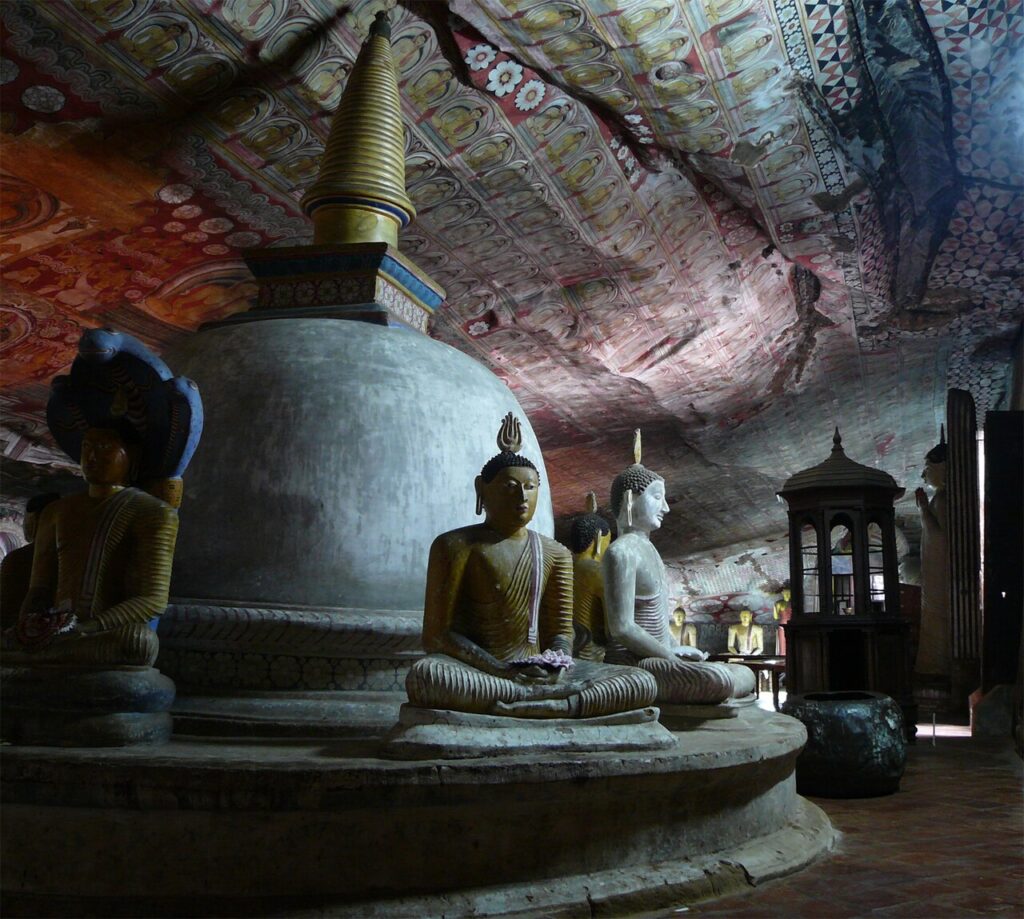
The five caves of Dambulla are entered through a series of doorways at the base of the rock overhang (the caves are natural granite chambers formed by the weathering of the rock face, with additional walls and ceilings added in brick and plaster to create enclosed shrine rooms within the natural overhang — the ceilings of the caves follow the contour of the natural granite rock above, and all visible surfaces of ceiling and walls have been plastered with lime and painted with Buddhist imagery): Cave I (Devaraja Viharaya — “Temple of the Lying-Down God”, the oldest of the five caves, containing the 15-metre-long reclining Buddha image of Vattagamani Abhaya’s original vow, in the Parinirvana posture, accompanied by images of Vishnu and Ananda carved from the live rock — the Vishnu image is notable as an example of the syncretic inclusion of Hindu deity images within a Buddhist shrine, reflecting the dual Buddhist-Hindu religious character of the ancient Sinhalese court); Cave II (Maharaja Viharaya — “Temple of the Great King”, the largest and most elaborately decorated of the five caves, approximately 57 m wide × 23 m deep × 7 m high, containing approximately 56 statues of the Buddha, 2 statues of Sinhalese kings [Vattagamani Abhaya and Nissanka Malla], images of bodhisattvas including Maitreya and Upulvan, and a statue of the Hindu deity Vishnu, all against a ceiling and wall surface painted with approximately 1,500 individual painted figures — the largest single concentration of Buddhist paintings in Sri Lanka, painted and repainted multiple times over the 2,000-year history of the cave, with the current visible painting predominantly from the 18th-century CE restoration by King Kirti Sri Rajasinha of Kandy); Cave III (Maha Alut Viharaya — “New Great Temple”, built in the 18th century CE by King Kirti Sri Rajasinha, containing approximately 50 statues of the Buddha and images of bodhisattvas, with a painted ceiling of Buddha images arranged in a grid pattern of approximately 1,500 repetitions — a canonical Buddhist meditational ceiling design used in Kandyan-period cave temples); Cave IV (Pachima Viharaya — “Western Temple”, a smaller cave with approximately 10 statues and a central dagoba that is said to contain the “jewellery of Queen Somawathie” — a gold-and-jewel reliquary reportedly hidden in the dagoba by the Queen of King Vattagamani Abhaya and the subject of various attempts at removal during the British colonial period); and Cave V (Devana Alut Viharaya — “Second New Temple”, the most recently built of the five, built approximately 18th century CE, originally a storage room used by the cave monastery, with approximately 11 statues including a distinctive reclining Buddha in the posture of entering Parinirvana, painted in a more stylised 18th-century manner).
Practical information
Dambulla is approximately 148 km north of Colombo (2.5 hours by expressway to Kurunegala then national road north to Dambulla, or approximately 3 hours by bus) and approximately 17 km south of Sigiriya (UNESCO 1982, the nearest UNESCO complement in the Cultural Triangle area). The cave temple is open daily 07:00–19:00 (last entry 18:30); admission fees apply (foreigners pay a significantly higher rate than Sri Lankan nationals — the fee includes access to the museum at the base of the rock and the cave complex at the top). The approach to the cave entrance from the car park at the rock base is a concrete staircase of approximately 350 steps (approximately 30 minutes of ascent, past vendors selling lotus flowers for offering and past the golden dome of the 20th-century stupa at the terrace level). Shoes must be removed before entering the cave temple area (the concrete path to the cave entrance and all cave floors are walked barefoot; bring socks for comfort on hot stone surfaces in the midday heat). Photography inside the caves (without flash) is permitted but tripods are not allowed. The ideal visiting time is early morning (07:00–09:00 before tour groups arrive) or late afternoon (16:00–18:00 when the slant of the afternoon light illuminates the painted ceilings at a low angle). Dambulla is the natural base for a Cultural Triangle circuit: Sigiriya is 17 km north (30 min), Anuradhapura is approximately 65 km further north (1 hour), and Polonnaruwa is approximately 65 km east (1 hour).
Frequently Asked Questions
What is the significance of the paintings at Dambulla and how were they created?
The Dambulla cave paintings represent the largest surviving body of ancient Buddhist mural painting in Sri Lanka — approximately 2,100 m² of painted surface across the five caves, spanning stylistically from the earliest surviving fragments (approximately 2nd–3rd century CE, visible in the oldest sections of Cave I and Cave II where later plaster has flaked away) to the 18th-century CE Kandyan-period repainting that constitutes the bulk of the currently visible decorative surface. The technique used throughout the Dambulla paintings is tempera on wet lime plaster — strictly speaking a “fresco secco” (dry fresco) rather than “buon fresco” (wet fresco), as the pigments were applied to a partially dried lime-plaster surface rather than directly into wet plaster. The process began with the preparation of a coarse lime-sand base coat (“arriccio”) applied to the cave wall or rock face to create a smooth flat surface, followed by a fine lime-putty finish coat (“intonaco”), followed by the drawing of the composition in charcoal or red ochre outlines, followed by the application of mineral pigments (red ochre for reds and flesh tones, yellow ochre for yellows, green malachite for greens, lapis lazuli or azurite for blues [although locally available indigo plant pigment was more common than mineral blue at Dambulla], carbon black for dark outlines, and white lime for highlights) in a binding medium of coconut milk, bee’s wax, or egg white — the specific binding medium varied between painting campaigns and has been partly identified by modern analysis. The most remarkable achievement of the Dambulla paintings is the continuity of iconographic programme across 2,000 years: each major restoration campaign (the known documented campaigns are those of Nissanka Malla approximately 1187–1196 CE, King Senasammata Vikramabahu approximately 1489 CE, King Kirti Sri Rajasinha approximately 1747–1782 CE, and a late colonial period restoration in the 19th century CE) has maintained the overall scheme of the “thousand Buddhas” ceiling (repeated rows of identical seated Buddha images filling every available ceiling space) while adding new statues and new wall compositions. The “thousand Buddhas” ceiling type reflects the Mahayana-influenced cosmological concept of the “thousand Buddhas of the present kalpa” (the current cosmic age is said to contain 1,000 Buddhas who teach the Dharma in sequence to humanity — a theme that generates the meditational ceiling programme of repeating Buddha images, in which the meditator lying on his back gazes upward into a field of identical Buddhas representing the infinite plurality of the enlightened beings of the cosmos) — a concept incorporated into the formally Theravada cave temples of Dambulla in a characteristically Sri Lankan synthesis of Theravada and Mahayana doctrinal elements.
How does the Dambulla Rock function in the broader landscape of the Cultural Triangle?
The Sri Lanka Cultural Triangle (a term coined approximately 1980 CE by the Sri Lankan government to describe the area between the three ancient capitals of Anuradhapura, Polonnaruwa, and Kandy, within which the majority of Sri Lanka’s UNESCO World Heritage and archaeologically significant sites are concentrated) is a geographical region of approximately 100 km × 150 km in the North Central, Central, and North Western Provinces of Sri Lanka, containing the four UNESCO sites of Anuradhapura (1982), Polonnaruwa (1982), Sigiriya (1982), Kandy (1988), and Dambulla (1991) within a roughly triangular area that can be efficiently visited in a 4–5 day circuit from Colombo. Dambulla’s specific role in this landscape is that of the geographic and spiritual nexus of the triangle: the Dambulla Rock is approximately equidistant from Sigiriya (17 km north), Polonnaruwa (65 km east), and Anuradhapura (65 km northwest), placing it at the natural overnight stop for any circuit of the triangle’s sites, and the cave temple’s continuous 2,200-year history provides the clearest narrative of the evolution of Sinhalese Buddhist kingship and material culture from the pre-Christian era to the Kandyan period — a time span that the three secular capital sites (Anuradhapura, Polonnaruwa, Kandy) document more fragmented. The Dambulla Rock also occupies the visual centre of the agricultural plain between the Cultural Triangle sites: the rock is visible from the plains in all directions as a dramatic isolated granite outcrop rising 160 m above the flat paddy fields and scrub jungle of the North Central Province, creating the experience (shared with Sigiriya, 17 km north) of a sacred landscape in which the natural rock outcrops of the ancient Deccan granite plateau serve as the anchors of the Buddhist sacred geography. The relationship between the two rocks — Dambulla (the cave-temple rock, continuously inhabited by Buddhist monks) and Sigiriya (the palace-rock, occupied for approximately 18 years by a king who fled to South India and never permanently used as a monastic site) — is further heightened by the contrast between their histories: Dambulla’s continuity against Sigiriya’s abandonment makes the plain between them a meditation on the transience of royal power versus the permanence of Buddhist practice.
EXCERPT: Rangiri Dambulla Cave Temple, Sri Lanka, UNESCO-inscribed 1991, is the largest Buddhist cave complex in Sri Lanka — 153 statues and 2,100 m² of painted ceilings across five caves on a 160-metre granite rock, 2,200 years of royal patronage from King Vattagamani Abhaya’s 89 BCE exile, and the geographic centre of the Sri Lanka Cultural Triangle (Sigiriya 17 km, Anuradhapura 65 km, Polonnaruwa 65 km).
META: UNESCO World Heritage Sites near Rangiri Dambulla Cave Temple Sri Lanka: Ancient City of Sigiriya 17 km north (UNESCO 1982), Sacred City of Anuradhapura 65 km northwest (UNESCO 1982), Ancient City of Polonnaruwa 65 km east (UNESCO 1982) — Dambulla cave temple Sri Lanka UNESCO 1991, Buddhist cave paintings 2100 sqm, Vattagamani Abhaya exile 89 BCE, Cultural Triangle North Central Province, Kandyan paintings cave shrines.
Sources
- S1 — UNESCO World Heritage Centre — Rangiri Dambulla Cave Temple (Ref. 561) — https://web.archive.org/web/20230601000000/https://whc.unesco.org/en/list/561/
- S2 — UNESCO World Heritage Centre — Statement of Outstanding Universal Value (Ref. 561) — https://whc.unesco.org/en/list/561/
Spotted an error? Write to the editors and we correct it the same day.