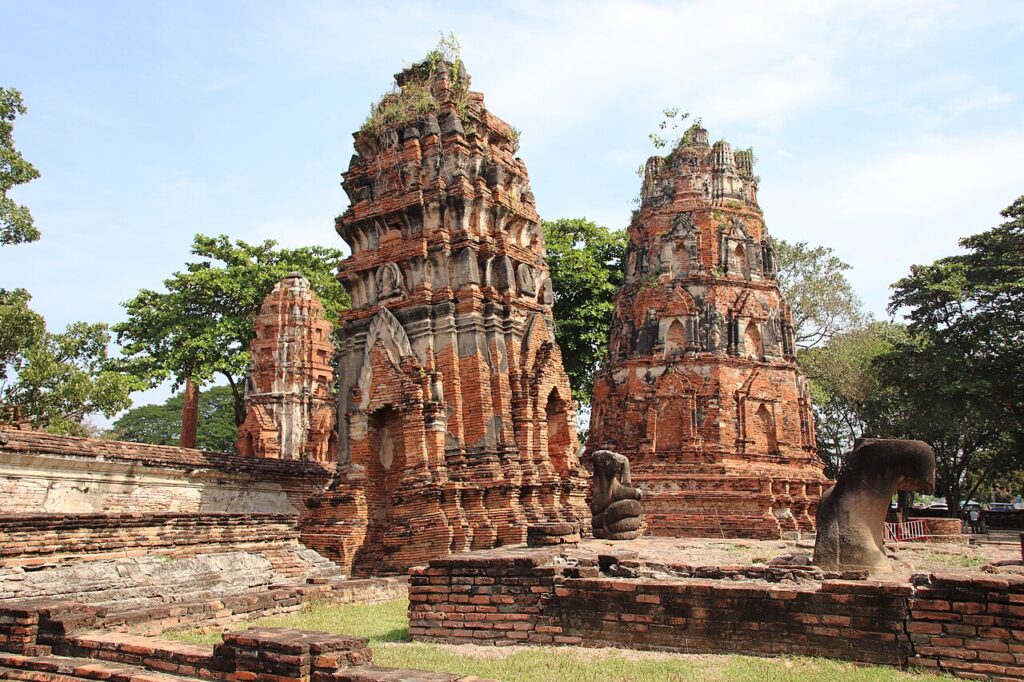
The Historic City of Ayutthaya (พระนครศรีอยุธยา, “Phra Nakhon Si Ayutthaya” — “Holy Ayodhya”, named after the birthplace of Rama in the Hindu Ramayana epic), inscribed by UNESCO in 1991, was the capital of the Ayutthaya kingdom (1351–1767 CE — 416 years of continuous existence as the dominant political power in mainland Southeast Asia) and at its peak in the 17th century one of the largest cities in the world, with an estimated population of 300,000–800,000 inhabitants and a cosmopolitan trading community of Chinese, Japanese, Malay, Indian, Portuguese, Dutch, French, and English merchants and diplomats that made it one of the most internationally connected cities in Asia. The city was systematically destroyed by Burmese forces in 1767 CE after a 14-month siege — the Burmese destruction of Ayutthaya (the second and final Burmese sacking; the first was in 1569 CE and the city was rebuilt) included the deliberate demolition of the city’s major Buddhist temples (to deny legitimacy to the Thai monastic tradition), the melting of gold from temple structures, and the removal of the Thai royal court and significant numbers of artisans to the Burmese capital at Ava — creating the characteristic Ayutthaya archaeological landscape of brick-rubble prang towers, headless Buddha statues (the heads systematically removed during the Burmese sacking), and chedi ruins that visitors see today. The Ayutthaya Historical Park (approximately 289 ha on the island formed by the confluence of the Lopburi River, Chao Phraya River, and Pasak River — the rivers that formed the natural moat of the historic city) contains the ruins of more than 400 temples, palaces, and statues.
Ayutthaya’s ruins and the Thailand heritage corridor Wat Phra Si Sanphet · Wat Mahathat · Wat Ratchaburana · Bang Pa-In · Bangkok — 0 to 80 km
The Ayutthaya Historical Park’s most significant individual sites within the walled city include: Wat Phra Si Sanphet (the royal chapel of the Ayutthaya Palace, with three large bell-shaped chedis containing the ashes of three Ayutthaya kings — the formal royal palace chapel that was the principal state temple of the Ayutthaya kingdom from the 15th to the 18th century, now ruined but with the three chedis preserved as the most recognisable silhouette of the Ayutthaya archaeological park); Wat Mahathat (the “Temple of the Great Relic” — the first royal temple of the Ayutthaya kingdom, founded in 1374 CE, now famous for the stone Buddha head that has become entwined in a strangler-fig’s roots as the tree grew over the fallen statue head, creating one of the most photographed images of Ayutthaya and one of the most reproduced heritage images of Thailand — the head remains in situ surrounded by the roots, and visitors are asked to kneel below the head to keep it above eye level in a gesture of respect); and Wat Ratchaburana (built in 1424 CE by King Boromraja II on the cremation site of his two elder brothers who killed each other in an elephant duel for the throne, the temple’s intact central prang tower contains an underground crypt whose wall paintings of the early 15th century are among the earliest surviving examples of Thai mural painting, and whose treasure vault was looted in 1957 CE — though recovered items are now displayed in the Chao Sam Phraya National Museum in Ayutthaya). The Bang Pa-In Royal Palace (approximately 20 km south of Ayutthaya on the Chao Phraya — a 19th-century royal summer palace in an eclectic architectural style combining Thai, Chinese, and Italian Baroque elements, used by Thai kings in the Rattanakosin period as a riverside retreat) and the boat journey along the Chao Phraya river between Bangkok and Ayutthaya (approximately 1.5 hours by express river boat — the traditional approach to Ayutthaya that follows the same river route used by historical merchants and diplomats arriving from the Gulf of Thailand) are the most scenic ways to approach the site.
Practical information
Ayutthaya is approximately 80 km north of Bangkok by train (Ayutthaya train station is on the Bangkok–Chiang Mai main line — approximately 1.5 hours from Hua Lamphong Station, frequent departures throughout the day), by bus (approximately 1.5–2 hours from Bangkok Mo Chit or Victory Monument bus terminals), or by river boat (2–3 hours from Bangkok by Chao Phraya Express Boat from Nonthaburi or from Wang Lang pier). The Historical Park is on an island in the river confluence — accessible within the island by tuk-tuk, songthaew, bicycle (hire at the train station area), or tour-guide vehicle. Site is open daily 08:00–18:00; individual site fees apply (each major temple has a separate entrance fee; there is no single combined ticket). The Chao Sam Phraya National Museum (adjacent to Wat Ratchaburana, open Wednesday–Sunday) displays the recovered Wat Ratchaburana treasure and Ayutthaya Buddhist art. The annual Ayutthaya World Heritage Fair (December) features illuminated evenings at the major temple sites. Best visiting months: November–February (dry season, temperatures 25–30°C; the rainy season June–October sometimes floods the low-lying island with Chao Phraya backwater). Day trip from Bangkok is the most common visit pattern (1 day sufficient for the main sites); overnight in Ayutthaya allows a more relaxed visit including the evening river views.
Frequently Asked Questions
Why was Ayutthaya destroyed by the Burmese in 1767 and what was the political context?
The destruction of Ayutthaya in 1767 CE by the Konbaung dynasty Burmese forces under King Hsinbyushin was the culmination of a centuries-long rivalry between the Burmese (Bamar) and the Siamese (Thai) kingdoms that had roots in the competition for control of the Mon kingdom of Lower Burma and the Shan principalities of the upper Chao Phraya watershed. The immediate political context of the 1765–1767 Burmese campaign against Ayutthaya was: the Konbaung dynasty (established by King Alaungpaya in 1752 CE, the most powerful Burmese dynasty in history, which unified Burma and extended Burmese control to the borders of China, India, and Siam) had concluded a successful war against the Siamese-allied Mon kingdom of Pegu in 1757 CE and was expanding its influence southward and eastward; the Ayutthaya kingdom under King Suriyamarin had provided refuge to Mon refugees from the Burmese conquest, which the Konbaung dynasty viewed as a hostile act. The 1765 Burmese invasion (by two armies converging from the north and south on Ayutthaya) achieved a 14-month siege of the capital city. The city fell in April 1767 CE after the Siamese defenders ran out of food and ammunition; the Burmese forces conducted a systematic destruction of the city (the deliberate nature of the destruction — melting gold from temple structures, removing Buddha statues, burning libraries of palm-leaf manuscripts, taking skilled craftsmen and court officials as captives to Burma) reflected the Konbaung strategy of destroying the rival Siamese kingdom’s material and cultural foundation rather than simply replacing its ruler. The destruction of Ayutthaya did not permanently establish Burmese control over Siam — the Thai general Taksin organised a military recovery within months of the fall of Ayutthaya, expelled the Burmese garrison within approximately a year, and established a new capital at Thonburi (the western bank of the Chao Phraya at Bangkok, approximately 80 km south of Ayutthaya) in 1767–1768 CE. The subsequent Rattanakosin dynasty (Bangkok, established by Rama I in 1782 CE) moved the capital to the eastern bank of the river at Bangkok, where it remains today. The 1767 destruction was thus a catastrophic but temporary interruption of Thai political continuity — the Rattanakosin dynasty explicitly claimed legitimacy through the Ayutthaya royal tradition (adopting “Ayutthaya” as the formal title of the new capital city in full ceremonial usage) and the artistic, literary, and legal traditions of Ayutthaya were systematically reconstructed in Bangkok over the subsequent century. The UNESCO World Heritage designation (1991) and the Ayutthaya Historical Park (established in the 1980s) represent a further stage in the rehabilitation of the destroyed city as the foundational monument of the Thai national heritage.
What was the Ayutthaya kingdom’s cosmopolitan international character?
The Ayutthaya kingdom’s cosmopolitan character — the presence of Japanese, Chinese, Malay, Indian, Portuguese, Dutch, French, and English trading communities and diplomatic missions in the capital simultaneously — is documented in extensive contemporary foreign-language sources that make Ayutthaya one of the best-documented pre-modern Asian cities in Western historical records. The Portuguese were the first Europeans to establish relations with Ayutthaya (in 1511 CE, when Afonso de Albuquerque, following his conquest of Malacca in the same year, sent a diplomatic mission to the Ayutthaya court that resulted in a trade agreement and the establishment of a Portuguese trading community in the city); the Dutch East India Company (VOC) established a factory in Ayutthaya in 1634 CE; the French sent three diplomatic missions to King Narai (1656–1688 CE) including the French envoy Simon de la Loubière, whose account “Du Royaume de Siam” (1691 CE) is one of the most important European descriptions of 17th-century Ayutthaya; and the most dramatic episode of Ayutthaya’s international relations — the rise of the Greek adventurer Constantine Phaulkon (Konstantinos Hierakis, born approximately 1647 CE in the Greek island of Kefalonia) to the position of first minister of King Narai, making him effectively the most powerful person in the Siamese kingdom after the king, a position from which he was attempting to forge a French-Siamese political alliance against the Dutch — ended catastrophically with Phaulkon’s execution in 1688 CE during the “Siamese Revolution” (the palace coup that replaced the French-influenced Narai court with a nationalist government that expelled all French officials and reversed Phaulkon’s pro-French policies). The Japanese community at Ayutthaya (“Japan Town” or “Nihonmachi”, established approximately 1604 CE) included the legendary figure of Yamada Nagamasa (approximately 1590–1630 CE), a Japanese merchant-adventurer who rose to become the commander of the Siamese royal guard’s Japanese company and was appointed Governor of Nakhon Si Thammarat province — one of the most remarkable careers of any Japanese person in the pre-modern world outside Japan. The cultural legacy of Ayutthaya’s cosmopolitan period is visible in the Thai language (which has absorbed Portuguese, Malay, Chinese, and Persian vocabulary in its commercial and culinary terminology), in Thai cuisine (the Portuguese introduction of chili peppers to the Ayutthaya region in the 16th century transformed Thai food from the pre-chili tradition), and in the specific architectural vocabulary of the Ayutthaya-period temples (which show direct Khmer, Mon, Sri Lankan, and Chinese architectural influences simultaneously).
EXCERPT: Historic City of Ayutthaya, UNESCO-inscribed 1991, was a 300,000-person Southeast Asian capital for 416 years (1351–1767 CE) destroyed by Burmese invasion — the strangler-fig-rooted Buddha head at Wat Mahathat, three royal ashes chedis at Wat Phra Si Sanphet, and the cosmopolitan city where Portuguese, Dutch, French, and Japanese communities coexisted with Chinese, Malay, and Indian merchants.
META: UNESCO World Heritage Sites near Historic City of Ayutthaya Thailand: Historic Town of Sukhothai 390 km north (UNESCO 1991), Thungyai-Huai Kha Khaeng Wildlife Sanctuaries 250 km west (UNESCO 1991) — Ayutthaya kingdom Thailand UNESCO heritage, Wat Mahathat Buddha head banyan tree, Burmese 1767 destruction, Bang Pa-In royal palace, Chao Phraya river.
Sources
- S1 — UNESCO World Heritage Centre — Historic City of Ayutthaya (Ref. 576) — https://web.archive.org/web/20230601000000/https://whc.unesco.org/en/list/576/
- S2 — UNESCO World Heritage Centre — Statement of Outstanding Universal Value (Ref. 576) — https://whc.unesco.org/en/list/576/
Spotted an error? Write to the editors and we correct it the same day.