
A masquerade festival born from African diaspora traditions, Junkanoo pulses through the Bahamas with drums, dance, and elaborate street parades that blend resilience and joy.
In UNESCO’s words
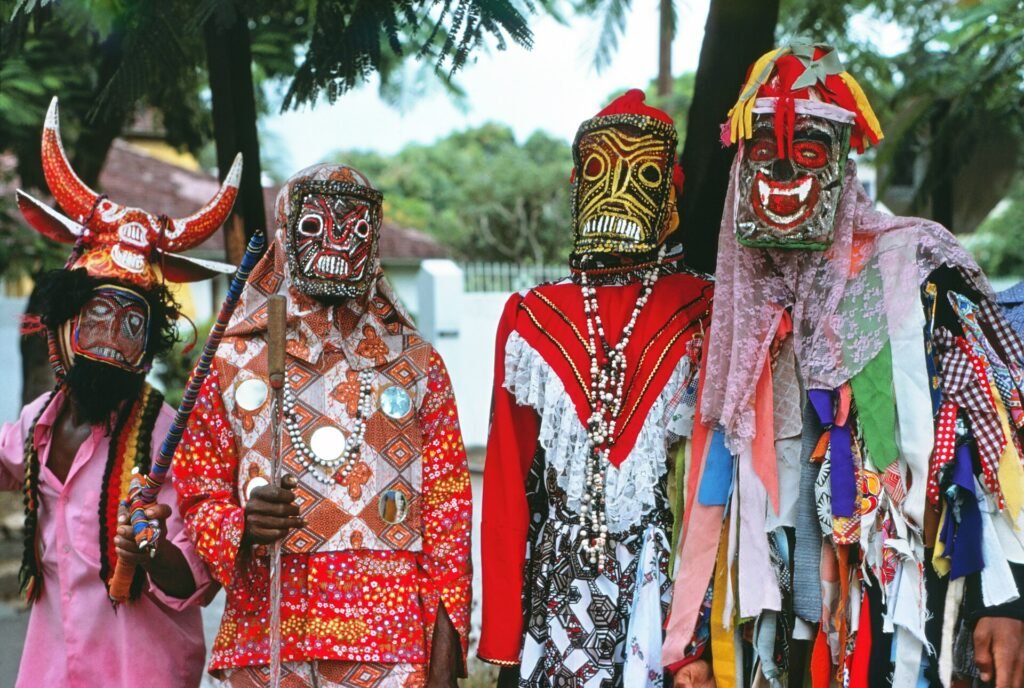
Junkanoo is the national cultural festival of The Bahamas. Dating back to the beginning of the nineteenth century, it was brought to The Bahamas by enslaved Africans who used their three-day holiday to recreate festivals from home. An outlet for creative expression, today Junkanoo is mainly celebrated through parades that retain many African elements and are a grand spectacle of indigenous music, performances, storytelling and craftsmanship. Junkanoo is a celebration of unity, bringing together thousands of people of all ages and backgrounds in the creation of towering, colourful costumes with cardboard and crepe paper. The costumes are prepared in ‘shacks’, where the practitioners display their craft and transmit their knowledge to younger generations. The knowledge and skills related to the performance and the creation of costumes are also transmitted within families. The entire community plays a part in preparing youth for their rites of passage into Junkanoo. Junkanoo is incorporated into every major national event as a celebration, as entertainment, and as a traditional cultural expression. It fosters a sense of community pride, identity, companionship, spirituality and unity. Junkanoo is a celebration of creativity that refines the art of making beauty out of junk.
Official description, UNESCO Intangible Cultural Heritage List — Junkanoo
At a glance
Junkanoo is the national cultural festival of The Bahamas. It is celebrated primarily through parades that showcase indigenous music, performances, storytelling, and craftsmanship. The festival brings together thousands of people of all ages and backgrounds to create towering, colourful costumes made from cardboard and crepe paper. At its heart, Junkanoo is a celebration of creativity that transforms everyday materials into art.
Origins & history
Junkanoo dates back to the beginning of the nineteenth century, when enslaved Africans in The Bahamas used a three-day holiday to recreate festivals from their homelands. From those origins, the tradition has endured as a living expression of African cultural heritage adapted to Caribbean life.
The practice
Practitioners prepare costumes in 'shacks', where they display their craft and pass skills to younger generations. Families also transmit knowledge within their own circles, with the entire community participating in preparing youth for their rites of passage into Junkanoo. The parades retain many African elements and combine music, performance, and the visual spectacle of handmade costumes.
Cultural significance
Junkanoo fosters community pride, identity, companionship, spirituality, and unity among participants. It is incorporated into every major national event as both celebration and traditional cultural expression. The festival represents a celebration of creativity and collective joy that strengthens social bonds across all generations and backgrounds.
Key facts
- Country: Bahamas
- Inscribed: 2023
- UNESCO list: Representative List of the Intangible Cultural Heritage of Humanity
- UNESCO reference: 01988
- UNESCO vocabulary: Costumes; Festivals; Performing arts; Social participation
- Map: not shown — UNESCO’s official description of this element names no locality, and a living tradition is practised across a community, not at one address.
Where to experience it
Junkanoo pulses through The Bahamas year-round, with parades during Christmas and New Year celebrations offering the most vivid expressions of this national festival. Visitors can witness thousands of people of all ages creating towering, colourful costumes in community 'shacks', where practitioners display their craft and transmit knowledge to younger generations. The festival is incorporated into every major national event as a celebration and traditional cultural expression, bringing together diverse communities in performances featuring indigenous music, storytelling and craftsmanship that honour African heritage.
Sources & resources
- UNESCO — official element page: Junkanoo
- UNESCO — open data record: Intangible Heritage List, reference 01988
- UNESCO — official video: UNESCO film on this element — embedded on this page
- UNESCO — official photograph: Junior Junkanoo participants 2019 parade on Eleuthera Island — Eric Rose, 2019
- Reference — Wikipedia (secondary): Junkanoo — consulted as a secondary reference, not as confirmation
- Cultural Heritage Online: Our archive and city guides

Sources
- S1 — Wood, Vivien. Junkanoo: Festival of the Bahamas. Macmillan Caribbean, 1995. ISBN 978-0-333-62534-7.
- S2 — Craton, Michael, and Gail Saunders. Islanders in the Stream: A History of the Bahamian People. University of Georgia Press, 1998. ISBN 978-0-8203-2122-6.
Spotted an error? Write to editorial@culturalheritageonline.com and we correct it the same day.