
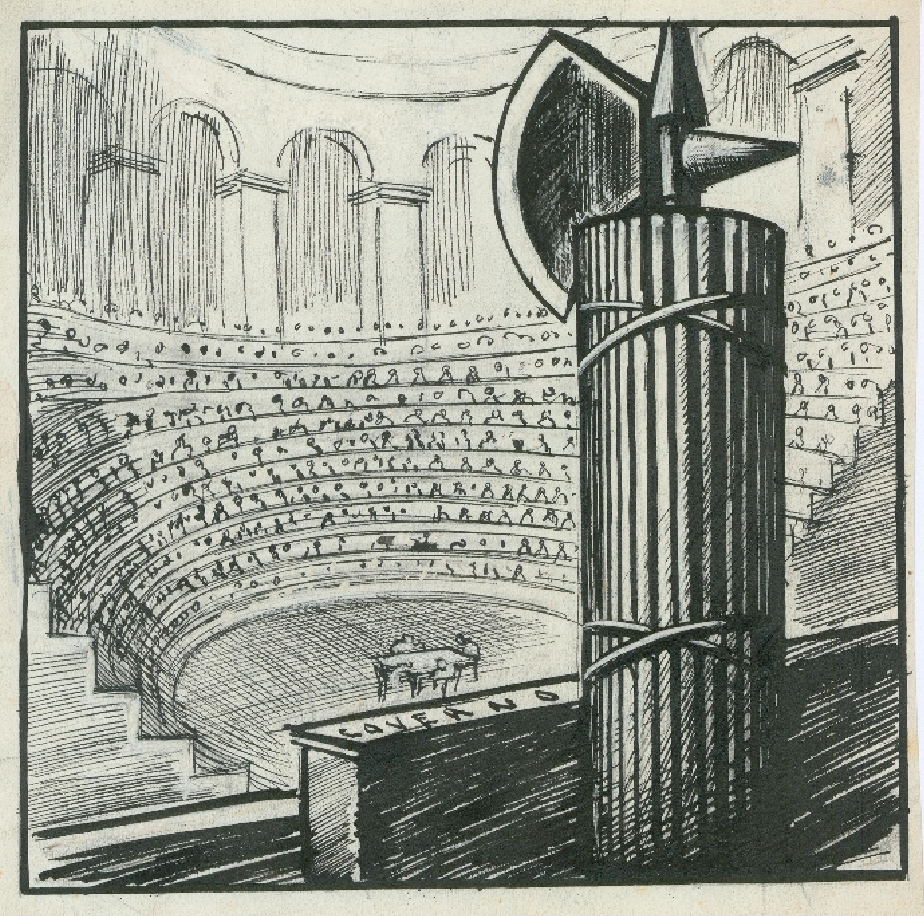
This illustration was created by Mario Sironi for Popolo d’Italia on 16 November 1922. Sironi was an Italian modernist artist active as a painter, sculptor, illustrator, and designer, whose work characteristically featured massive, immobile forms executed in a somber aesthetic.
The commission exemplifies Sironi’s multifaceted practice during the interwar years, a period when he moved fluidly between fine art and applied design. His early training under Giacomo Balla at the Accademia di Belle Arti di Roma in Rome, combined with exposure to Expressionist movements during travels to Germany between 1908 and 1911, shaped his distinctive visual language. By 1922, Sironi had established himself as a significant figure in Italian modernism, bringing the vocabulary of contemporary art to commercial and journalistic contexts.
About Mario Sironi
Born in Sassari, Sardinia, in 1885, Sironi initially studied engineering at the University of Rome before pursuing painting following a nervous breakdown in 1903. He worked across painting, sculpture, illustration, and design throughout his career until his death in 1961, maintaining a visual approach defined by monumental, static forms and a restrained palette.
Details
- Creator: Mario Sironi
- Date: 16 November 1922
- Publication: Popolo d’Italia
- Medium: Illustration
- Movement: Italian Modernism
On video
Frequently asked questions
Who was Mario Sironi?
Mario Sironi (1885–1961) was an Italian modernist artist who worked as a painter, sculptor, illustrator, and designer. He studied under Giacomo Balla at the Accademia di Belle Arti di Roma and was influenced by Expressionism during his travels to Germany between 1908 and 1911.
What was Popolo d’Italia?
Popolo d’Italia was an Italian publication for which Sironi created illustrations, as demonstrated by this work from November 1922. The commission shows his engagement with journalistic and commercial applications of modernist design.
What characterizes Sironi’s artistic style?
Sironi’s work is marked by massive, immobile forms rendered in a characteristically somber palette. His style reflected modernist principles while maintaining a distinctive Italian sensibility across painting, sculpture, and graphic design.


