
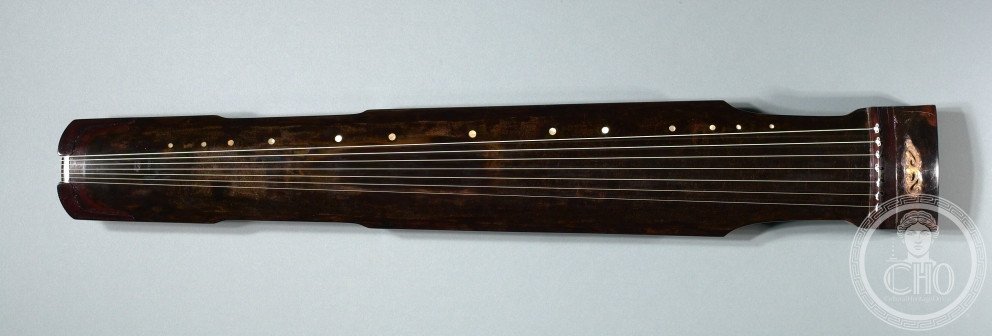
A seven-string plucked instrument of profound subtlety, the guqin has been played for millennia by scholars and sages as a vessel of refinement and philosophical wisdom.
In UNESCO’s words
The Chinese zither, called guqin, has existed for over 3,000 years and represents China’s foremost solo musical instrument tradition. Described in early literary sources and corroborated by archaeological finds, this ancient instrument is inseparable from Chinese intellectual history. Guqin playing developed as an elite art form, practised by noblemen and scholars in intimate settings, and was therefore never intended for public performance. Furthermore, the guqin was one of the four arts – along with calligraphy, painting and an ancient form of chess – that Chinese scholars were expected to master. According to tradition, twenty years of training were required to attain proficiency. The guqin has seven strings and thirteen marked pitch positions. By attaching the strings in ten different ways, players can obtain a range of four octaves. The three basic playing techniques are known as san (open string), an (stopped string) and fan (harmonics). San is played with the right hand and involves plucking open strings individually or in groups to produce strong and clear sounds for important notes. To play fan, the fingers of the left hand touch the string lightly at positions determined by the inlaid markers, and the right hand plucks, producing a light floating overtone. An is also played with both hands: while the right hand plucks, a left-hand finger presses the string firmly and may slide to other notes or create a variety of ornaments and vibratos. Nowadays, there are fewer than one thousand well-trained guqin players and perhaps no more than fifty surviving masters. The original repertory of several thousand compositions has drastically dwindled to a mere hundred works that are regularly performed today.
Official description, UNESCO Intangible Cultural Heritage List — Guqin and its music
At a glance
The guqin is a seven-string plucked instrument that has been central to Chinese musical and intellectual life for over 3,000 years. It produces a range of four octaves through ten different string-attachment methods. Historically, the guqin was one of four arts—alongside calligraphy, painting, and an ancient form of chess—that Chinese scholars were expected to master. Unlike most instruments, it was developed as an elite art form for intimate settings rather than public performance.
Origins & history
Archaeological evidence and early literary sources confirm the guqin's existence over three millennia ago, making it China's foremost solo musical tradition. The instrument developed among noblemen and scholars as a refined practice inseparable from Chinese intellectual history. Tradition held that twenty years of training were required to achieve proficiency in playing.
The practice
The guqin's seven strings can be attached in ten different ways, with thirteen marked pitch positions enabling players to reach four octaves. Three basic techniques form the foundation of playing: san (open string), an (stopped string), and fan (harmonics). San uses the right hand to pluck open strings individually or in groups. Fan involves the left hand touching strings lightly at marked positions while the right hand plucks, creating light overtones. An employs both hands—the right plucks while the left presses firmly, allowing slides and ornamental vibratos.
Cultural significance
For Chinese scholars, mastery of the guqin represented philosophical attainment and intellectual refinement. Today, fewer than one thousand well-trained players remain, with perhaps fifty surviving masters. The original repertory of several thousand compositions has reduced to roughly one hundred works regularly performed, putting the tradition at risk of further erosion.
Key facts
- Country: China
- Inscribed: 2008
- UNESCO list: Representative List of the Intangible Cultural Heritage of Humanity
- UNESCO reference: 00061
- UNESCO vocabulary: Instrumental music; Musical instruments; Plucked string instruments
- Map: not shown — UNESCO’s official description of this element names no locality, and a living tradition is practised across a community, not at one address.
Where to experience it
Guqin remains alive among a small community of dedicated practitioners across China, with fewer than one thousand well-trained players and perhaps fifty surviving masters keeping the tradition alive. Visitors seeking to encounter this ancient instrument can attend performances at venues dedicated to classical Chinese music and traditional conservatories, where both public recitals and intimate study sessions occasionally welcome guests. The rarity of accomplished guqin players means that authentic performances and instruction are precious opportunities, reflecting the instrument's exclusive history as an elite scholarly art form never meant for mass audiences.
Sources & resources
- UNESCO — official element page: Guqin and its music
- UNESCO — open data record: Intangible Heritage List, reference 00061
- UNESCO — official video: UNESCO film on this element — embedded on this page
- UNESCO — official photograph: Detail on guqin practice — Chinese Academy of Arts
- Reference — Wikipedia (secondary): Guqin — consulted as a secondary reference, not as confirmation
- Cultural Heritage Online: Our archive and city guides

Sources
- S1 — Van Gulik, R. H. The Lore of the Chinese Lute: An Essay in the Ideology of the Ch'in. Sophia University, 1969. ISBN 978-0-8048-0869-9.
- S2 — Yung, Bell. Celestial Airs of Antiquity: Music of the Seven-String Zither of China. A-R Editions, 1997. ISBN 978-0-89579-313-3.
Spotted an error? Write to editorial@culturalheritageonline.com and we correct it the same day.