A student who documents a building for a course produces work that disappears at the end of the term. A researcher who checks a site produces a note that nobody can cite. CHO Academic exists to give that work a permanent address, under the author’s name, inside an archive that other people read.
1. What the programme is
CHO Academic is the free professional account for students and faculty of partner institutions. It is the Operator PRO plan at no cost, for as long as the author holds an email address at a partner institution.
It is not a discount and it is not a trial: it is the same professional account, given to the people who use the archive to study, document and compare places.
2. What you receive
- The professional account, free. The plan that costs 99 dollars a year, at no cost for partner institutions.
- An author page. Every contribution is listed at a permanent address under your name, with a portrait, a bio and a contact form that never shows your email.
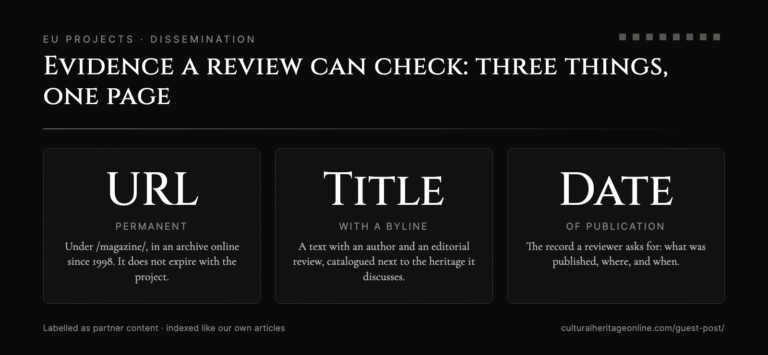
- A publication record. The page is what a supervisor, a jury or an employer can open: the list of what you have published, with dates.
- The tools to publish. Places, events, articles, photographs and itineraries, under your own name.
3. What is not included
The selling tools of the professional plan — ticketed itineraries, road-books, payouts — are not part of Academic. Academic is for publishing, not for selling.
That is a deliberate limit: the programme is built for study and documentation, and the commercial tools belong to the professionals who work with them.
4. The correspondent track
Contributors who report regularly from their country can be named CHO Correspondent for that country: listed on the masthead, with a letter of accreditation from the publisher for the events they cover.
One correspondent per country, chosen by the editors on what has been published and on sustained engagement, and reviewed every year. It is not an application: it is a record that becomes visible. The letter of accreditation is written by the publisher, and it is what a press office asks for when a correspondent covers an opening.
5. How to publish
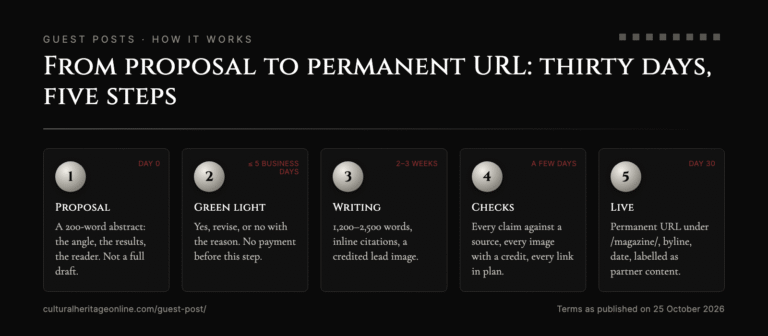
Three steps, the same for every author:
- 1. Propose a subject: a place, a building, an event, a route. The archive already holds 16,968 places and 6,341 cities (figures measured on 22 October 2026), so the first question is what the contribution adds.
- 2. Write with sources: the dates, the documents, the credits of the images. The editorial review is the same as for any other author.
- 3. Publish under your name, and link the page from your CV, your department page, your profile.
The review is not a formality: it is what makes the page citable. It is also the reason the programme costs nothing: the institution pays no fee, and the account is tied to the email domain, so the free plan ends when the person leaves the institution, not when the money runs out.
The three kinds of contribution a course produces most often are a place-card (a building, with its sources), an event (a date, a place, a programme) and an article (an argument, with citations). Each has its own review, and each stays under the author’s name.
6. Why it matters for a department
A department that documents its city produces, every year, a set of pages that nobody outside the course can find. With an author page and an archive behind it, the same work becomes:
- a record for the students, which they keep after graduation;
- a public description of the city, which residents, travellers and other researchers use;
- a reason for the department to be cited by the people who write about the same places.
The department signs nothing and pays nothing. What we ask is that the programme is announced where students and staff will see it: a line on the department page, in a newsletter, on a notice board. The reading is ours — every page is read by our editors before it goes live, and a course of twenty students produces twenty pages to read. That review is the reason the pages can be cited.
7. How the review works
A contribution is proposed, not uploaded: the subject, the sources, the images with their credits. The editorial team checks that it adds something the archive does not already have, and that every factual claim can be opened in a source.
If the answer is yes, the page is published under the author’s name, with the date and the review. If the answer is no, the reason is written: it is usually the source, not the subject.
Read the programme and join with your institutional address: /collaborate/academic/
Sources
- Cultural Heritage Online, CHO Academic and Correspondents programme page, https://culturalheritageonline.com/collaborate/academic/ — read 30 October 2026
- Cultural Heritage Online, Masthead, https://culturalheritageonline.com/masthead/
- Cultural Heritage Online, Terms and conditions §3.1 (institutional accounts), https://culturalheritageonline.com/terms/
Spotted an error? Write to [email protected] and we correct it the same day.