
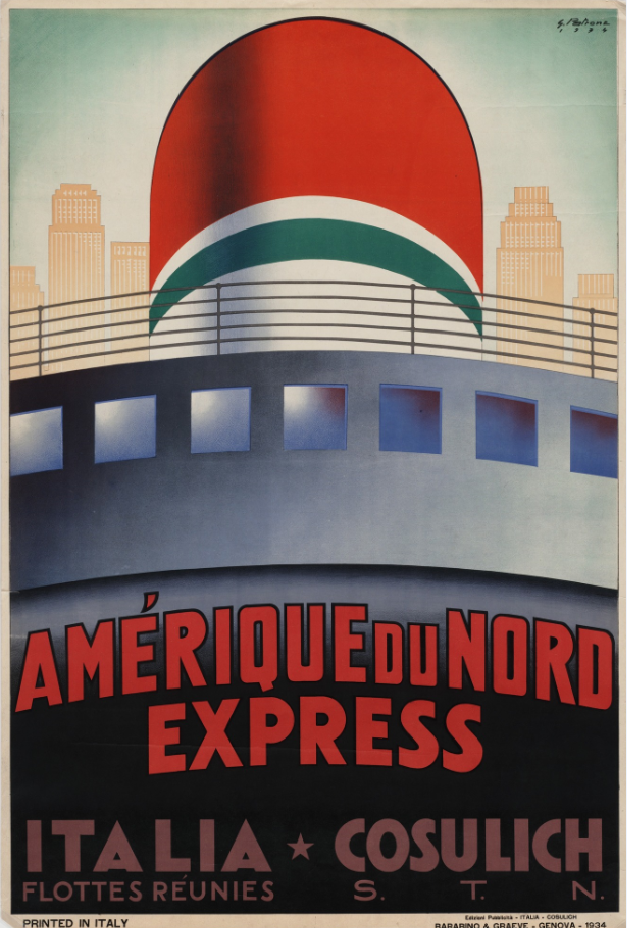
An advertising poster by Giovanni Patrone, created in 1934. Patrone was an Italian painter of figures trained in Naples under the academic masters Domenico Morelli and Filippo Palizzi, and later became a professor of design.
The poster represents commercial graphic design during Italy’s interwar period, when such works served both functional advertising and artistic purposes. Patrone’s background in figure painting informed his approach to commercial imagery.
About Giovanni Patrone
Giovanni Patrone was born in Naples on 17 March 1847. He studied at the Royal Institute of Fine Arts of Naples, where he won numerous awards. His academic training under two of the institute’s most prominent instructors—Morelli and Palizzi—shaped his development as a painter of figurative subjects. He worked in both oil and watercolor, and exhibited regularly at the Promotrice of Naples before establishing himself as a design professor.
Details
- Creator: Giovanni Patrone
- Year: 1934
- Object type: Advertising poster
- Medium: Commercial graphic design
- Period: Italian interwar period
Frequently asked questions
Who was Giovanni Patrone?
Giovanni Patrone was a Neapolitan painter and professor of design, born in 1847. He trained under Domenico Morelli and Filippo Palizzi at the Royal Institute of Fine Arts of Naples and became known for figure painting in oil and watercolor.
What period does this poster represent?
The poster dates to 1934, during Italy’s interwar period (1922–1943), when graphic design and commercial imagery were integral to modern visual culture.
Where did Patrone study and teach?
Patrone studied at the Royal Institute of Fine Arts of Naples and later became a professor of design there. He exhibited his work regularly at the Promotrice of Naples.
Sources
- S1 — Menegazzi, Luigi. Il manifesto italiano: 1882-1925. Electa, 1995. ISBN 978-88-435-5134-7.
- S2 — De Fusco, Renato. Storia del design. Laterza, 2002. ISBN 978-88-420-6623-1.
Spotted an error? Write to editorial@culturalheritageonline.com and we correct it the same day.


