

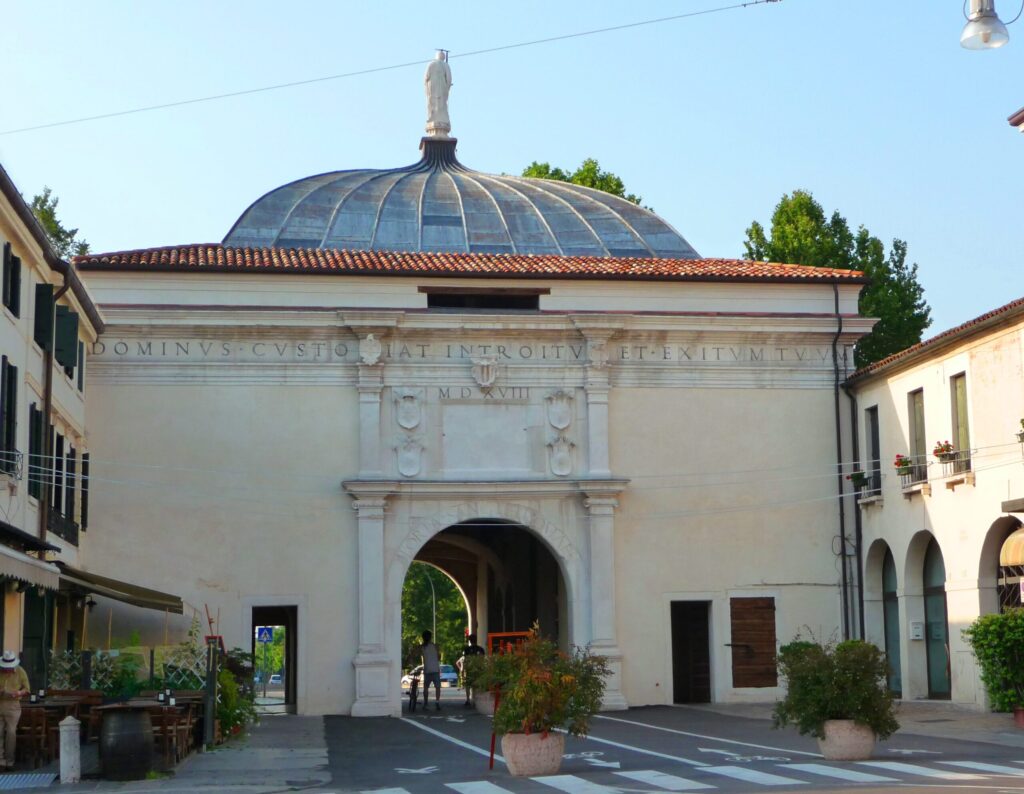
Porta San Tomaso is one of the best-preserved medieval city gates of Treviso, a walled commune in the Veneto region of northeastern Italy. Built in 1518 in ten months under the podestà Paolo Nani, as part of the Venetian remaking of the city’s defences, it remains a defining landmark of the historic centre, guarding the road that once led toward Conegliano and the Dolomite foothills.
At a glance
- Type
- Medieval city gate
- Period
- 1518; built as part of the Venetian remaking of the city’s defences
- Style
- Renaissance military architecture, Corinthian order in Istrian stone
- Location
- Treviso, Veneto, Italy · 45.6724° N, 12.2349° E
Overview
Porta San Tomaso stands at the northern edge of Treviso’s historic centre, where the old city walls once enclosed a prosperous medieval commune under Venetian influence. The gate takes its name from the nearby church dedicated to Saint Thomas the Apostle, a common dedication in northern Italian towns from the twelfth century onward. Together with Porta Santi Quaranta and Porta Altinia, it forms the surviving triad of Treviso’s ancient access points still visible today.
History
Treviso’s communal walls were constructed and extended in phases from the twelfth through the fifteenth century, when the city came under the dominion of the Republic of Venice in 1389. The gates were strategic nodes in this circuit, controlling access and taxation of goods entering the city. Porta San Tomaso belongs to the Venetian remaking of the terraferma fortifications; it is attributed to Guglielmo d’Alzano, known as il Bergamasco, and was restored in 1703, cleaned inside in 1931 by Mario Botter and restored again in 2007 by the Comune di Treviso. The gate survived the destructions of the two World Wars that heavily damaged Treviso, including the devastating Allied bombing of Good Friday 1944.
What you see
The gate presents a robust masonry structure with a tall pointed arch framing the passage, typical of the Veneto communal tradition blending Romanesque solidity with Gothic proportions. The outer facade is clad in Istrian stone, divided by six columns on triangular bases in the Corinthian order, and is crowned by a statue of Saint Paul. Decorative blind arching and corbelling details survive on the facade, giving the structure visual articulation beyond its purely defensive function. The surrounding remnant of the city wall provides context for understanding the original scale of Treviso’s medieval fortifications.
Cultural significance
Porta San Tomaso is listed among the protected historical monuments of the Veneto region and contributes to Treviso’s reputation as one of the best-preserved walled cities of northeastern Italy. It is a point of reference in the itineraries of the Marca Trevigiana, a cultural landscape celebrated for its frescoed churches, canals, and medieval heritage. The gate also appears frequently in local iconography, from Renaissance paintings of the city to contemporary photography celebrating the Veneto’s urban heritage.
Practical information
- Address
- Via Sant’Agostino / Viale Bartolomeo d’Alviano, 31100 Treviso TV
- Admission
- Exterior visible at all times, free of charge
- Hours
- Open air; no restricted access to the gate passage
Getting there
Treviso is served by Treviso Airport (TSF) and is reachable from Venice in approximately 30 minutes by regional train from Venezia Santa Lucia to Treviso Centrale. From the station, Porta San Tomaso is about a 15-minute walk north through the historic centre. Local buses operated by MOM (Mobilità di Marca) connect the station with the city walls. The area around the gate is easily navigable on foot or by bicycle.
Sources
Find it on the map
See this place and what’s around it →📷 Become a Cultural Heritage Online photographer
Share your photos of places: they stay published under your name as the author. The more they're seen, the more you get noticed — and soon a contest will reward the most appreciated photos.
Log in or sign up free to add a photo