
Curated Itinerary
When Rome Built Albania: An Italian Rationalism Trail in Tirana and Durrës (1937–1941)
Five buildings, two architects, and a four-year occupation that gave Albania a capital it never asked for — and that it has lived with, renamed, and used…
When Rome Built Albania: An Italian Rationalism Trail in Tirana and Durrës (1937–1941)
Five buildings, two architects, and a four-year occupation that gave Albania a capital it never asked for — and that it has lived with, renamed, and used ever since.
Between 1937 and 1941 the Italian government rebuilt central Tirana according to a plan conceived by Gherardo Bosio, a Florentine architect who died of cancer at thirty-eight, having never seen his most ambitious project completed. Alongside Bosio, Florestano Di Fausto — who had already transformed the Greek island of Rhodes and the Libyan coast — built the only significant Rationalist villa on the Albanian Adriatic. Together, these two architects produced what may be the best-preserved ensemble of Italian colonial Rationalism anywhere in the Balkans.
This itinerary follows the five principal surviving buildings in walking order through central Tirana, then continues by bus or taxi to Durrës for Di Fausto’s Royal Villa. The route takes one full day or can be split across two days if the Durrës leg is combined with the city’s Roman amphitheatre and archaeological museum.
The trail
-
Dëshmorët e Kombit Boulevard, Tirana
The two-kilometre spine of Italian Tirana: renamed three times, still standing, still in use. Walk it south to north for the full institutional sequence.
-
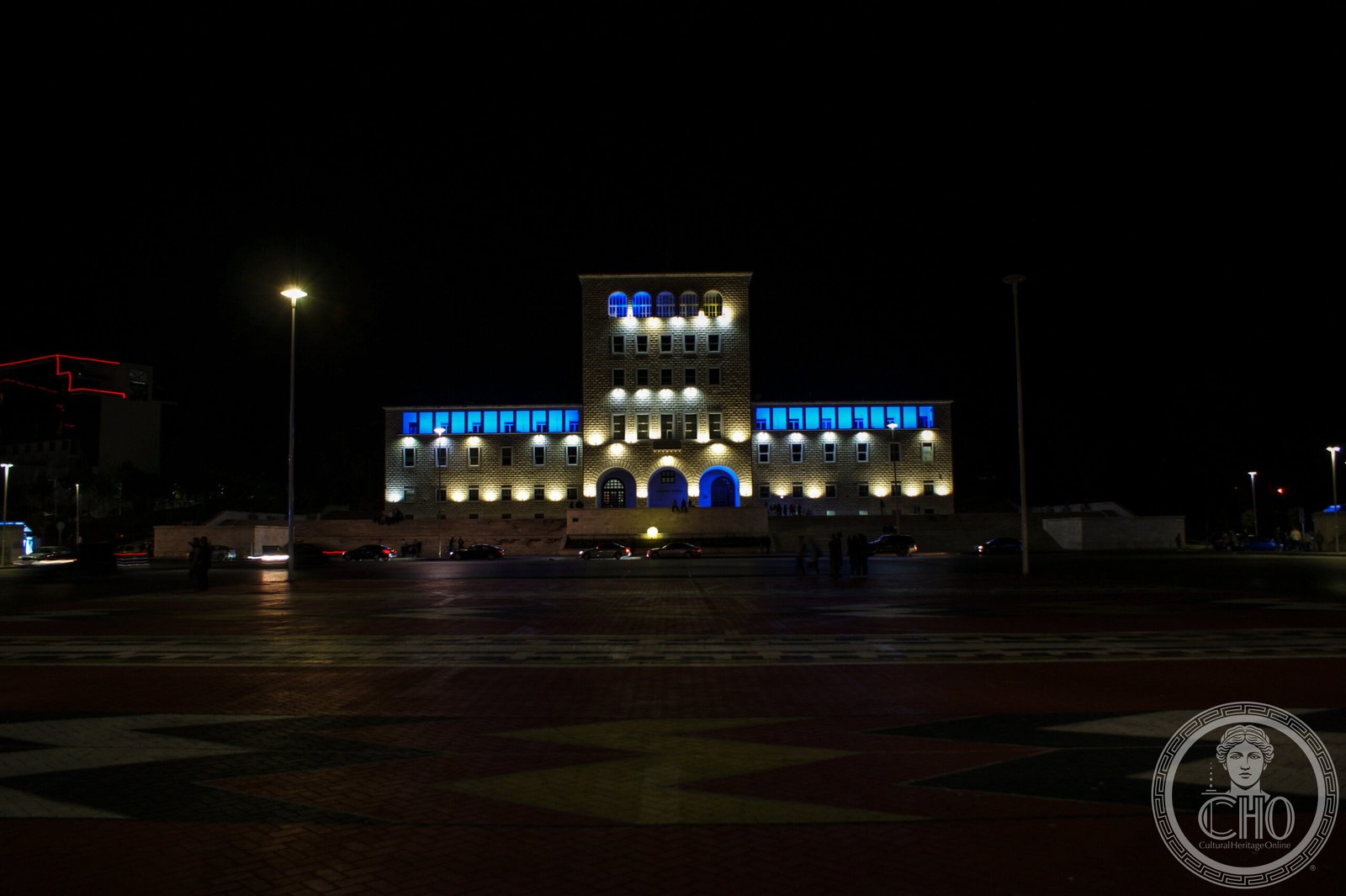
University of Tirana (main building)
Bosio’s Rationalist terminus for the boulevard axis: built as an institutional building, adopted seventeen years later as Albania’s first university.
-
Prime Minister’s Office (Palazzo della Luogotenenza)
Completed one month after Bosio’s death by his colleague Ferdinando Poggi. The strictest piece of Italian government Rationalism in Albania: pure stripped classicism with no concession to local ornament.
-
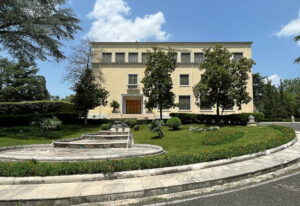
Presidential Palace (Pallati i Brigadave)
Commissioned by King Zog, finished by the Italians who had expelled him. Four names in eighty years, one building, continuous use as Albania’s seat of state.
-
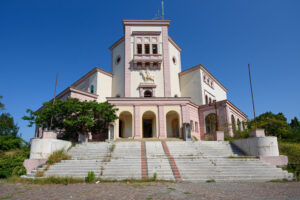
Royal Villa of Durrës (Vila e Zogut)
The only Di Fausto building in Albania designed for its landscape rather than a city grid: 98 metres above the Adriatic, with terraces that step down toward the bay.
Practical information
- Duration: 1–2 days (Tirana alone: 1 day; Tirana + Durrës: 2 days or 1 long day)
- Distance: approx. 45 km total including the Durrës leg
- Getting around: Tirana boulevard stops: walkable (2 km). Presidential Palace: 25 min walk from boulevard or taxi. Durrës: furgon from Tirana bus station, 40 min. Kodër Vilë from Durrës centre: taxi, 10 min.
- Language: Albanian; Italian is understood by older residents; English increasingly spoken in Tirana’s centre
- Currency: Albanian lek (ALL); carry cash, card payment is limited outside Tirana centre
- Best season: April–June and September–October; July–August is very hot; buildings are exterior visits only so rain is the main variable
- Access: all five sites are exterior visits (active government buildings, university, partly closed villa); the University of Tirana entrance hall is accessible during weekday hours
Before you go
A word from your host
Albania moves at its own pace, which is fast in some respects (coffee arrives immediately, conversation is direct) and slow in others (opening hours are approximate, restoration timelines are elastic). The buildings on this trail are active government buildings, a university, and a partly closed villa: plan to see them from the outside rather than the inside, except the university entrance hall. Carry cash; card payment is not universal outside Tirana centre.
Getting around
Tirana has taxis and a growing bus network; for the boulevard stops, walking is practical (the full Deshmoret e Kombit Boulevard is 2 km). The Presidential Palace is at the south end of the boulevard, accessible on foot. Durrës is 38 km west of Tirana: the furgon (shared minibus) from Tirana bus station runs frequently and takes about 40 minutes. From Durrës centre to the Royal Villa, take a taxi to Koder Vile (about 3 km, 10 minutes).
Step by step
Dëshmorët e Kombit Boulevard, Tirana
The storyThe boulevard was renamed Viale del Impero (Avenue of the Empire) immediately after the Italian annexation of April 1939, and reverted to an Albanian name only after 1944. The name the Albanians chose -- Deshmoret e Kombit, Martyrs of the Nation -- was a deliberate counter-narrative: the same physical axis, opposite political meaning.
Insider tipThe best time to walk the boulevard is early morning, before 08:00, when it is used mainly by joggers and commuters. The planted medians with their pine trees -- original to the Bosio plan -- have grown large enough to frame the government buildings in a way that the original design intended but that photographs from the 1940s could not have anticipated.
A fitting stopBar Kombi on the boulevard (south end near Mother Teresa Square) is a consistent local option for a macchiato and a byrek (flaky pastry with cheese or meat). For a longer breakfast, the National Gallery cafe nearby is quieter and has good views of the square.
University of Tirana
The storyBosio designed the building in early 1940, one year before he died. The University of Tirana as an institution did not exist until 1957, seventeen years after the building was completed -- so for its first seventeen years, the building served functions entirely different from the ones it was eventually named for.
Insider tipThe entrance hall is open during university hours (weekdays, roughly 08:00-20:00) and worth entering for the stairwell proportions and the terrazzo floors. Albanian university students are generally friendly to foreign visitors; asking about architecture usually produces a useful guide.
A fitting stopThe university area around Mother Teresa Square has several small cafes used by students. These are cheaper and faster than the boulevard options. Look for any cafe with a vinyl upholstered interior -- the Albanian 1990s aesthetic -- which will serve an excellent espresso.
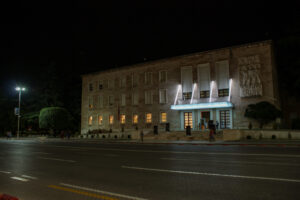
Prime Minister’s Office, Tirana
The storyBosio designed four government buildings in Tirana in less than two years -- the Boulevard plan, the Prime Minister's Office, the Presidential Palace, and the Hotel Dajti -- before dying of cancer at 38 in April 1941. The Albanian projects were completed by his colleague Ferdinando Poggi, who had collaborated on the Casa del Fascio.
Insider tipThe building's proportions are most legible from the opposite (west) side of the boulevard, where you can see the full three-storey composition against the sky. The security fencing on the east side reduces the forecourt view significantly.
A fitting stopThe Rogner Hotel, immediately south of the Prime Minister's Office on the boulevard, has a terrace cafe open to non-guests. It is expensive by Albanian standards but the position on the boulevard makes it useful for a coffee while studying the Italian buildings across the street.
Presidential Palace, Tirana
The storyKing Zog fled Albania within hours of the Italian invasion of 7 April 1939, reportedly taking with him enough gold to fill several lorries. The palace he had commissioned but not yet occupied was completed by the Italians and used for exactly the kind of state ceremony it had been designed for -- just not by the client who ordered it.
Insider tipThe south facade (as in the hero image) gives the clearest view of the Bosio composition. Approach from the road that runs along the south side of the Grand Park; the trees do not obstruct the facade view from this angle. Security is present but unobtrusive if you stay on the road.
A fitting stopThere is no cafe near the Presidential Palace. The Grand Park of Tirana, immediately adjacent, has a kiosk cafe by the Artificial Lake that is open in warm weather. The walk from the palace to the lake takes 10 minutes.
Royal Villa of Durrës
The storyDi Fausto is described in his Wikipedia article as the 'architect of the Mediterranean' -- a description that fits this building more precisely than any of his Libyan or Tirana work. The villa is the only Di Fausto building in Albania that was designed specifically for its landscape, with terraces that step down toward the Adriatic.
Insider tipEven if the villa is inaccessible (check restoration progress before visiting), the hilltop road offers views along the Albanian coast that are exceptional on clear days. The Adriatic side has good late afternoon light; the Albanian side facing inland shows the mountains that divide Albania from North Macedonia. Either direction is worth the taxi fare.
A fitting stopDurres waterfront has several fish restaurants along the promenade. The Iliria restaurant (local seafood) and similar venues near the beach are consistently good. For a quick stop before the taxi to the villa, the pastry shops near Durres train station serve byrek and yogurt at any hour.
Download for tour navigation
PDF is the stop list with GPS, to print or keep on the phone. GPX for Garmin / Komoot / OsmAnd. KML for Google Earth and Maps.