
Curated Itinerary
Budapest Szecesszió: An Art Nouveau Walking Trail
Six landmarks by Ödön Lechner and his circle, linked by tram and on foot through a city that invented its own version of Art Nouveau and never stopped…
Budapest Szecesszió: An Art Nouveau Walking Trail
Six landmarks by Ödön Lechner and his circle, linked by tram and on foot through a city that invented its own version of Art Nouveau and never stopped arguing about it.
About this trail
In the last two decades of the nineteenth century, Budapest was building itself as a European capital at extraordinary speed. The 1896 Millennium celebrations — marking a thousand years of the Hungarian kingdom — created a civic appetite for a style that was neither Viennese nor Parisian but distinctly Magyar. Architect Ödön Lechner found that style in a combination of structural rationalism, Zsolnay ceramic cladding made in Pécs, and decorative motifs drawn from Hungarian folk embroidery and pottery. The buildings on this trail are the results: six structures from roughly 1894 to 1906 that show the arc of a movement from its commercial peak to its academic conclusion.
The route runs roughly west to east, beginning at the Danube embankment and ending in a nineteenth-century villa district where the city becomes very quiet. Total walking distance is approximately 7 kilometres; trams cover the two sections where the route gaps. Budget a full day to enter the buildings that admit visitors and to sit at least once in a historic café.
The six stops
-
Gresham Palace
The most complete Art Nouveau facade on the Danube embankment, completed 1906 for a British insurance company. Now a Four Seasons hotel; the atrium is freely accessible.
-
Hungarian Postal Savings Bank
Ödön Lechner’s most inventive roofline, covered in Zsolnay ceramic bees and flower urns — visible only from a distance and designed, Lechner said, for the birds. Now OTP Bank headquarters.
-
Franz Liszt Academy of Music
The principal concert hall of Hungary, inaugurated in 1907, with one of the finest Art Nouveau interiors in Central Europe. Student concerts most evenings; check the website for the schedule.
-
New York Palace (Café New York)
The most famous coffee house in Budapest, opened 1894, restored 2006. Three tiers of gilded galleries and frescoed vaults; the place where Hungarian literary modernism held its editorial meetings.
-
Museum of Applied Arts
Lechner’s 1896 Millennium centrepiece: a white Zsolnay atrium inside a building whose explicit brief was to look nothing like Vienna. The most serene interior on the route.
-
Geological Institute of Hungary
Lechner’s most literal building — a scientist’s headquarters whose roofline figures carry the weight of the globe in Zsolnay pyrogranite. Still in active use as a geological survey institute.
Before you go
Getting around: Budapest has an excellent tram network. Trams 2, 4 and 6 connect most stops on this route. A 24-hour travel card from BKK vending machines at metro stations covers all city transport. The route is mostly walkable; the final section to the Geological Institute calls for tram 1 from the Nagykörút.
Local notes: Budapestians take their coffee seriously and their café hours seriously. Most historic cafés close earlier than you expect on weekdays and fill up on weekend mornings. The Postal Savings Bank is an active bank headquarters: photograph the exterior freely, do not expect to enter. Szecesszió buildings tend to be in residential or working areas, so you will often be the only visitor in sight — which is the point.
Before you go
A word from your host
Budapestians take their coffee seriously and their cafe hours seriously. Most historic cafes close earlier than you expect on weekdays and fill up on weekend mornings. The Postal Savings Bank is an active bank headquarters: photograph the exterior freely, do not expect to enter. Szecesszio buildings tend to be in residential or working areas, so you will often be the only visitor in sight.
Getting around
Budapest has an excellent tram network. Trams 2, 4 and 6 connect most stops on this route. A 24-hour travel card from BKK vending machines at metro stations covers all city transport. The route is mostly walkable; the final section to the Geological Institute calls for tram 1 from the Nagykörút.
Step by step

Gresham Palace
The storyThe Gresham was commissioned by the London-based Gresham Life Assurance Society and completed in 1906, just as the Secession movement peaked across Central Europe. During the communist era it became a block of flats. The story of what was found inside its sealed rooms when restoration began in 1999 -- intact mosaic floors under decades of painted-over grime -- became a Budapest legend.
Insider tipStand on the Chain Bridge side and look up at the two towers: the ironwork grilles between them are original Zsolnay ceramic-coated castings. Few visitors notice them. The atrium, now the hotel lobby, can be visited even if you are not a guest: walk in confidently during business hours.
A fitting stopKavehaz at the Gresham is hotel-priced. For a better breakfast-to-coffee ratio, cross to the Buda side via the Chain Bridge and walk five minutes to Ruszwurm Cukraszda on Castle Hill, the oldest confectionery in Budapest (founded 1827).
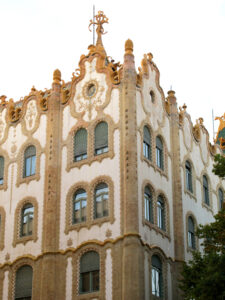
Hungarian Postal Savings Bank
The storyOdoen Lechner placed the Zsolnay ceramic bees on the roofline at heights that make them almost invisible from street level, then said -- reportedly -- that they were intended for God and the birds. The building is now the OTP Bank headquarters.
Insider tipThe best view of the roofline requires height. The corner of Hold utca and Becsi utca gives you the geometry of Lechner's ceramic crown at an angle the main entrance does not offer.
A fitting stopGerbeaud on Vorosmarty ter is touristy but historic (founded 1858). For something quieter and closer, try the covered market on Hold utca: the upper floor serves classic Hungarian dishes at non-hotel prices.
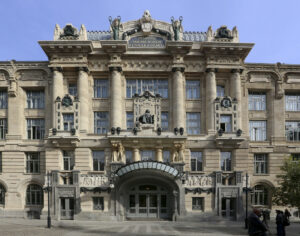
Franz Liszt Academy of Music
The storyThe Academy was inaugurated in 1907 with a performance conducted by Gustav Mahler. The concert hall seats around 900 and has acoustics ranked among the finest in Europe for chamber orchestras. The 2013 renovation replicated the original Zsolnay ceramic tiles using the same pyrogranite process as 1907.
Insider tipStudent concerts happen most weekday evenings during the academic year and are either free or very inexpensive. Check the Academy website for the schedule: the programme leans toward Central European repertoire you will rarely hear outside Hungary.
A fitting stopLiszt Ferenc ter itself is lined with cafes. Menza on the square has been consistent for years. For a quieter option walk one block to the Cafe Vian on Lazar utca.
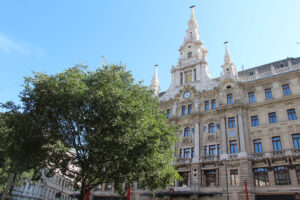
New York Palace, Budapest
The storyWriters from the journal Nyugat -- the literary magazine that defined Hungarian modernism from 1908 -- held editorial meetings in the Cafe New York. When the building was nationalised after World War II, the cafe was converted into a sports goods store, a form of symbolic erasure that Budapest still discusses.
Insider tipThe cafe is expensive and busy. Visit on a weekday morning before 10:00 when the tour groups have not yet arrived. The upper mezzanine galleries have the best views of the frescoed ceiling without requiring a table.
A fitting stopInside the cafe, the Dobos torte and the retes (strudel) are reliable. For lunch at less theatrical prices, walk two minutes to Kazinczy utca in the Jewish Quarter.

Museum of Applied Arts, Budapest
The storyOdoen Lechner designed the Museum for the 1896 Millennium Exhibition celebrating Hungary's thousand years as a kingdom. Emperor Franz Joseph I attended the opening but reportedly said nothing -- diplomatic restraint about a building whose explicit programme was Hungarian national identity expressed in a style that owed nothing to Vienna.
Insider tipEnter through the main portal and turn immediately to look at the atrium ceiling: the white Zsolnay ribbed vaulting against the pale green walls is the most serene interior in Budapest.
A fitting stopThe museum cafe is reliable for a coffee break. Alternatively, the Nagycsarnok (Great Market Hall) is five minutes south on Vamhaz korut -- the best food market in the city.
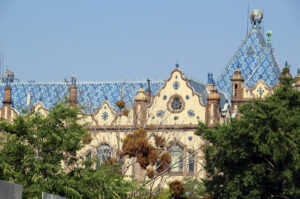
Geological Institute of Hungary, Budapest
The storyThe pyrogranite process that gives Zsolnay ceramics their frost-resistance was developed in the 1870s specifically for architectural use in Hungarian winters. Lechner exploited it more fully here than anywhere else: the globe-bearing figures at the roofline have survived more than 125 Hungarian winters without structural damage.
Insider tipThe area around Stefania ut is a late-nineteenth-century villa district used mainly by embassies and research institutions. Walk half a block in either direction to see what Budapest looks like when it is not performing for tourists.
A fitting stopThere is no historic cafe in the immediate area. The Nagycsarnok (if you saved it) is the practical option. Alternatively, a ten-minute walk brings you to Varoshiget (City Park) and the seasonal terrace at Vajdahunyad Castle.
Download for tour navigation
PDF is the stop list with GPS, to print or keep on the phone. GPX for Garmin / Komoot / OsmAnd. KML for Google Earth and Maps.