

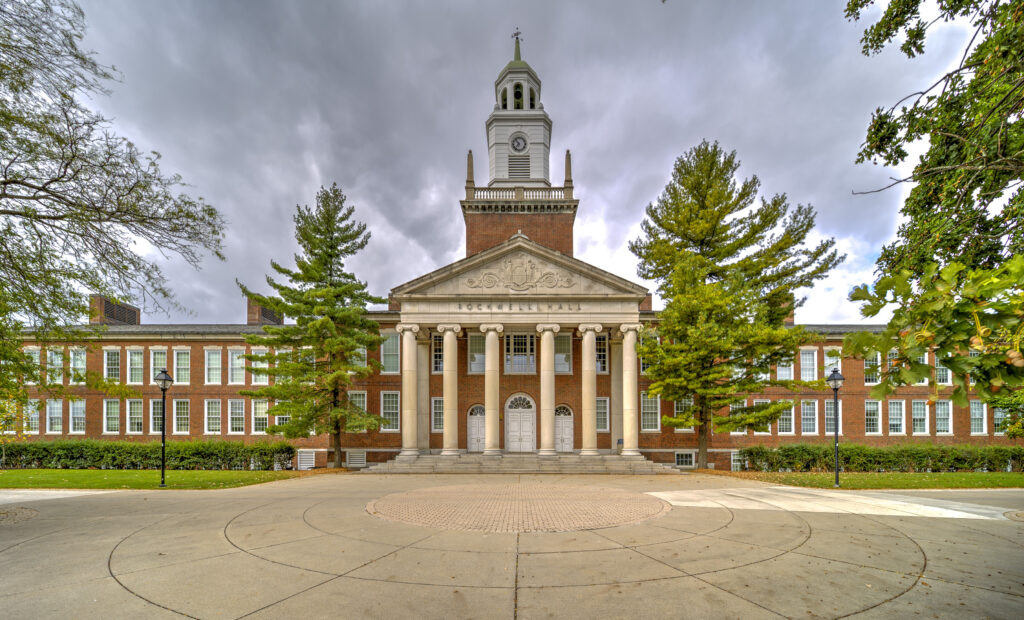
Rockwell Hall is the red-brick landmark on the eastern edge of Buffalo State University's campus, raised between 1928 and 1931. It has held the college library, a great auditorium, and now the college's art conservators.
At a glance
The building faces Elmwood Avenue. The Albright-Knox Art Gallery stands across the road, with the rest of the campus behind. Its model was Independence Hall in Philadelphia, a choice that suited the colonial revival of the day. The plans were begun by Sullivan Jones and finished by William Haugaard. Since 1961 the building has carried the name of Harry W. Rockwell, president of the college from 1919 to 1951.
Key facts
- Begun in 1928 to plans by Sullivan Jones, completed in 1931 to plans by William Haugaard
- Cornerstone laid on 9 October 1929 by Edward H. Butler Jr.
- Known at first as the Administration Building, renamed Rockwell Hall in 1961
- Red brick, six columns on the Elmwood Avenue front, a bell tower above
- Houses the Garman Art Conservation Department and the music department
- Art conservation office in Rockwell Hall 230, 1300 Elmwood Avenue
- Address: 1300 Elmwood Avenue, Buffalo, NY 14222
History
Rockwell Hall belongs to the campus Buffalo State laid out in 1928, when the college left its old quarters in the city. Work began that year under the architect Sullivan Jones. The building was finished in 1931 under the final plans of William Haugaard, who took the design over. Its shape was borrowed from Independence Hall in Philadelphia: red brick, six columns across the front, a bell tower above.
The cornerstone was laid on 9 October 1929 by Edward H. Butler Jr. He used the trowel his father had handled at the cornerstone of the second Buffalo Normal School in 1913. The building opened to students as the Administration Building. It held the library, the offices, classrooms and the auditorium. For a generation it was the working centre of the college.
The building took its present name in 1961, after Harry W. Rockwell. In 1919 the college had been one building with 250 students and 45 teachers. Rockwell retired in 1951. The library left in 1952 and the empty rooms went to the Burchfield collection.
A fire in 1969 closed the auditorium. The building slipped into disrepair while money for repairs was scarce. A campaign by the Friends of Rockwell Hall brought the state funding back, and renovation began in September 1984. The work was shown to the campus at a festival in October 1987. Between 2003 and 2005 the performance hall inside was rebuilt, with a new stage, screens, wiring and sound. Its outward appearance was carefully left alone.
What you see
Two teaching departments now share the building. The Garman Art Conservation Department runs studios for objects, paper and paintings: the Sheldon and Caroline Keck paintings studio, the objects and paper studios, the F. Christopher Tahk conservation science laboratories and the Dan Kushel laboratory for imaging and technical examination. Students work on real objects under laboratory light. A library of their own sits beside the studios.
The music department shares the building. The Ciminelli Recital Hall gives it a room for recitals and rehearsals. The Metcalfe Rooms keep two reconstructed interiors from the Metcalfe House in Buffalo as period rooms. On the Elmwood Avenue side the steps, the columns and the bell tower still do the work they did in the 1930s. They announce that this is a college.
Practical information
- Address: Rockwell Hall, 1300 Elmwood Avenue, Buffalo, NY 14222
- Art conservation department office: Rockwell Hall 230, telephone (716) 878-5025, [email protected]
- A working university building: studios, laboratories and offices, entered on college business
- Recitals in the Ciminelli Recital Hall, ticketed by the college
- The facade is best seen from Elmwood Avenue
Getting there
Rockwell Hall stands on Elmwood Avenue at the eastern side of the campus, north of downtown Buffalo and a short walk from the museum district around Delaware Park. City buses run the length of Elmwood Avenue.
Nearby
- Albright-Knox Art Gallery, across Elmwood Avenue
- Delaware Park and the museum district
- Elmwood Village, the shopping street to the south
Sources
Find it on the map
See this place and what’s around it →📷 Become a Cultural Heritage Online photographer
Share your photos of places: they stay published under your name as the author. The more they're seen, the more you get noticed — and soon a contest will reward the most appreciated photos.
Log in or sign up free to add a photoIs this page about you?
This page is read by travellers and heritage enthusiasts who find it on Google. Tell us how you are connected to this place and we will take it from there.
This entry stays online and free either way — and a free account lets you add to it yourself.