

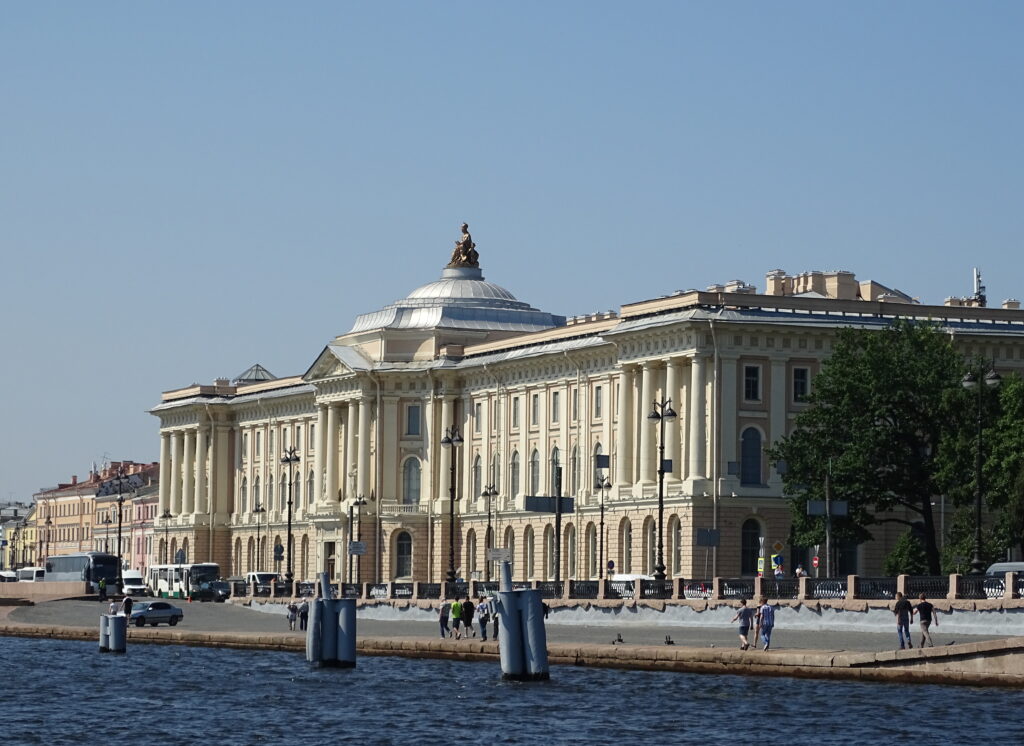
The Repin Academy of Arts teaches painting, sculpture, architecture and the history of art in the Imperial Academy building on the Neva, whose main works were completed in 1788.
At a glance
The academy is the old imperial art school of Russia, founded in 1757 and chartered by Catherine II in 1764. Its building fills a block of Vasilyevsky Island, with the main front on the Universitetskaya embankment of the Neva. Five faculties teach there, and more than a thousand students are enrolled full time. The building has been a school of art for more than two centuries and has never served another purpose.
Key facts
- Academy founded by a Senate decree in 1757
- Charter of Catherine II approved on 4 November 1764
- Main academic building designed by Jean-Baptiste Vallin de la Mothe
- Construction carried on by Alexander Kokorinov, then Yury Felten
- Main works completed in 1788
- Five faculties and more than 1,000 full-time students
- Address: 17 Universitetskaya embankment, Vasilyevsky Island
History
The Academy of the Three Noblest Arts was founded in 1757, on the initiative of Ivan Shuvalov and Mikhail Lomonosov, by decree of the Senate. Teaching began the next year, in several classes at once: painting, sculpture, architecture and medal engraving. On 4 November 1764 Catherine II approved its charter and privileges, the act by which the state recognised the value and independence of artistic work. The date is still read in the mosaic numerals MDCCLXIV set into the floor of the entrance hall.
The building took decades. The project for the main block came from Jean-Baptiste Vallin de la Mothe, the academy's first professor of architecture. Alexander Kokorinov, its rector, directed the first stage of the work, and Yury Felten carried it on after him. Kokorinov was accused of overspending and died in 1772, by an unofficial account taking his own life. Felten's pupil Yegor Sokolov supervised the site. The main works were finished in 1788.
Later architects added to the complex. Andrey Zakharov was architect of the academic buildings. He held the post from 1794 to 1800. Andrey Mikhailov the Second built the garden wing and, in 1817, closed the through passage from the Neva into the round courtyard. Konstantin Ton finished the state interiors in the middle of the nineteenth century, and his pupil Alexander Rezanov completed the central round hall, now the conference hall.
Teaching followed a strict sequence. Students began with drawing. Then came copies from engravings and casts, and finally the nude. Painters painted from the model while sculptors modelled it, and architects studied the orders, measured buildings and designed small pavilions before larger projects. The best students won gold medals. A travelling scholarship took them to Italy or France. Repin, Kramskoy, Surikov, Serov, Bryullov, Levitsky and Kiprensky studied here, and so did the architects Bazhenov, Starov and Zakharov.
What you see
From the Neva the building shows a long classical front with four-column porticoes, a central one and two at the sides. Its centre still carries baroque traits, as early classicism did, and the dome over the round hall answers the round vestibule below it. In the middle of the plan is a circular courtyard. The building wraps around it.
Inside, only the lower vestibule keeps its first appearance, with the passage that once ran through it into the courtyard. The state rooms were never finished as Vallin de la Mothe designed them, and the church was never begun. What the academy shows instead is a working school: studios, plaster casts and drawing classes of the kind it has run since the eighteenth century. Five faculties teach more than a thousand full-time students, with some five hundred more on part-time courses, from Russia and abroad.
Practical information
- Address: 17 Universitetskaya embankment, Vasilyevsky Island, Saint Petersburg.
- Telephone: +7 (812) 323-61-89.
- Hours: from half past nine in the morning to six in the evening.
- Visits: a working academy, not a museum; teaching and admissions offices deal with visitors.
- Status: in use as an art academy, as it has been since the 1760s.
Getting there
The academy faces the Neva on Universitetskaya embankment, on Vasilyevsky Island, opposite the Bronze Horseman and Senate Square. The courtyard entrance is on the landward side of the block.
Nearby
- Kunstkamera
- Menshikov Palace
- Bronze Horseman, Senate Square
- The Twelve Collegia, Saint Petersburg State University
Sources
Find it on the map
See this place and what’s around it →📷 Become a Cultural Heritage Online photographer
Share your photos of places: they stay published under your name as the author. The more they're seen, the more you get noticed — and soon a contest will reward the most appreciated photos.
Log in or sign up free to add a photoIs this page about you?
This page is read by travellers and heritage enthusiasts who find it on Google. Tell us how you are connected to this place and we will take it from there.
This entry stays online and free either way — and a free account lets you add to it yourself.