

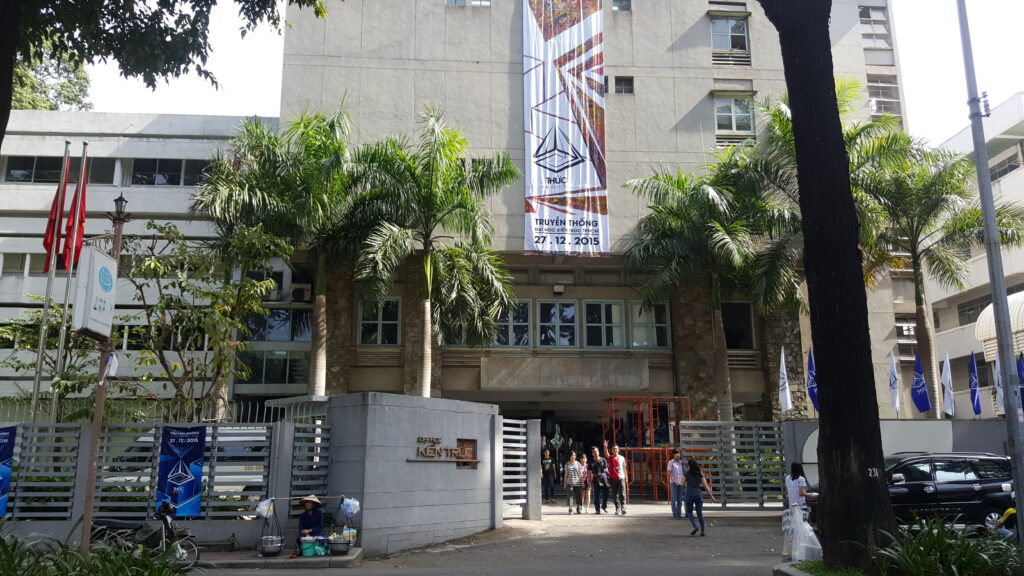
Architecture has been taught in Vietnam in one line since 1926, when the Indochina School of Fine Arts opened its architecture section in Hanoi. The line runs to the University of Architecture Ho Chi Minh City, on Pasteur Street.
At a glance
The university teaches architecture, urban planning, urban engineering, interior architecture, industrial art, fine arts and civil engineering. It occupies a campus on Pasteur Street in District 3, in the centre of Ho Chi Minh City. The university reports to the Ministry of Construction. Its history is the history of architectural teaching in Vietnam. The school counts its years from 1926.
Key facts
- Architectural teaching in Vietnam counted from 1926
- Architecture section of the Indochina School of Fine Arts, Hanoi
- Campus on Pasteur Street since the end of 1950
- University of Architecture Saigon by decree of 30 October 1967
- Present name by decision of the Prime Minister, 27 October 1976
- Studio building of 1972-73 with its washed-stone facade
- Address: No. 196 Pasteur, Xuan Hoa Ward, Ho Chi Minh City
History
The Indochina School of Fine Arts was founded in Hanoi in 1924, by a decree of 22 October. Its founder was the painter Victor Tardieu. Its architecture section opened on 1 October 1926, and the first architects graduated five years later.
The school was divided in 1942 into a college of fine arts and a school of applied arts. In 1944 the architecture section became a school of architecture in its own right, and its diploma was accepted for practice in both France and Indochina. War moved it south. It went to Da Lat in 1945. There it reopened as the Da Lat School of Architecture on 1 February 1947, and in 1948 it joined the University of Indochina.
At the end of 1950 the school moved to Saigon, to 196 Pasteur, and took the name Saigon College of Architecture. A decree of 30 October 1967 raised it to the University of Architecture Saigon. On 27 October 1976 a decision of the Prime Minister renamed it the University of Architecture Ho Chi Minh City. It sat under the Ministry of Construction to 1995, spent four years inside the Vietnam National University, and has been with the ministry again since 2002.
Most of the old campus has changed. One building survives. The studio building, the họa thất, went up in 1972 and 1973, and it began as a student's graduation project, drawn by Truong Van Long under the architect Pham Van Thang. Its facade of washed stone is intact, silvered by weather, and the school calls it a washed-stone facade heritage of old Saigon.
What you see
The campus fills a block on Pasteur Street in District 3, behind a gate that carries the school's name. Teaching blocks, design studios, workshops and a library centre stand inside, and students work in the yard between them. The studio building of 1972-73 is the oldest piece still standing, and its washed stone reads pale grey against the newer concrete.
Around it stands the city the school teaches about. Notre-Dame Cathedral and the Central Post Office, both of the French period, are a few blocks north on Dong Khoi. The Reunification Palace and the Museum of Fine Arts lie within easy reach. Graduation shows, guest lectures and the annual student exhibitions fill the studios through the year.
Practical information
- Address: No. 196 Pasteur, Xuan Hoa Ward, Ho Chi Minh City
- Switchboard (028) 38.222748; the architecture department answers on extension 147
- Email [email protected] for the Department of Architecture
- A working school: studios and workshops are not open to casual visitors
- University, master's and doctoral courses in architecture and its neighbouring fields
Getting there
The campus stands on Pasteur Street in District 3, a few minutes from the cathedral and the Central Post Office. Pasteur runs north from the centre, and the school gate is on the east side of the street.
Nearby
- Notre-Dame Cathedral Basilica of Saigon
- Saigon Central Post Office
- Reunification Palace
- Ho Chi Minh City Museum of Fine Arts
Sources
Find it on the map
See this place and what’s around it →📷 Become a Cultural Heritage Online photographer
Share your photos of places: they stay published under your name as the author. The more they're seen, the more you get noticed — and soon a contest will reward the most appreciated photos.
Log in or sign up free to add a photoIs this page about you?
This page is read by travellers and heritage enthusiasts who find it on Google. Tell us how you are connected to this place and we will take it from there.
This entry stays online and free either way — and a free account lets you add to it yourself.