

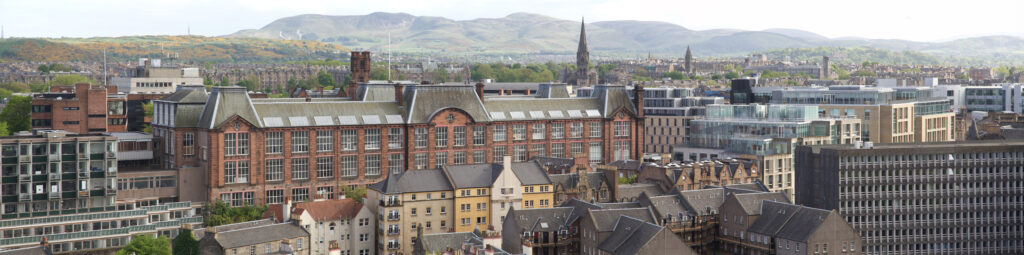
An art school below Edinburgh Castle, in a Beaux Arts building of red sandstone designed by J M Dick Peddie. It has taught art, design and architecture here for more than a century.
At a glance
Edinburgh College of Art is the art school of the University of Edinburgh, on Lauriston Place in the Old Town. Its main building of 1906-1909 is listed category A. Five subject areas are taught: architecture and landscape architecture, art, design, history of art, and music. About three thousand students and five hundred research and teaching staff work across four locations close together in the city centre, on fifty-six programmes.
Key facts
- Art school of the University of Edinburgh since the merger of 2011
- Main building by J M Dick Peddie, 1906-1909, Beaux Arts in red sandstone
- Listed category A, added to the list on 14 December 1970
- Five subject areas, from architecture to music
- 56 programmes, about 3,000 students and 500 research and teaching staff
- Sculpture court with casts of the Parthenon friezes
- Lauriston Place campus under a redevelopment project
History
Before the college was founded in 1906, the Trustees Academy had trained painters such as Alexander Nasmyth, David Wilkie and William Allan. The new building rose on the site of the Municipal Cattle Market, which the city moved to Gorgie to free the ground. The western section went up from June 1907. When the market had gone, the eastern part followed and was completed in 1912.
The high French roofs were meant to be seen from Johnston Terrace and the Castle esplanade, and they still cut into the skyline. The plan wraps two rectangular courts. The western court held a glass pavilion for painting in the open air, and a passage wide enough for horses; it was roofed over in 1925. The eastern court was the double-height sculpture court, made to hold the collection of antique casts begun by the Board of Manufactures in 1797. Casts of the Parthenon friezes line the corridor walls.
The building was paid for in part by a gift from Andrew Grant of Pitcorthie, member of parliament for the Leith Burghs. Professor Rowan attributes the actual design to James Forbes Smith, with an input from George Washington Browne, while the sculptor James Pittendrigh MacGillivray shaped the brief. The college merged with the University of Edinburgh in 2011.
What you see
The front is symmetrical. Two storeys and an attic in red sandstone ashlar, with mansard-roofed pavilions at the angles. A Doric frieze with triglyphs and guttae runs between the floors, and a pedimented portico of four Roman Doric columns marks the door. Corner pavilions carry paired windows flanked by giant Doric columns.
Inside, a coffered Doric entrance hall leads to a double-return stair lit from lunette windows and an octagonal cupola, with paired Ionic columns at first floor. The sculpture court rises through two storeys under a top light, an arcade of key-consoled arches below a gallery on paired Ionic columns. Studios on three floors take the northern light. Outside, the retaining walls, gate piers and railings carry the words EDINBURGH COLLEGE OF ART in metal letters.
The college still teaches in the building, and the Lauriston Place campus is being redeveloped to gain research and teaching space. The former Architecture School Building is excluded from the listing, so what is protected is the 1906-09 block, its walls, piers and railings.
Practical information
- Address: 74 Lauriston Place, Edinburgh, EH3 9DF, Scotland
- Five subject areas: architecture and landscape architecture, art, design, history of art, music
- 56 programmes, about 3,000 students and 500 research and teaching staff
- Listed category A since 14 December 1970
- Email [email protected], telephone +44 (0)131 651 5800
Getting there
The college stands on Lauriston Place, below the Castle rock, a few minutes from the Grassmarket and the Meadows.
Nearby
- Greyfriars Kirkyard
- National Museum of Scotland
- The Meadows
Sources
Find it on the map
See this place and what’s around it →📷 Become a Cultural Heritage Online photographer
Share your photos of places: they stay published under your name as the author. The more they're seen, the more you get noticed — and soon a contest will reward the most appreciated photos.
Log in or sign up free to add a photoIs this page about you?
This page is read by travellers and heritage enthusiasts who find it on Google. Tell us how you are connected to this place and we will take it from there.
This entry stays online and free either way — and a free account lets you add to it yourself.