

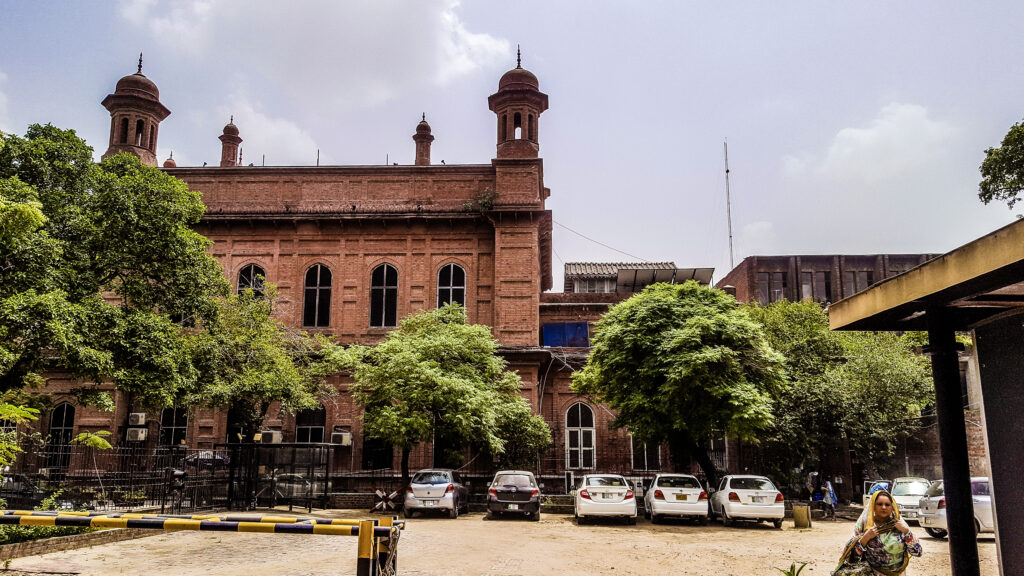
The National College of Arts works from the Kipling Block of 1880, a red brick building on the Mall in Lahore where the Mayo School of Arts trained craftsmen for the Punjab.
At a glance
The National College of Arts is a federal chartered institute for art, design and architecture in Lahore. It occupies the Kipling Block, built for the Mayo School of Arts, on Shahrah-e-Quaid-e-Azam. The Lahore Museum stands on one side of the college and the Town Hall on the other. Teaching spans fine arts, design and architecture, and the college also works on conservation in the Walled City and at the Lahore Fort.
Key facts
- Mayo School of Arts founded in Lahore in 1875
- Kipling Block begun in 1880, now the administration block
- John Lockwood Kipling the school's first principal
- Renamed National College of Arts between 1956 and 1958
- Degree-awarding status granted in 1985
- UNESCO Chair in the management of historic towns from 2009
- Centre for Conservation and Restoration Studies, opened 2003
History
The school began as the Mayo School of Arts. It was set up in 1875 on the lines of the Kensington model, and it ran alongside the Central Museum. The purpose was to document the crafts of the Punjab and to train craftsmen who could meet the demands of production. John Lockwood Kipling became its first principal. He was also curator of the Central Museum.
The building came a few years later. Prince Albert Victor laid the foundation stone of the Kipling Block on 3 January 1880. The design used Mughal imagery, at a date when accounts called the style late Mughal. Khan Bahadur Ganga Ram, a Lahore engineer, supervised the works. The block held six rooms at first. Additions of 1881 were made permanent in 1891 to a design by the principal then in office, and by 1902 four machine workshops and a photolithography studio were running. Bhai Ram Singh designed the fountain in front of the main entrance. The brick walls end at the roof with a red sandstone cornice said to have come from Delhi.
After the partition of the subcontinent the school was restructured. Between 1956 and 1958 it became the National College of Arts, with Mark Ritter Sponenburgh as principal. The departments of fine arts, design and architecture followed in 1958. Degree-awarding status came in 1985. The NCA Act of 2021 made the college a federal chartered institute.
Conservation is part of the college's work. Staff and students have joined projects on the Lahore Fort. The library and archives hold original documents going back more than a century. A UNESCO Chair in the management of historic towns and urban centres was set up at the college in 2009. The Centre for Conservation and Restoration Studies opened in 2003. It works from an old mansion inside Lahori Gate, in the Walled City.
What you see
The Kipling Block now houses the administration. It is a two-storey brick block, with arched openings, small domed kiosks at the corners and a heavy cornice along the roofline. The fountain by Bhai Ram Singh stands in front of the main entrance.
The college is flanked by the Lahore Museum and the Town Hall. The old Punjab University campus is across the road. The studios and workshops inside are in daily use. Galleries show student work. The conservation centre works from the Walled City rather than from the campus.
Practical information
- Address: 4 Shahrah-e-Quaid-E-Azam, Lahore, Pakistan.
- Telephone: +92 42 99210544.
- A working college: the Kipling Block is the administration block.
- The Lahore Museum stands next door.
Getting there
The college stands on the Mall, between the Lahore Museum and the Town Hall, with the old Punjab University campus across the road.
Nearby
- Lahore Museum
- Lahore Town Hall
- Badshahi Mosque
- Walled City of Lahore
Sources
Find it on the map
See this place and what’s around it →📷 Become a Cultural Heritage Online photographer
Share your photos of places: they stay published under your name as the author. The more they're seen, the more you get noticed — and soon a contest will reward the most appreciated photos.
Log in or sign up free to add a photoIs this page about you?
This page is read by travellers and heritage enthusiasts who find it on Google. Tell us how you are connected to this place and we will take it from there.
This entry stays online and free either way — and a free account lets you add to it yourself.