

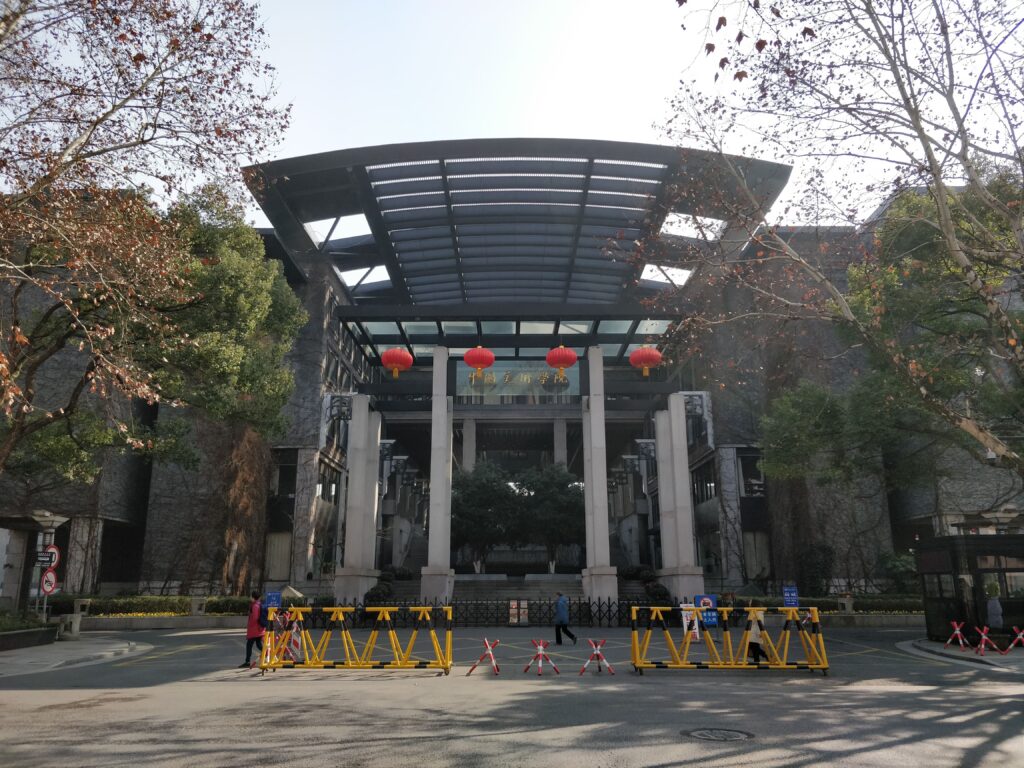
The China Academy of Art has trained painters, sculptors and designers since 1928. Its Nanshan campus, completed in 2003, holds the studios and museums of the country's first national art academy, beside West Lake.
At a glance
The China Academy of Art is a public university of art and design in Hangzhou, Zhejiang. It descends from the National Academy of Art, founded on the shore of West Lake in 1928 by Cai Yuanpei. The Nanshan campus, the academy's city site, was completed in 2003 at 218 Nanshan Road. The school runs five campuses in Hangzhou and Shanghai, and painting, calligraphy, design, film, architecture and art history sit inside one institution.
Key facts
- Founded in 1928 as the National Academy of Art
- Nanshan campus completed in 2003
- Five campuses in Hangzhou and Shanghai
- More than 10,000 students and about a thousand staff
- Art museum, folk art museum and international design museum
- Double First-Class status in two consecutive rounds
History
Cai Yuanpei, then head of the national university council, chose a site beside West Lake in 1928 for the National Academy of Art. The new school opened with four departments: Chinese painting, Western painting, sculpture and design. Its founding idea was aesthetic education in place of religion. The name changed with the century, from National Academy of Art to Hangzhou National College of Art, then Zhejiang Academy of Fine Arts, and finally China Academy of Art. War pushed the school west to Jiangxi, Hunan, Yunnan and Chongqing. The teachers moved with it.
Two teaching lines ran through the school. Lin Fengmian, the first president, argued for a fusion of Chinese and Western painting. Pan Tianshou, who followed, pushed tradition towards renewal. Their students and colleagues included Huang Binhong, Liu Kaiqu, Wu Guanzhong, Zao Wou-Ki and Chu Teh-Chun. The academy names those two currents as its most important tradition. It has kept both alive rather than choosing between them.
The Nanshan campus gave the academy a modern site in the city. Xiangshan followed in 2007 and Liangzhu in 2021, and the five campuses now cover 1,245 mu across Hangzhou and Shanghai. The school is jointly run by the Zhejiang provincial government, the Ministry of Education and the Ministry of Culture and Tourism. It holds Double First-Class status in two consecutive rounds, and its fine art and design disciplines were both rated A+ in the fifth national assessment.
What you see
The campus opens off Nanshan Road through a covered gateway of brick piers and a steel roof. Behind it stand teaching buildings, studios and exhibition rooms, with trees and courtyards between them. The academy runs an art museum, a folk art museum and an international design museum. Those exhibitions are what a visitor can see. The studios stay what they are, working rooms for students.
Nanshan Road is itself part of the visit. West Lake lies a short walk to the west. The lakefront, the tea houses and the wooded hills above the road fill the rest of a morning. The academy's main gate faces that traffic, and the museum entrances are usually reached from the road.
Practical information
- Address: 218 Nanshan Road, Shangcheng District, Hangzhou 310002, Zhejiang.
- Telephone: +86 571 87164609, the academy office number.
- Status: a working university; studios and teaching floors are not public space.
- Opening times: exhibitions change, so check the museum programme before travelling.
Getting there
The campus stands on Nanshan Road, on the eastern side of West Lake in central Hangzhou. City buses run along the road, and the lakefront is a short walk away.
Nearby
- West Lake
- Leifeng Pagoda
- Wu Hill (Wushan)
- Hefang Street (Qinghefang)
Sources
Find it on the map
See this place and what’s around it →📷 Become a Cultural Heritage Online photographer
Share your photos of places: they stay published under your name as the author. The more they're seen, the more you get noticed — and soon a contest will reward the most appreciated photos.
Log in or sign up free to add a photoIs this page about you?
This page is read by travellers and heritage enthusiasts who find it on Google. Tell us how you are connected to this place and we will take it from there.
This entry stays online and free either way — and a free account lets you add to it yourself.