

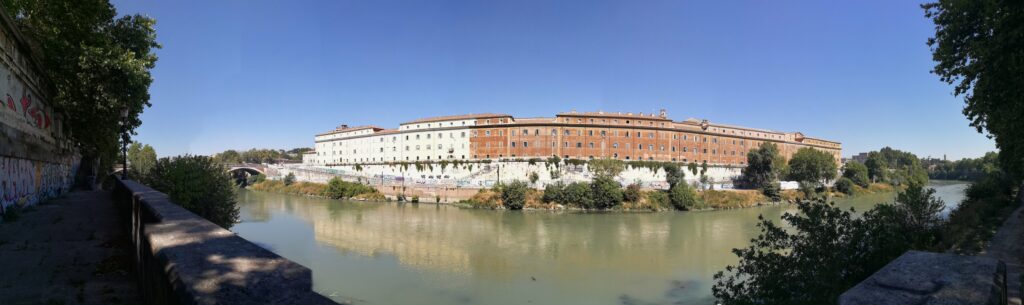
A pope put orphans and poor old men in a building on the river, and gave them work to do inside it. Three centuries later the Italian state put its central institutes for restoration, cataloguing and the fine arts in the same rooms.
At a glance
The Complesso Monumentale di San Michele a Ripa Grande stretches along the right bank of the Tiber in Trastevere, near Porta Portese, with a front of about three hundred and fifty metres. Its first nucleus was built between 1686 and 1689 to designs by Carlo Fontana and Mattia de’ Rossi under Innocent XI Odescalchi, and it grew for more than a century: Nicola Michetti gave it the modular front on the Lungotevere, Ferdinando Fuga added the women’s prison in 1734, and the Conservatorio delle Zitelle was added from 1790 under Pius VI. Today it houses directorates of the Italian Ministry of Culture, the Istituto Centrale per il Restauro and the Istituto Centrale per il Catalogo e la Documentazione.
Key facts
- First nucleus: built between 1686 and 1689
- Architects: Carlo Fontana and Mattia de’ Rossi
- Pope: Innocent XI Odescalchi
- Earlier institution: the Conservatorio dei Ragazzi, created in 1673 and moved to Ripa Grande
- Reform: in 1693 Innocent XII gathered Rome’s public assistance into a single institution and a single place
- Eighteenth century: the Carcere Femminile by Ferdinando Fuga, 1734; the Conservatorio delle Zitelle from 1790
- Acquired by the Italian state: August 1969
- Today: Ministry of Culture directorates, the ICR and the ICCD
- GPS: 41.8852, 12.4750 · Open in Google Maps
History
The complex began as an answer to a problem of poverty, not of architecture. One of the institutions that came together here was the Conservatorio dei Ragazzi, created in 1673 for orphaned and destitute boys, which was moved to Ripa Grande, where the first part of the hospice began to rise in 1686. In 1693 Innocent XII decided to reorganise the public assistance of Rome, gathering orphans in one institution and one place and planning to concentrate there the other categories of the poor who were then at Ponte Sisto and the Palazzo Lateranense.
What makes the building unusual is that charity came with work. Beside the original function of shelter and correction, the complex took on an educational one: the boys were trained in trades, and the hospice held a wool works, a tapestry workshop and a printing press. The great hanging hall, the Sala dello Stenditoio, existed so that tapestries could dry in the shade.
The eighteenth century kept adding to it. In 1734 Clemente XII gave Ferdinando Fuga the building of the women’s prison, on the side facing Piazza di Porta Portese, linked to the Ospizio dei Fanciulli by the Caserma dei Doganieri, a lower block used for warehouses and customs barracks. Under Pius VI, from 1790, the Conservatorio delle Zitelle closed the whole composition at its eastern end.
What you see
A long, even front along the Tiber, four storeys high towards the river, with lower wings behind it around a series of courtyards: the courtyard of the women, the courtyard of the customs, of the marbles, of the arts, of the carts. The building is not a single monument but a small city of institutions, and it still works that way.
From prison to institute
In the war and after it, the buildings were occupied by soldiers and by people made homeless, and they declined until roofs and systems collapsed. The Italian state acquired the complex in August 1969 and destined it for the Direzione Centrale Antichità e Belle Arti of the Ministry of Public Education. In 1972 the juvenile prison was closed and moved to Casal del Marmo; in 1981 the Sala dello Stenditoio opened as a conference hall; in 1983 the central office for environmental, archaeological, architectural and artistic heritage moved into San Michele.
The most recent work has been on what is inside rather than on the walls: between 2022 and 2023 the Directorate General for Archaeology, Fine Arts and Landscape ran a programme for the structural safety of the decorative apparatus, including the painted vault of the crypt beneath the Chiesa Grande.
Practical information
- Address: Via di San Michele 22–25, 00153 Rome, in Trastevere
- Status: working seat of the Ministry of Culture, the ICR and the ICCD; not a museum with regular opening hours
- Access: the courtyards and the institutions inside are reached through the offices that occupy them
Getting there
The complex is in Trastevere, on the Tiber side of the Janiculum, between Viale Trastevere and the river. It is a short walk from Porta Portese and from the tram stops along Viale Trastevere.
Nearby
- Museo Naval — down the Lungotevere, towards the centre
Sources & resources
- Ministero della Cultura, Direzione Generale Creatività Contemporanea, Complesso Monumentale di San Michele a Ripa Grande — the first nucleus of 1686–1689, Fontana and de’ Rossi, Innocent XI, the Conservatorio dei Ragazzi, the reform of 1693, Fuga and the Carcere Femminile, the acquisition of 1969, the occupation and the works of 1972–1983
- Istituto Centrale per il Catalogo e la Documentazione, La sede — the front of about 350 metres on the Tiber, Michetti, the courtyards, and the Conservatorio delle Zitelle from 1790
- Ministero della Cultura, Direzione Generale Archeologia Belle Arti e Paesaggio, Apparati e stucchi — the works on the decorative apparatus in 2022 and 2023
- Istituto Centrale per il Restauro, Il carcere di Carlo Fontana — the workshops of the hospice: wool, tapestry and printing
Find it on the map
See this place and what’s around it →📷 Become a Cultural Heritage Online photographer
Share your photos of places: they stay published under your name as the author. The more they're seen, the more you get noticed — and soon a contest will reward the most appreciated photos.
Log in or sign up free to add a photoIs this page about you?
This page is read by travellers and heritage enthusiasts who find it on Google. Tell us how you are connected to this place and we will take it from there.
This entry stays online and free either way — and a free account lets you add to it yourself.