

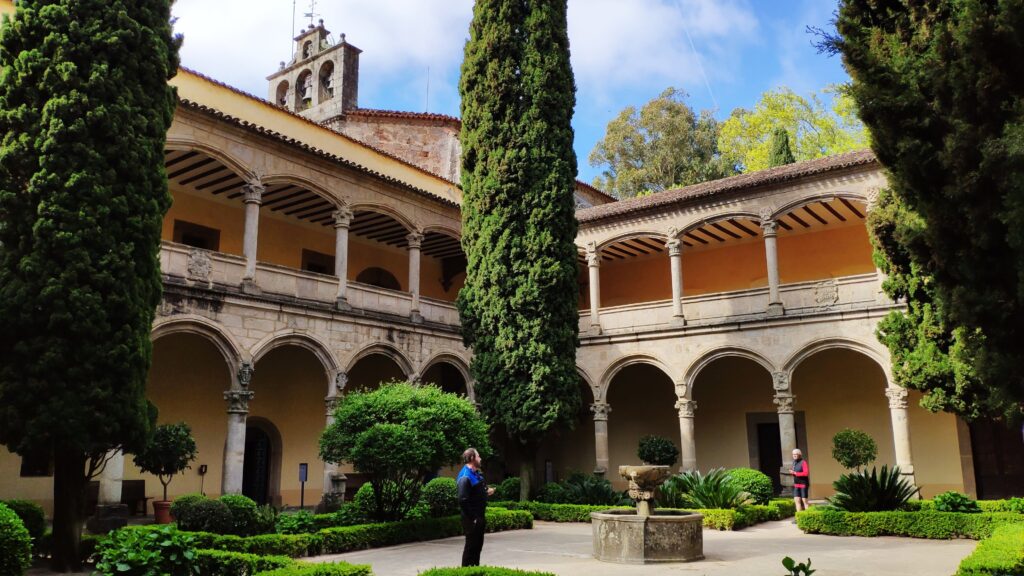
The Monastery of Yuste, in Cuacos de Yuste in the province of Cáceres, is the Hieronymite house where Charles V retired after giving up his crowns and where he died in 1558; it is a royal site of Patrimonio Nacional.
At a glance
The monastery stands at Cuacos de Yuste, in the province of Cáceres, in La Vera, Extremadura. The first cell of the present building dates from 1402. Charles V retired here after abdicating and died in the house on 21 September 1558. The monastery joined Patrimonio Nacional in 2004. It has been an Asset of Cultural Interest since 1931 and European Heritage since 2007. A renovation of 2.5 million euros began in July 2025. The monument stayed open.
Key facts
- First cell of 1402, between the Gilona and Vercelejo streams
- Charles V born in Ghent on 24 February 1500
- Moved in on 3 February 1557; died there on 21 September 1558
- Burnt by Napoleonic troops from 1809
- Monks expelled by the Desamortización in 1835
- Jeronymite monks back in 1958, after the restoration by González-Valcárcel
- Patrimonio Nacional since 2004; European Heritage since 2007
- 2.5 million euros of works from NextGenerationEU, begun July 2025
History
The origins lie at the ermita de San Salvador de la Sierra, between Cuacos and Garganta la Olla. The first cell of the building that stands today dates from 1402. That year the owner of the land between the Gilona and Vercelejo streams ceded it so that the hermits of the poor life could raise a convent.
Charles V was born in Ghent on 24 February 1500. After abdicating he chose Yuste for his retirement. Beside the monastery he had a house-palace built, hung with tapestries and paintings by Titian. He moved in on 3 February 1557 and died there on 21 September 1558. His son Philip II ordered his remains taken to El Escorial.
In 1809 Napoleonic troops burnt the monastery. In 1835 the Desamortización expelled the Jeronymite monks. The house lay in ruin. The restoration by González-Valcárcel brought the monks back in 1958. It was declared an Asset of Cultural Interest in 1931, entered Patrimonio Nacional in 2004 and became European Heritage in 2007. It is still a place of worship. Monks of the Polish order of Saint Paul the First Hermit serve it.
The works began in July 2025 with NextGenerationEU money and were due to end in the summer of 2026. The north range of the Renaissance cloister has a new roof. Inside, stairs and finishes are being reworked to move the seat of the Fundación Academia Europea e Iberoamericana de Yuste. That frees the ground floor of the palace for a longer visit. The old infirmary becomes the library, with 22 choir books of the 16th to 18th centuries.
What you see
The visit includes the house-palace Charles V built beside the monastic rooms, hung with tapestries and paintings by Titian. The infirmary holds the library and its 22 choir books.
The usual route has not been altered, and the monument has stayed open throughout. Next comes a visitor reception centre on the ground floor of the Palacio de Carlos V.
Practical information
- Monasterio de San Jerónimo de Yuste, 10430 Cuacos de Yuste, Cáceres
- Royal site of Patrimonio Nacional
- Open to the public throughout the works
- Library in the former infirmary, 22 choir books
- Renovation: 2.5 million euros, begun July 2025
- European Heritage since 2007
Getting there
The monastery is at Cuacos de Yuste, in the province of Cáceres, in La Vera, Extremadura. Its postal address is 10430 Cuacos de Yuste, Cáceres.
Nearby
- Cuacos de Yuste
- Garganta la Olla
- The ermita de San Salvador de la Sierra, between the two villages
Sources
- Europa Press, on the works and the library: europapress.es
- Fundación Yuste, history: fundacionyuste.org
- Fundación Yuste (English): fundacionyuste.org/en
- Junta de Extremadura, on the label and the monks: juntaex.es
- Hoy, on 1809 and the monks: hoy.es
- Cronistas Oficiales de España: cronistasoficiales.com
Find it on the map
See this place and what’s around it →📷 Become a Cultural Heritage Online photographer
Share your photos of places: they stay published under your name as the author. The more they're seen, the more you get noticed — and soon a contest will reward the most appreciated photos.
Log in or sign up free to add a photo