

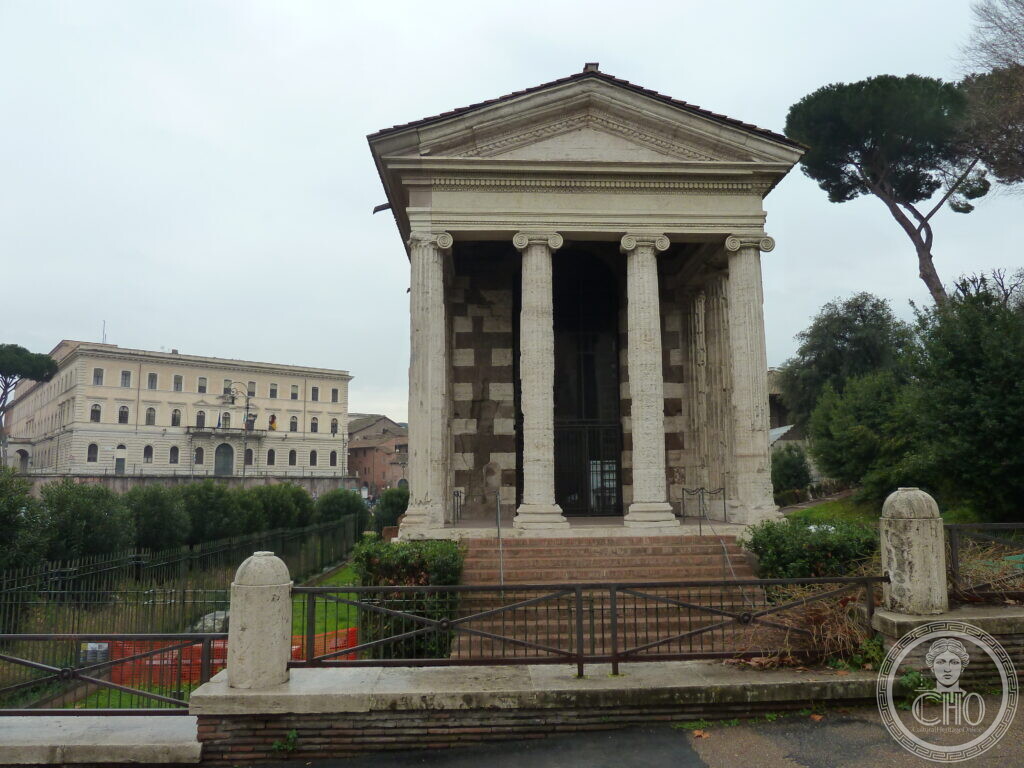
A small rectangular Roman temple in the Forum Boarium, dedicated to Portunus, god of river ports, and one of the best-preserved buildings of ancient Rome.
At a glance
It stands in Piazza della Bocca della Verità, beside the ancient Portus Tiberinus on the Tiber. The temple is of Ionic order, with a tetrastyle porch and engaged columns around the cella, and is documented as dating in its first phase to the 4th or 3rd century BCE.
Key facts
- Where: Piazza della Bocca della Verità, Rome
- What: Monument
- When: 4th or 3rd century BCE, with the current building dated between 80 and 70 BCE
- GPS: 41.8892, 12.4809 · Open in Google Maps
History
The temple was dedicated to Portunus, the Roman god of river ports, and stood in the Forum Boarium, the ancient cattle market, near the Portus Tiberinus. According to the Soprintendenza Speciale di Roma, the earliest temple on the site is datable between the end of the 4th and the beginning of the 3rd century BCE, and the present building dates to the period between 80 and 70 BCE. A restoration after 70 BCE is also recorded by the Ministero della Cultura.
In the 9th century the structure was converted into a Christian church, first known as Santa Maria de Gradellis or de Secundicerio and later as Santa Maria Egiziaca. It kept that dedication until 1916, when the church was deconsecrated and the ancient temple restored. During the restoration, a cycle of early medieval frescoes was uncovered, and it is described by the Ministero della Cultura as a unique testimony of its kind, made more legible by a recent restoration.
What you see
The photograph shows the temple from outside a fenced area, with a multi-storey building and a tall pine tree behind it. The building rises on a high podium faced with travertine slabs and has four Ionic columns on the front. The columns of the pronaos and the corner columns of the cella are in travertine, while the other engaged columns are in Aniene tufa, with plaster originally imitating marble.
Do you know more about this place?
If you know a date, a name, a document, a plaque or a photograph that tells its story, write to Sofia through the contact page. What arrives with a source goes into this page, with your name as the contributor.
Nearby
- Boarium Forum – Virtual Tour 360° — the ancient cattle market where the temple stands
- Temple of Hercules Victor – Virtual Tour 360° — the nearby round temple, the first marble temple in Rome
- The Mouth of Truth – Virtual Tour 360° — in the portico of Santa Maria in Cosmedin, a short walk away
- The Palatine and the Roman Forum — the Heart of Ancient Rome — the political and religious centre of ancient Rome
Sources
- Turismo Roma, Tempio di Portuno: identification, location, dating, materials and later church history
- Ministero della Cultura, Tempio di Portunus al Foro Boario: dating, restoration after 70 BCE, church conversion and fresco cycle
- Soprintendenza Speciale Archeologia Belle Arti e Paesaggio di Roma, Tempio di Portunus: building phases, materials and the restoration directed by Antonio Munoz
- Romano Impero, Tempio di Portuno o Fortuna Virile: architectural description and identification history
- Stefano Vigolo, photographs and notes to the editorial staff (2026): identification of the subject. Not a published source
Find it on the map
See this place and what’s around it →📷 Become a Cultural Heritage Online photographer
Share your photos of places: they stay published under your name as the author. The more they're seen, the more you get noticed — and soon a contest will reward the most appreciated photos.
Log in or sign up free to add a photoIs this page about you?
This page is read by travellers and heritage enthusiasts who find it on Google. Tell us how you are connected to this place and we will take it from there.
This entry stays online and free either way — and a free account lets you add to it yourself.