

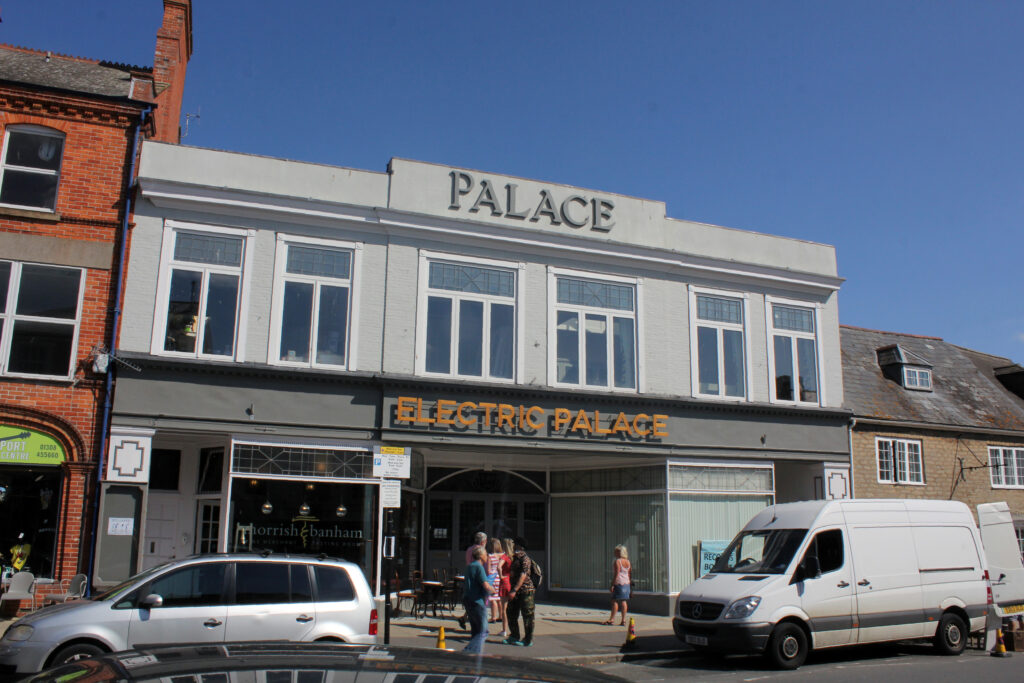
A brewing family built this cinema and opera house in Bridport in 1926, and a hundred years later almost everything they put inside it is still there. The list entry calls the Electric Palace a rare and remarkably little altered example of a 1920s cinema, with a unique collection of contemporary murals in the foyer.
At a glance
The building at 35 South Street is listed Grade II as “Palace Cinema and flanking shops” and stands inside the Bridport Conservation Area. It was put up in 1926 for the Palmer brewing family as a cinema and an opera house at the same time, with a pair of shops across its street front. It has been working almost continuously since, and today presents film, theatre, music and comedy; the auditorium seats 410, or 480 standing.
History
The reason the building exists is unusual enough to be worth stating plainly: the list entry records that it was erected for dual use as a cinema and opera house for the Palmer brewing family, who wanted to bring opera to Dorset. The brewers J C and R H Palmer were not building a picture house that happened to have a stage. They were building both.
The other half of the ambition is in the name. The theatre generated its own electricity in an engine room at the rear, at a time when mains power was not something a Dorset town could assume, and that is what let Bridport see the new age of cinema at all. It opened on 14 June 1926 to a packed audience of over 500 people, and was named The New Electric Palace.
What you see
A steel frame clad in brick, on a site hemmed in on every side. The street range is two storeys and six bays, the central two bays stepping forward slightly under a raised parapet above the entrance passage, with a continuous cornice band and casement windows on the first floor. The two shops have angled fronts, towards the street and towards the passage, and they keep their original leaded upper glazing and their corner columns on a deep plinth.
You reach the cinema down the passage between the shops, under a segmental arch, on terrazzo flooring that spells out the words ‘PASSAGE ENTRANCE’ with an arrow, still with the queueing rails and gates at the far end. The passage opens into a forecourt under a glazed canopy, where four pairs of doors sit between square columns under a dentil moulded cornice — and beside them an external paybox, which the list entry notes as an unusual feature in Britain.
Inside, the foyer has a terrazzo floor and a staircase with a lincrusta balustrade and timber handrail rising to the balcony, with the original hanging lights. The auditorium has a barrel-vaulted roof and a giant pilaster order along the side walls, an urn moulding in the tympanum over the stage end, and a balcony with two boxes at the rear and moulded swag decoration along its front. The projection equipment is, unusually, in a box under the balcony rather than above it. The stage has full facilities, with dressing rooms, curtains and a clock, and the front rows of seating are little altered.
The murals, and a name spelt two ways
The foyer murals are the reason the building is on the list in the form it is. The list entry describes them as a collection of 1930s murals by George Byles, a pub sign painter for Palmers, and calls them a unique surviving example of a semi-vernacular kind of decoration once common in semi-public buildings of the period — that is, work done by a craftsman who painted signs for a living, not by a decorative artist. The theatre’s own account dates them to 1936 and spells the painter George Biles, the local brewery sign writer, and says they run through the foyer, the stairs and the landing. The two sources agree on who he was and disagree on his surname by one letter; we have left both spellings here rather than choose for the reader.
There was mural decoration in the auditorium too. It has been painted over.
Practical information
- Electric Palace, 35 South Street, Bridport, Dorset DT6 3NY, United Kingdom
- Ticket booking line 01308 424901; theatre office 01308 426336
- Programme and tickets: electricpalace.org.uk
- Grade II listed, list entry 1386804; Dorset Historic Environment Record MDO19931; within the Bridport Conservation Area
Where it stands now
In 2026, its centenary year, the Electric Palace was offered for sale in May together with the shops and two apartments. The apartments have been sold. In November 2026 Bridport Town Council bought the two retail units at the entrance, to protect the South Street frontage and to give continuity to the businesses in them, and with them the responsibility for the front section of the building and the accessway to the venue. The council’s purchase does not include the theatre itself, which remains on the market; the council has said it supports discussions about whether a community-led vehicle could secure the building’s future. The theatre has been owned for the past twelve years by Alasdair Warren.
Sources
- Statutory list entry, “Number 35, Palace Cinema and flanking shops”, Bridport, Grade II, list entry 1386804 (reference 1/10006), full text: britishlistedbuildings.co.uk
- Dorset Council, Dorset Historic Environment Record, listed building record MDO19931, “Palace Cinema, 35 South Street, Bridport”: heritage.dorsetcouncil.gov.uk
- Electric Palace, “About”: electricpalace.org.uk
- Ros Tappenden, “Council buys theatre shop units to preserve façade”, BBC News, 12 November 2026 (read in the syndicated copy): yahoo.com
- Wikidata, Palace Cinema, Bridport (Q26666487), for the coordinates: wikidata.org
Find it on the map
See this place and what’s around it →📷 Become a Cultural Heritage Online photographer
Share your photos of places: they stay published under your name as the author. The more they're seen, the more you get noticed — and soon a contest will reward the most appreciated photos.
Log in or sign up free to add a photo