

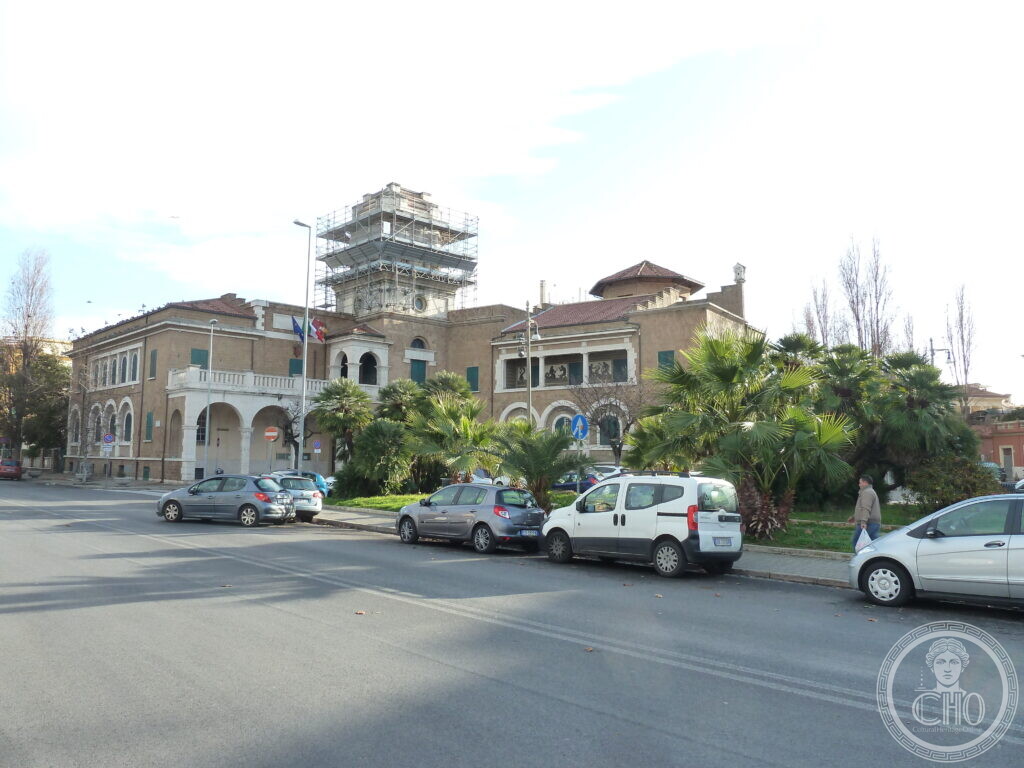
The monumental seat of the original municipal delegation for the new seaside district of Ostia, built in the 1920s to designs by Vincenzo Fasolo and still in civic use today.
At a glance
The building stands on Piazza della Stazione Vecchia in Lido di Ostia, the coastal district of Rome. It was designed as a public office block for the Governorate and has retained a civic function ever since.
Key facts
- Where: Piazza della Stazione Vecchia, 19, Roma
- What: Palace
- When: 1924–1928
- GPS: 41.7309, 12.2799 · Open in Google Maps
History
The Palace of the Governorate was built between 1924 and 1928 to a design by the architect Vincenzo Fasolo. Its foundation stone was laid on 10 August 1924, the same day on which the Rome–Lido railway was inaugurated, in the presence of Cardinal Vincenzo Vannutelli, Bishop of Ostia, and with the signature of the head of government, Benito Mussolini. In its early years it housed the municipal delegation and other public services. After the Second World War the first-aid room served as Ostia’s only emergency medical post until the early 1980s. A major restoration of the tower and friezes was inaugurated on 21 April 2026.
What you see
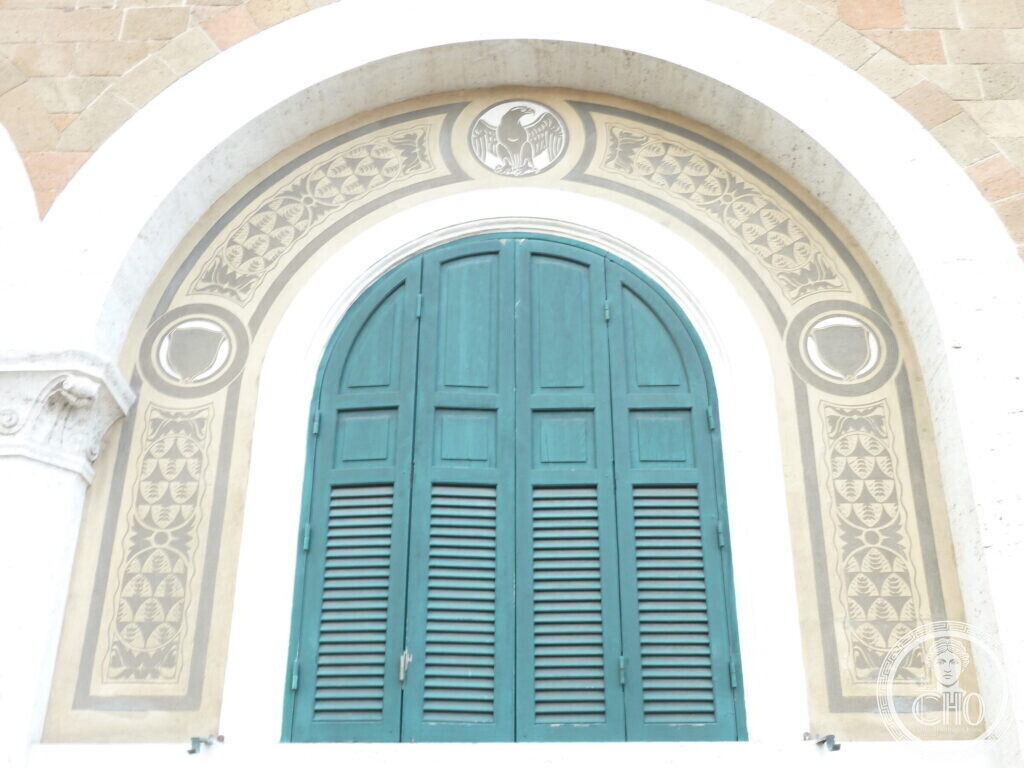
The photographs show the exterior of the palace as it appeared in 2010, according to Stefano Vigolo, with the main tower under scaffolding. The building combines travertine from Tivoli and golden tufa from the Roman countryside in a monumental classical style. A close view of a teal arched door shows louvered shutters framed by painted decorative bands and an eagle medallion above. A painted frieze with repeating leaf motifs and a central medallion depicting a figure in a boat runs above rough stone masonry. The fourth photograph records a brick block with a clock tower and green shutters, signed “Circoscrizione Militare”, which may or may not belong to the Governorate complex.
Do you know more about this place?
If you know a date, a name, a document, a plaque or a photograph that tells its story, write to Sofia through the contact page. What arrives with a source goes into this page, with your name as the contributor.
Nearby
- Town Hall of Ostia — a short walk away
- Church of Santa Maria Regina Pacis — part of the same civic centre plan
Gallery


Sources
- FAI, PALAZZO DEL GOVERNATORATO | Luogo FAI: construction date, architect, materials, and original uses
- Roma Capitale, Roma Capitale | Sito Istituzionale | Ostia, il Palazzo del Governatorato torna a splendere: inauguration of restoration and relation to the railway station
- RomaToday, Ostia, terminato il restauro nel Palazzo del Governatorato: era partito 12 anni fa: restoration completion date and recent condition of the tower
- Stefano Vigolo, photographs and notes to the editorial staff (2026): identification of the subject and coordinates. Not a published source
Find it on the map
See this place and what’s around it →
Advertisement. Pictured, from the Cleveland Museum of Art (CC0) and not for sale: a parure of about 1850, a Lalique brooch, a Castellani bangle. How we handle this
📷 Become a Cultural Heritage Online photographer
Share your photos of places: they stay published under your name as the author. The more they're seen, the more you get noticed — and soon a contest will reward the most appreciated photos.
Log in or sign up free to add a photoIs this page about you?
This page is read by travellers and heritage enthusiasts who find it on Google. Tell us how you are connected to this place and we will take it from there.