

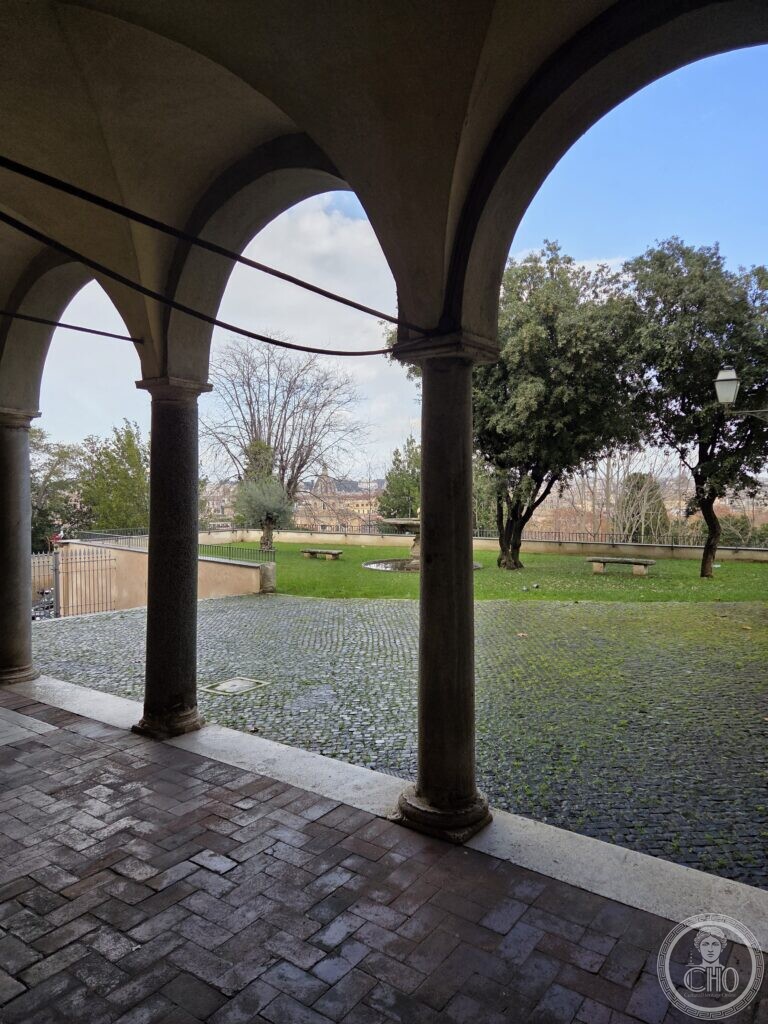
A fifteenth-century church and convent on the Janiculum Hill in Rome, known for its Renaissance portico, cloister frescoes and the rooms where the poet Torquato Tasso died in 1595.
At a glance
The complex stands at the top of the Salita di Sant’Onofrio, a steep lane opened in 1446 to give the faithful easier access. It grew from a hermitage founded by Nicola da Forca Palena, and its current form reflects building campaigns that continued into the late sixteenth century. The church is preceded by a grassed forecourt enclosed on two sides by a Renaissance portico, with a fountain at its centre.
Key facts
- Where: Piazza di Sant’Onofrio, 2, Roma
- What: Church
- When: Founded 1439 (church construction begun on the site of an earlier hermitage)
- GPS: 41.8972, 12.4612 · Open in Google Maps
History
The origins of Sant’Onofrio lie in a hermitage founded on the Janiculum by Nicola da Forca Palena, who had come to Rome on pilgrimage and wished to withdraw to a monastic life. He acquired land with donations from the faithful and established a romitorio dedicated to Saint Onuphrius, a fourth-century hermit and anchorite. Construction of the church began in 1439, and the complex was later expanded during the sixteenth century. In 1446 the Salita di Sant’Onofrio was opened to allow worshippers an easier approach; Sixtus V improved the road in 1588, and Clement VIII had it paved in 1600.
Pope Leo X elevated the church to a cardinal’s title in 1517, and in 1588 Sixtus V made it a presbyteral title. The church and convent are now in the care of the Franciscan Friars of the Atonement, who received custody of the complex from Pius XII with the Motu Proprio of 15 August 1945.
What you see
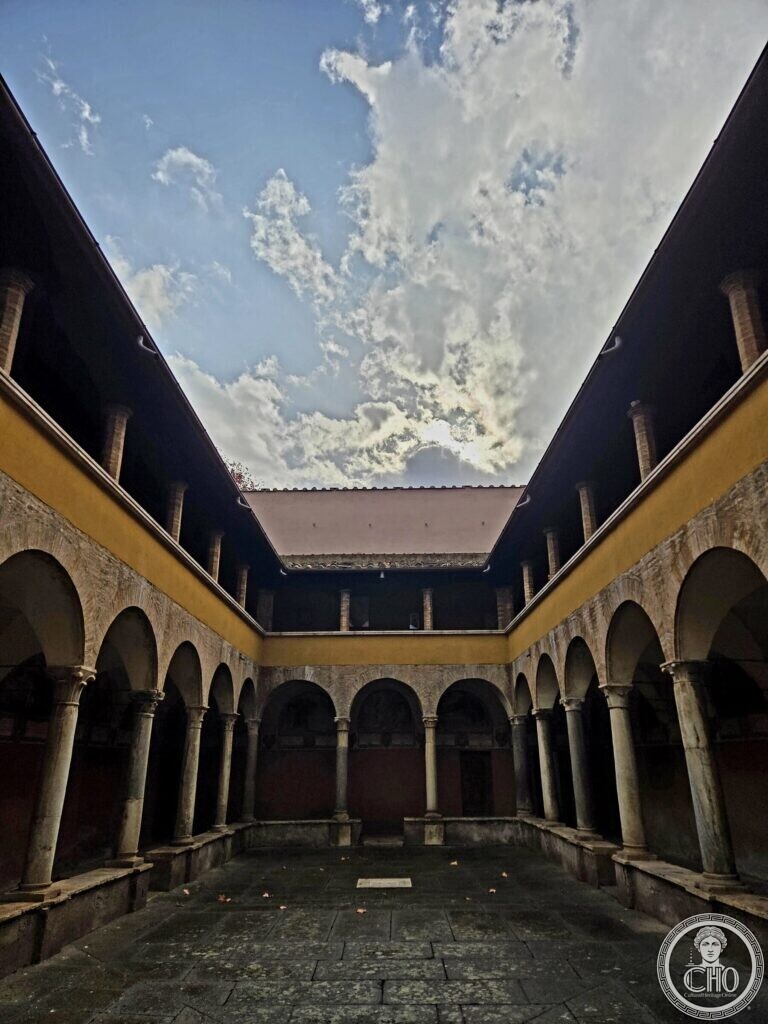
The church is preceded by a grassed sagrato closed on two sides by a Renaissance portico, whose lunettes were frescoed by Domenichino at the beginning of the 1600s. To the right stands the seventeenth-century Cappella della Madonna del Rosario, built for the Vaini family; its Baroque façade carries frescoes of the Sibyls attributed either to Agostino Tassi or to Giovanni Baglione. The portico leads to a rectangular cloister on two orders: the lower level has seven round-headed arches on the long sides and three on the short sides, resting on columns with leaf capitals, while the upper loggia is supported by octagonal brick pillars. Around 1600 the cloister lunettes were painted with stories from the life of Saint Onuphrius by the Cavalier d’Arpino, Sebastiano Strada and Claudio Ridolfi.
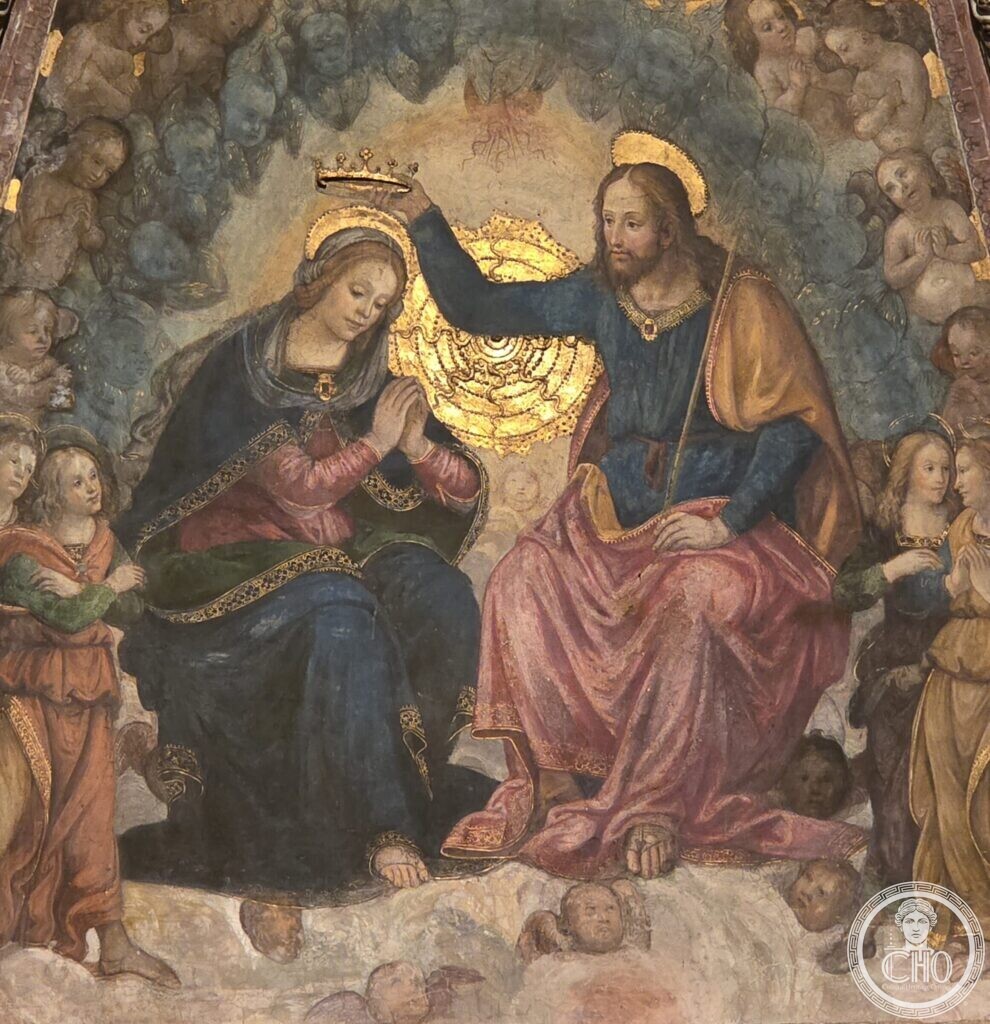
Inside, the church has a single nave with a cross-vaulted ceiling and five lateral chapels, ending in a polygonal apse. The apse frescoes, executed in the first half of the sixteenth century, include the Coronation of the Virgin by Pinturicchio in the upper part, and the Adoration of the Magi and the Flight into Egypt by Baldassarre Peruzzi below. The chapel dedicated to the Madonna of Loreto preserves an altarpiece attributed to Annibale Carracci. Near the entrance is the tomb slab of Nicola da Forca Palena, carved by an anonymous Tuscan artist.
The rooms where Torquato Tasso spent his last months are attached to the convent, and house a small museum with manuscripts, early editions of his works and his funerary mask. The poet died here on 25 April 1595.
Do you know more about this place?
If you know a date, a name, a document, a plaque or a photograph that tells its story, write to Sofia through the contact page. What arrives with a source goes into this page, with your name as the contributor.
Nearby
- Institute of the Sisters of Saint Dorothea in Rome — a short walk away, in Trastevere
Gallery
Sources
- Walks in Rome, The Church of Sant’ Onofrio al Gianicolo in Rome: dates of construction, role of Nicola da Forca Palena, portico, Tasso’s death
- Turismo Roma, Chiesa di Sant’Onofrio al Gianicolo: address, hermitage, opening of the Salita, apse frescoes, Carracci altarpiece, Tasso museum
- Frati Francescani dell’Atonement, Chiesa Sant’Onofrio Roma: XV-century complex, custody from Pius XII in 1945, Peruzzi apse
- Roma Segreta, S.Onofrio: cloister structure, Vaini chapel, Tasso monument and museum
- Ordine Equestre del Santo Sepolcro, La Chiesa di Sant’Onofrio al Gianicolo: founding hermitage, road paving, church interior
- OpenStreetMap, Chiesa di Sant’Onofrio al Gianicolo: coordinates and address
- RAOUL BENDINELLI, photographs and notes to the editorial staff (2026): identification of the subject, photograph captions. Not a published source
Find it on the map
See this place and what’s around it →📷 Become a Cultural Heritage Online photographer
Share your photos of places: they stay published under your name as the author. The more they're seen, the more you get noticed — and soon a contest will reward the most appreciated photos.
Log in or sign up free to add a photo