

Curated Itinerary
Walking Tour in Viareggio
Five Liberty buildings within a kilometre of each other, from the 1899 Negozio Martini to the Grand Hotel Royal of 1925, on foot along the Viareggio seafront.
Take this route into Google Maps
From Negozio Martini — 1899 Liberty Shopfront in Viareggio to Grand Hotel Royal — Belluomini’s Twin-Towered Liberty Hotel in Viareggio (1925), in the order we curated them.
➤ Turn on the navigator in Google MapsIt opens in the Google Maps app with every stop already loaded, in the order we put them in. From there the route is yours: pick how you travel — on foot, by bike, by public transport or by car — change where you start and where you end, drag the stops into a different order, and add places of your own along the way.
Viareggio is not the obvious place for a Liberty walk: no palaces, no grand set pieces. What it has is five buildings strung along the seafront within about a kilometre of each other, and they are there because the town burned. In 1917 a fire took the wooden promenade, the line of bath-houses, cafés and shops that had grown along the beach. Viareggio rebuilt it in masonry, and a government commission that included Alfredo Belluomini, Ugo Giusti and the painter Galileo Chini set the style of the new seafront. These five buildings are what that decision produced.
What you see
Start at the Negozio Martini on Viale Regina Margherita, beside the Gran Caffè Margherita: the chalet shopfront Modesto Orzali designed in 1899, with ceilings by Tito Chini, from the generation before the fire. Struck by bombing in 1944, it was rebuilt in 1947 in simplified form and is still a shop, five bays of wooden pilasters on a marble base.
A few doors on, the Magazzini Duilio 48 of 1927–1930 is the department store of the reconstruction: pilasters, oval glass signs, curved corner windows and the interlaced 48 still riding above the door. Its designer is not recorded; the language is unmistakable. Then the Bagno Balena, where the 1928 entrance is Belluomini’s masonry under Galileo Chini’s majolica, one of the clearest pieces of the rebuilt seafront.
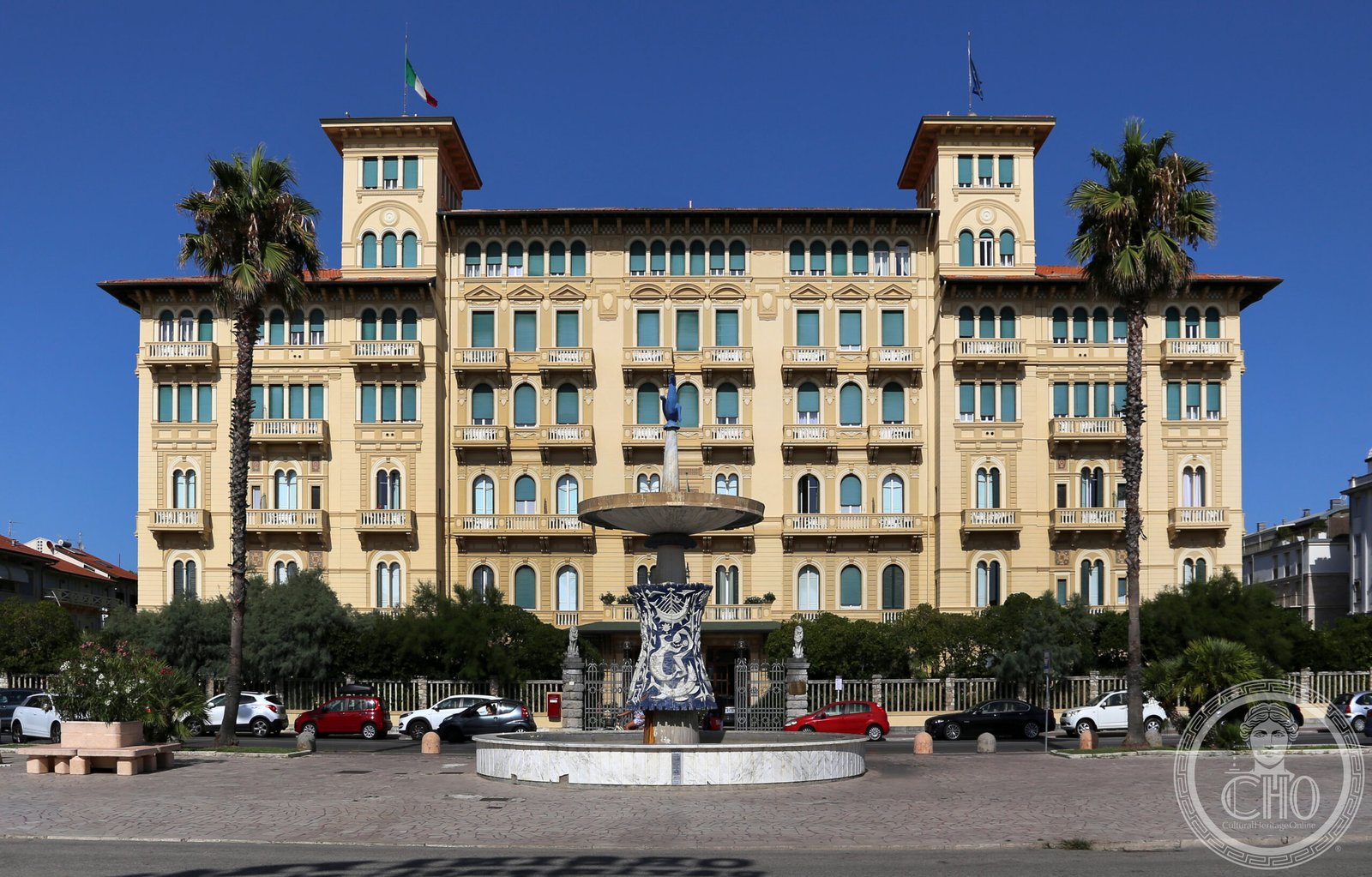
Turn inland for Villa Argentina, an 1868 villa remade in 1926, attributed to Belluomini, with Chini majolica and Giuseppe Biasi’s Persian wedding painted in the ballroom in 1930. It belongs to the Province of Lucca and is open for exhibitions. The walk ends at the Grand Hotel Royal on Viale Carducci: the old Palazzo Nelli, raised by Belluomini in 1925 into a hotel with twin towers and Chini ceramics, looking south down the promenade.
How to do it
On foot, five stops, about two hours including the time to look at the façades. The four stops on the seafront are within 200 metres of each other; the longest leg is 1.2 kilometres, from the Bagno Balena to Villa Argentina, and the walk closes with 900 metres from the villa to the Grand Hotel Royal. Measured on the streets, the whole route is 2.3 kilometres.
Under the map you find the track and the points to download for a phone navigator. The bathing establishments and the shops are open to customers, not for visits; the façades are seen from the street.
When to go
Morning or late afternoon, when the light comes in from the sea and the majolica reads clearly. July and August are the busiest weeks on the beach, and the seafront is crowded; April, May, September and October leave the pavements free and the buildings to yourself.
Read the article
The magazine has a longer piece on this walk, with a photograph of each building and the history behind it: Viareggio, five Liberty buildings on the seafront.
Step by step

Negozio Martini — 1899 Liberty Shopfront in Viareggio
The historic Chalet Martini of 1899 beside the Gran Caffè Margherita: a Liberty shopfront by Modesto Orzali, bombed in 1944 and rebuilt in simplified form in…

Magazzini Duilio 48 — Viareggio’s Liberty Department Store (1927–1930)
The curve-windowed store of 1927–1930, one of the buildings that turned Viareggio's seafront into a Liberty stage set.

Bagno Balena — Chini’s 1928 Liberty Entrance on the Viareggio Seafront
A historic Viareggio bathing establishment whose 1928 entrance — Belluomini's architecture under Galileo Chini's majolica — is a landmark of the Passeggiata.

Villa Argentina — Viareggio’s Liberty Jewel by Galileo Chini
An 1868 villa reborn in 1926 as a Liberty jewel, with Galileo Chini's majolica and Giuseppe Biasi's "Persian Wedding" in the ballroom.

Grand Hotel Royal — Belluomini’s Twin-Towered Liberty Hotel in Viareggio (1925)
Belluomini raised the old Palazzo Nelli into a twin-towered Liberty hotel in 1925, its facade dressed in Galileo Chini's ceramics.
Download for tour navigation
PDF is the stop list with GPS, to print or keep on the phone. GPX for Garmin / Komoot / OsmAnd. KML for Google Earth and Maps.
Walk it with the navigator on
It opens in the Google Maps app with every stop already loaded, in the order we put them in. From there the route is yours: pick how you travel — on foot, by bike, by public transport or by car — change where you start and where you end, drag the stops into a different order, and add places of your own along the way.
To keep the route in the app instead of opening it once, download the KML above and import it into Google My Maps — Create a new map, then Import: the route then sits among your own maps in Google Maps, with the stops and our notes attached to each one.