

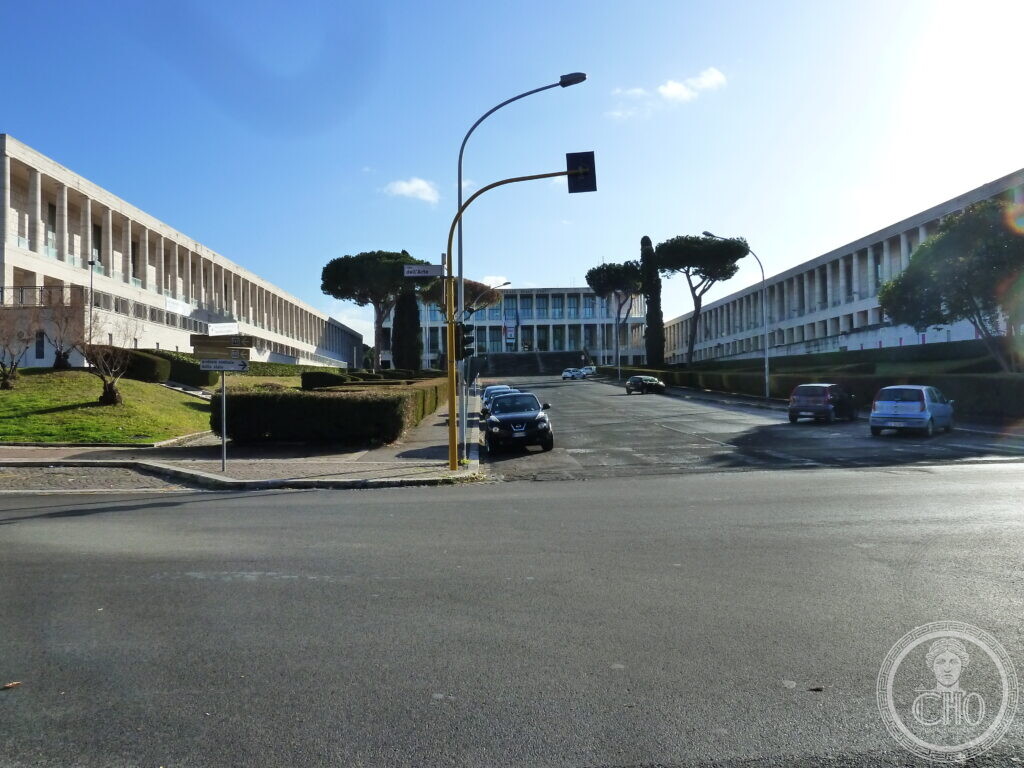
The Central State Archive occupies a monumental complex on Piazzale degli Archivi in Rome’s EUR district, keeping the documentary memory of the Italian unitary state.
At a glance
The archive stands in the EUR quarter of Rome, in the central body and the northern lateral building of a complex facing Piazzale degli Archivi. It is an institute with special autonomy under the Ministry of Culture, linked to the General Directorate for Archives, and preserves around 110 km of records from central state organs, public institutions, and private individuals.
Key facts
- Where: Piazzale degli Archivi, 27, 00144 Roma
- What: Building
- When: 1938 (project date, documented)
- GPS: 41.8289, 12.4764 · Open in Google Maps
History
The origin of the Central State Archive dates back to 1875, when Royal Decree 2552 of 25 May established the Kingdom’s Archives for records from central ministries no longer needed for ordinary business. For a long time the institution shared its headquarters and administration with the State Archive of Rome. Full autonomy came with Law no. 340 of 13 April 1953, which officially renamed it the Central State Archive and placed it under a director with the highest grade in archival administration. In 2008 it acquired scientific, financial, organisational and accounting autonomy under the Ministry of Heritage and Culture. The buildings were designed in 1938 to host the Exhibition of Autarchy, Corporatism and Social Security within the Universal Exposition of 1942. The original project, with all its graphic apparatus, is kept among the documentation of the Ente Autonomo Esposizione Universale di Roma deposited at the institute. Like many other EUR buildings, the complex remained unfinished after the Second World War. It was completed only in the 1950s on the initiative of Virgilio Testa, extraordinary commissioner of the Ente EUR, with modifications to adapt the palace to the needs of the Central State Archive, which found its definitive seat here after its establishment in 1953.
What you see
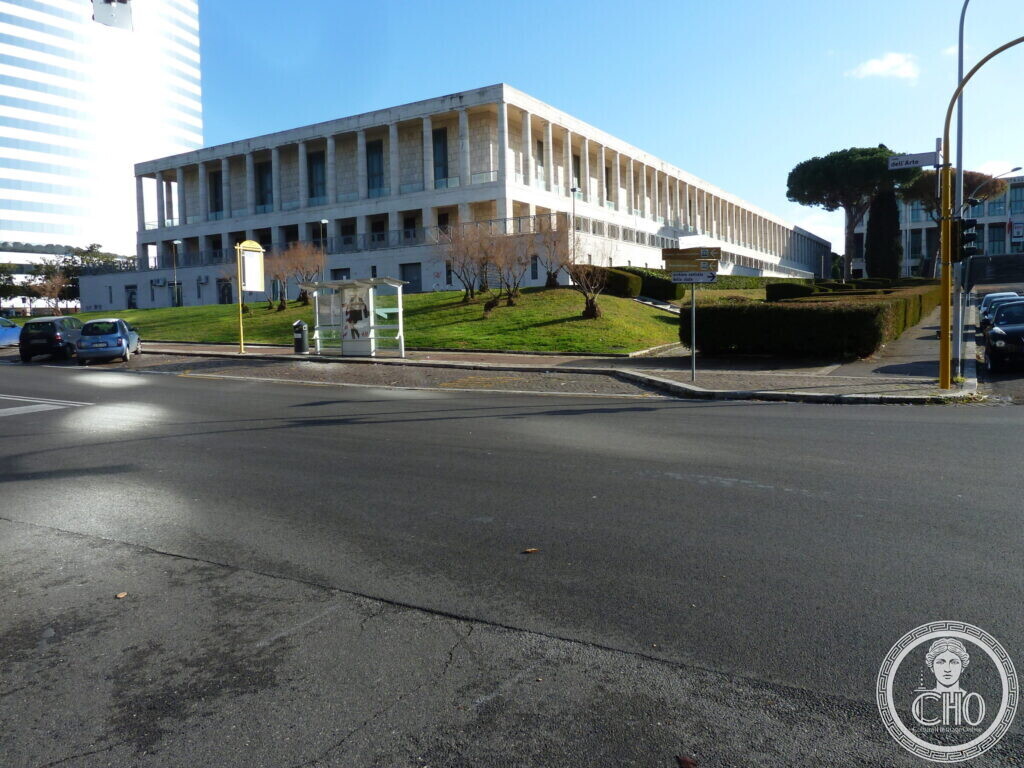
The photographs show a long, low white colonnaded building with a rhythmic sequence of pillars and a flat roof, set behind a wide road intersection and a grassed slope. In the first photograph, the two porticoed wings of the complex border the crossing, with umbrella pines and parked cars in front. The second photograph shows the same colonnade from a greater distance, across a lawn with young trees and a bus shelter bearing the sign “FERMATA”. The third photograph captures the monumental facade in strong backlight beyond a broad pedestrian crossing, with small distant figures. The building’s architectural quality was recognised in 2004, when the regional superintendency for cultural heritage of Lazio placed it under a preservation order.
Do you know more about this place?
If you know a date, a name, a document, a plaque or a photograph that tells its story, write to Sofia at sofia@culturalheritageonline.com or through the contact page. What arrives with a source goes into this page, with your name as the contributor.
Nearby
- Archivio Storico e Museo Birra Peroni — a corporate archive and museum in Rome, similar in archival purpose but different in scale and holdings
Gallery

Sources
- EHRI, EHRI – Archivio Centrale dello Stato: address, contacts, origin in 1875, autonomy in 1953 and 2008, EUR location, 110 km of holdings
- Direzione generale Archivi, Archivio Centrale dello Stato: institutional role, special autonomy under the Ministry of Culture, EUR seat, superintendent Gabriele Capone
- Archivio Centrale dello Stato, Edificio: 1938 project, 1942 exposition, incompletion after the war, completion in the 1950s by Virgilio Testa, 1953 seat, 2004 preservation order
- Visit Italy Maps, Palazzo dell’Archivio dello Stato: Piazzale degli Archivi 27 address, EUR palace as seat of the Central State Archive
- Stefano Vigolo, photographs and notes to the editorial staff (2026): identification of the subject and Google Maps coordinates. Not a published source
Find it on the map
See this place and what’s around it →📷 Become a Cultural Heritage Online photographer
Share your photos of places: they stay published under your name as the author. The more they're seen, the more you get noticed — and soon a contest will reward the most appreciated photos.
Log in or sign up free to add a photoIs this page about you?
This page is read by travellers and heritage enthusiasts who find it on Google. Tell us how you are connected to this place and we will take it from there.