From the 200-word proposal to the permanent URL: the five steps, the checks every article passes, the thirty days it takes, and the seven things we will not publish.
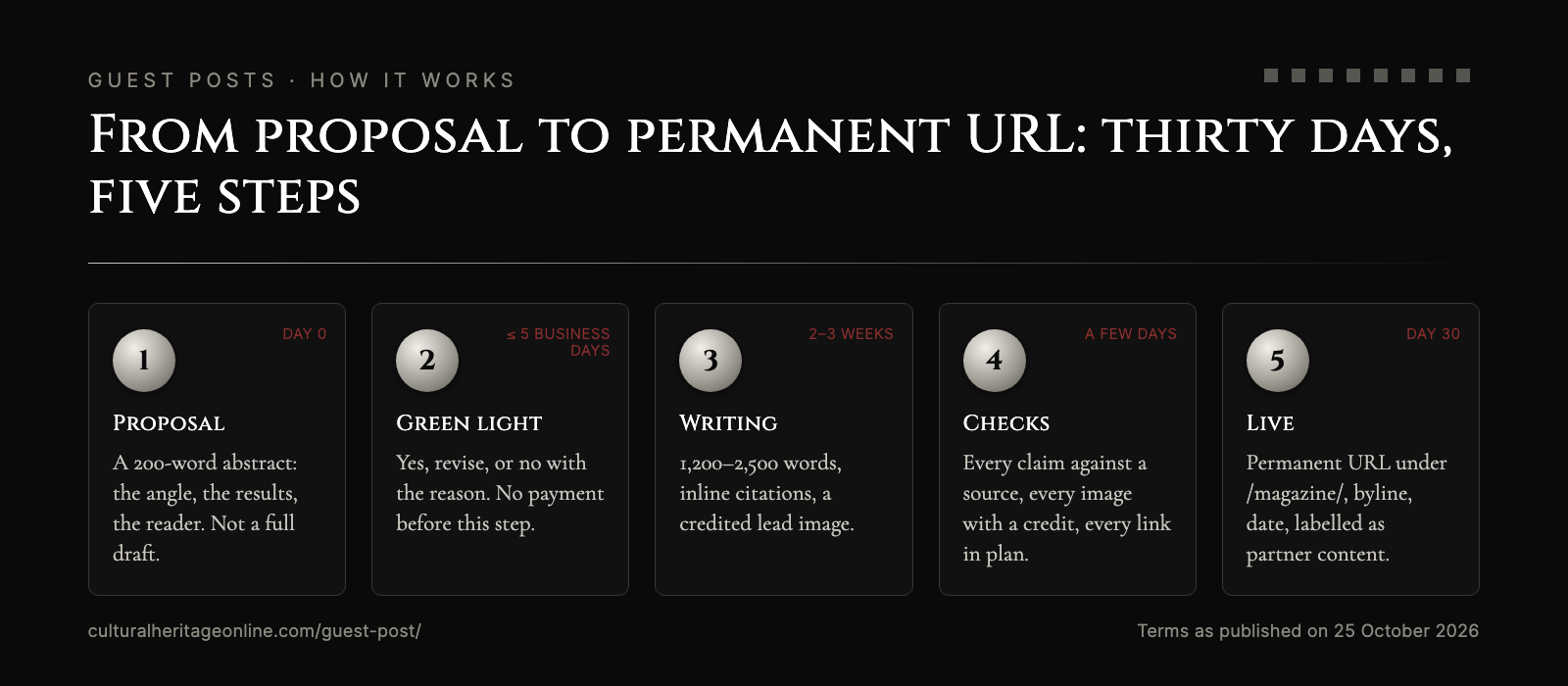
The process is short and it is written down, because the most common question from an agency is not about price: it is about what happens between the proposal and the URL.
1. The proposal
You send a 200-word abstract with the angle you want to develop, the results you want to show and the audience you are writing for. Not a full draft: the angle is what we evaluate, because the archive already covers a great deal, and the first question is always whether the article adds something the archive does not have.
Send it through the page, with the name of the person who will approve the text on your side. A proposal without a named approver is a proposal that will wait.
2. The green light
The editorial team answers within five business days: acceptance, revision request, or a no with the reason. If accepted, an editorial slot is reserved. No payment is due before this step.
The no is not personal: an article that repeats something the archive already covers, or that has no verifiable claims, is refused before anyone writes a sentence.
3. Writing
The article is 1,200 to 1,800 words on Standard, 1,800 to 2,500 on Plus. Inline citations for factual claims, a lead image proposed or sourced by us from Wikimedia Commons, and a clear separation between what the project did and what the article argues.
We edit for language and structure. We do not rewrite the argument: if the argument changes, the article changes with you, not behind your back.
4. The checks
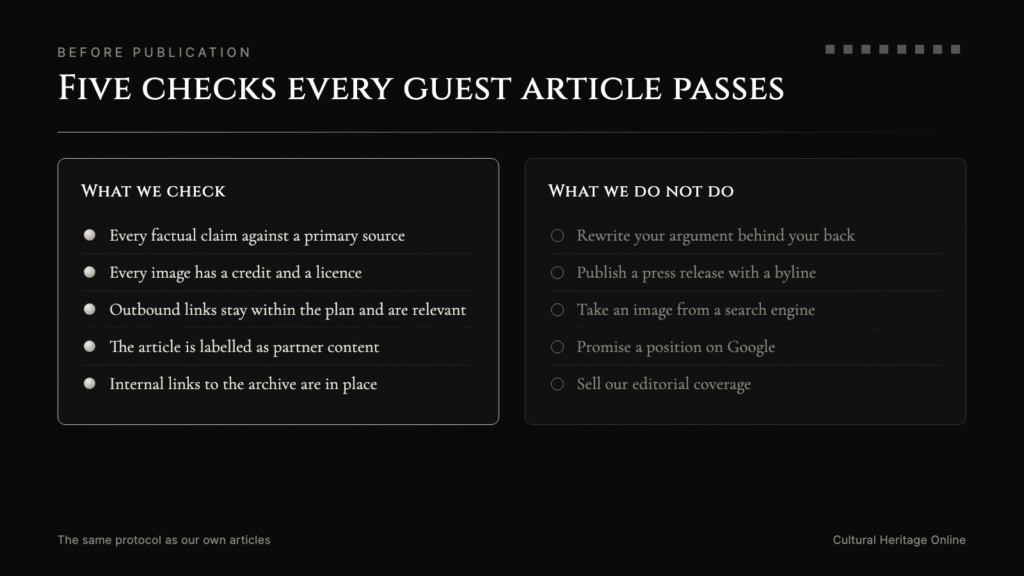
Before publication:
- every factual claim is checked against a primary source;
- every image has a credit and a licence;
- the outbound links stay within the plan and are relevant;
- the article is labelled as partner content;
- the internal links to related archive content are in place, so the article does not sit alone.
This is the same protocol we apply to our own articles. It is why the process takes days and not hours. A claim without a source is not a claim, it is an opinion: the editorial pass is where the difference is decided.
5. Publication
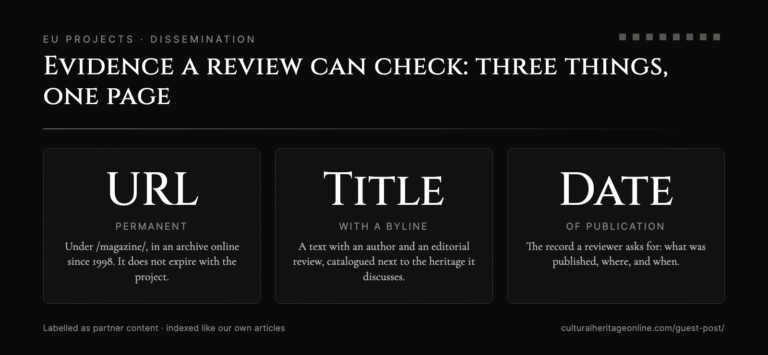
The article goes live under /magazine/ with a permanent URL, a byline, a publication date, and its place in the thematic index. It enters the home showcase for the number of days of the plan: seven on Standard, ninety on Plus. The social posts follow the same schedule, one every ten days, on our own channels.
Then the page is submitted to search engines and indexed.
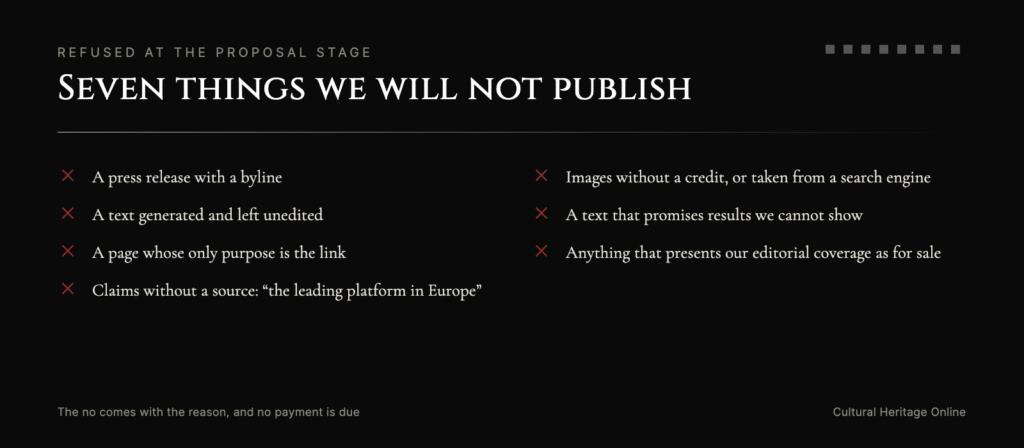
6. What we will not publish
- A press release with a byline.
- A text generated and left unedited: it is refused at the proposal stage.
- A page whose only purpose is the link.
- Claims without a source: “the leading platform in Europe” is not a claim, it is a slogan.
- Images without a credit, or taken from a search engine.
- A text that promises results we cannot show.
- Anything that presents our editorial coverage as for sale: it is not.
7. After publication
The article stays. It can be corrected for factual errors, with a note, and the correction is part of the record. It cannot be rewritten to say something else six months later: the byline and the date are the point of the page.
The author page stays with the article, and an Annual plan keeps six articles and the quarterly reports together.
8. What it costs, in time
From proposal to publication, thirty days is the normal path: five business days for the green light, two to three weeks for writing and editing, a few days for the checks and the publication.
9. What the editor will ask you
Before the green light, five questions come back, and they are always the same: what is the claim, which source proves it, what does it add to the archive, who is the reader, and who approves the text on your side.
A proposal that answers the five in the abstract takes one exchange. A proposal that answers none takes a week and often ends in a no, because the editor cannot build an article on a subject without a claim.
Questions we are asked
Can we include links to our project site?
Yes, within the plan: one outbound link on Standard, three on Plus. They must be relevant, and they are checked.
Can we write about our own organisation?
You can write about the work, with sources. An article that is only about the organisation is a press release, and it is refused.
Who owns the text?
You do, with the licence to publish it here. The byline names the author and the organisation.
Can we change it after publication?
Factual corrections yes, with a note. Rewrites no: the page is part of the record, and a text that changes its conclusion after publication is not a record, it is a brochure.
What if the proposal is refused?
You get the reason, and no payment is due. A revised angle can be proposed once.
Do you guarantee citations?
No. We guarantee the page, the indexing and the links. Citations are earned by the text.
Send a 200-word proposal, or read the three plans: culturalheritageonline.com/guest-post/
Sources
- Cultural Heritage Online, Editorial Guest Posts programme page (plans, process, labelling), https://culturalheritageonline.com/guest-post/ — read 25 October 2026
- Cultural Heritage Online, Editorial guidelines §10 editorial independence and §11 how our texts are written, https://culturalheritageonline.com/editorial-guidelines/
- Cultural Heritage Online, Advertising and affiliate transparency, https://culturalheritageonline.com/advertising-affiliate-transparency/
Spotted an error? Write to editorial@culturalheritageonline.com and we correct it the same day.