

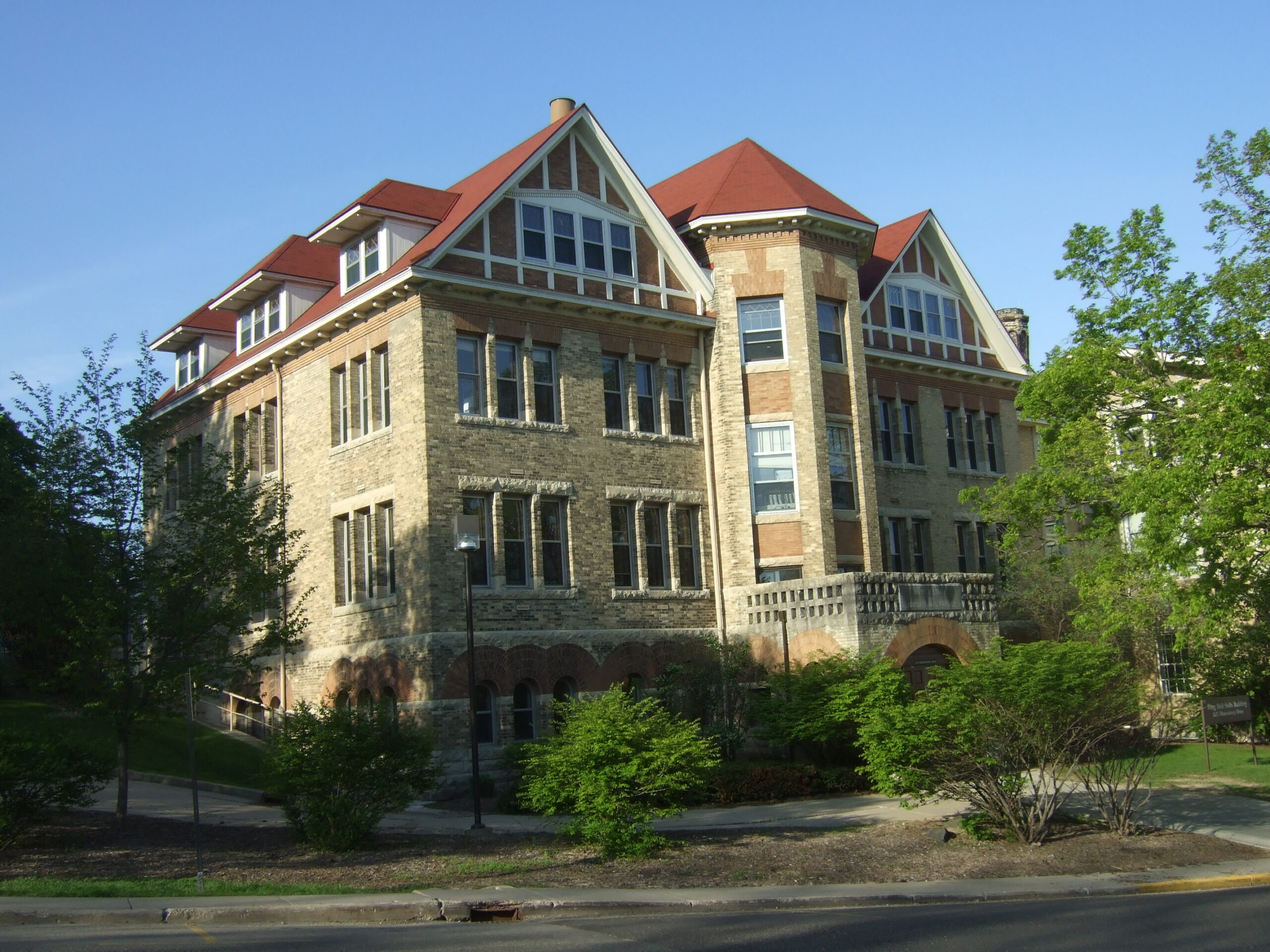
A Richardsonian Romanesque laboratory building that housed the first agricultural physics professorship in the United States, and where Franklin Hiram King laid the foundations of modern soil physics.
At a glance
King Hall, originally the Horticulture and Agricultural Physics and Soil Science Building, stands on the campus of the University of Wisconsin–Madison. Built in two campaigns, it combines a central tower and east wing from 1893 with a west wing from 1896. The building was listed on the National Register of Historic Places in 1985 and the State Register of Historic Places in 1989.
History
Agriculture developed slowly at the University of Wisconsin. Founded in 1848 with no formal agriculture program, the university was authorized by the state legislature in 1866 to teach agricultural and mechanical arts. A 195-acre tract west of the original campus was purchased for practical experimentation on soils and land. A School of Agriculture followed in 1868, but enrollment remained small for over a decade.
The turning point came in 1880, when William A. Henry was appointed chair. Enrollment grew, practical results mounted, and the College of Agriculture was formed in 1889. Between 1891 and 1893, the legislature allocated funds for a horticulture building. J.T.W. Jennings designed it. The first section, housing the horticulture department, rose in 1893: the central tower and the east wing. The west wing, for agricultural physics, followed in 1896.
The building was renamed King Hall in 1910 for Franklin Hiram King. Horticulture moved to its own building that same year. Agricultural physics soon outgrew the entire structure, and in 1915 the Soils Annex wing was added, designed by Arthur Peabody with advice from Laird and Cret.
What you see
The completed building is Richardsonian Romanesque in style, restrained but with the characteristic round arches. The stonework is multi-colored: white select brick with trimmings of pressed brick and Wauwatosa limestone. Half-timbering in the gable ends draws from Queen Anne style. Richardsonian Romanesque typically includes a dramatically asymmetric front profile; here that was achieved in the early years by a large windmill atop the west tower. The 1915 Soils Annex has three stories with walls of cream brick and half-timbering.
Cultural significance
The windmill tower was the base for some of Dr. Franklin Hiram King’s experiments. A native of Whitewater, King studied at Cornell University and taught at River Falls State Normal School before being hired by the university in 1888 as its first professor of Agricultural Physics—the first such professor in the United States. In that role he applied physics to Wisconsin’s agricultural problems.
King developed the round silo, improved methods for constructing and ventilating farm buildings, and popularized the round barn. He investigated wind as a source of energy, yielding some of the earliest research on wind power. He formulated methods of wind erosion prevention and constructed the first weighing lysimeters for water use studies. He also studied irrigation and drainage and developed a practical method for determining moisture content in soils, establishing the general principles of soil physics.
In 1901, King left to become Chief of the Division of Soil Management at the U.S. Department of Agriculture. The building was listed on the National Register for statewide contributions to science and agriculture and for its association with King.
Key facts
- Country: United States
- City: Madison
- Coordinates: 43.0764, -89.4106
Practical information & getting there
King Hall is located on the campus of the University of Wisconsin–Madison. Consult the university’s visitor information for campus access and parking.
Sources & resources
Find it on the map
See this place and what’s around it →📷 Become a Cultural Heritage Online photographer
Share your photos of places: they stay published under your name as the author. The more they're seen, the more you get noticed — and soon a contest will reward the most appreciated photos.
Log in or sign up free to add a photoIs this page about you?
This page is read by travellers and heritage enthusiasts who find it on Google. Tell us how you are connected to this place and we will take it from there.