

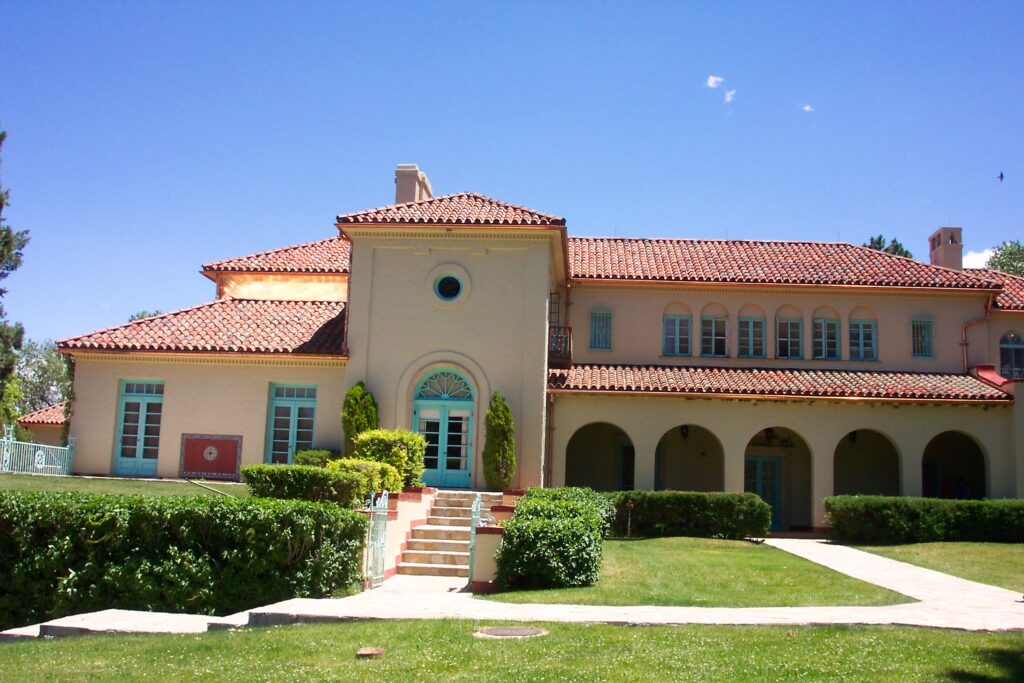
A large ranch home outside Cimarron, New Mexico, on the Boy Scouts of America’s Philmont Scout Ranch.
At a glance
Villa Philmonte is a large ranch house set within Philmont Scout Ranch, near Cimarron, New Mexico. The property is owned by the Boy Scouts of America.
History
Waite Phillips (1883-1964), an Oklahoma oilman, bought a ranch near the frontier town of Cimarron in 1922. Within ten years he had built it to more than 300,000 acres and named it Philmont, from his own name and the Spanish word for mountain. After selling his oil business the Phillips family sailed to the Mediterranean to gather architectural ideas in Spain and Italy, for a house at the ranch and a main residence in Tulsa.
They travelled with Edward Buehler Delk (1885-1956), the Kansas City architect commissioned for both. Delk had studied at the University of Pennsylvania and in London, practised in Philadelphia from 1913, and after the First World War master-planned the Country Club Plaza for the J.C. Nichols Company. He came to the ranch in late October 1925 to draw the first floor plan. The fifteen-room house was built in 1926 and 1927. The Phillips family gave it, with a large part of the ranch, to the Boy Scouts of America in 1941. A major restoration in the late 1970s worked from more than two hundred period photographs to return the house to how it looked in the late 1920s and 1930s.
What you see
Villa Philmonte is a two- and three-storey masonry house facing west toward the peaks of the Sangre de Cristo Mountains. Its walls are solid masonry finished in cement plaster and painted cream; the window and door frames are turquoise. Every roof is hipped and laid with variegated red Spanish clay tile. Connected wings and free-standing elements enclose a sequence of courtyards and patios, and it is this plan, together with the arcades, balconies and wide window groupings, that gives the house its Mediterranean eclecticism. Most of the windows are casements, in a deliberate variety of shapes and sizes.
The west front is organised around a vertical element built as a tower. Its top level, pierced by three unglazed openings on each face, was taken down shortly after the house was finished. Below it the eaves, the loggia arcade on the ground floor and the second-floor windows draw strong horizontal lines, and the front eaves carry a classical dentil frieze that the rear of the house does not have. Two elements break that discipline: the balcony off the second-floor library and the portal running to the gazebo, both in heavy timber with polychrome accents on carved balustrade and brackets. Inside the loggia, timber corbels and beams support a ceiling whose purlins are painted with geometric motifs. On the porch, a signature tile reads: Edward B. Delk Architect 1926.
Cultural significance
The property was listed on the National Register of Historic Places in 1995 for its architecture and for its association with Waite Phillips. Delk’s commissions for Phillips were among his first and launched a career that produced more than thirty landmark houses in Kansas, Oklahoma and Missouri. The villa is one of the clearest statements of the Spanish Mediterranean manner in northern New Mexico, and its Rustic and Spanish-Indian Revival interiors record a second interest of its owner, the building traditions of the region itself.
Six resources make up the historic district: the villa with its guest house, the north and south courtyards, and the pool with its pergola and pond. The house has served for decades as a memorial to the donors and to their gift to Scouting, and it remains in the hands of the Boy Scouts of America.
Key facts
- Country: United States
- City: Colfax County
- Coordinates: 36.4592, -104.9489
Practical information & getting there
Villa Philmonte is located outside of Cimarron, New Mexico, on Philmont Scout Ranch.
Sources & resources
Find it on the map
See this place and what’s around it →📷 Become a Cultural Heritage Online photographer
Share your photos of places: they stay published under your name as the author. The more they're seen, the more you get noticed — and soon a contest will reward the most appreciated photos.
Log in or sign up free to add a photoIs this page about you?
This page is read by travellers and heritage enthusiasts who find it on Google. Tell us how you are connected to this place and we will take it from there.
This entry stays online and free either way — and a free account lets you add to it yourself.