
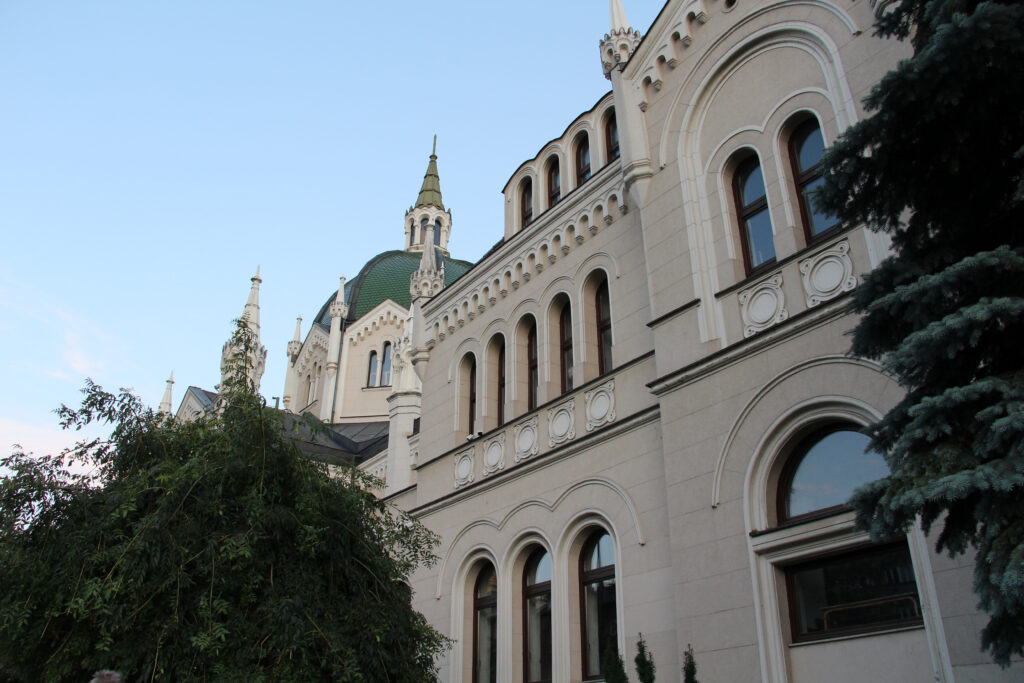
Austria-Hungary built one Evangelical church in Sarajevo. The congregation left with the empire, and eighty years later one of the last members handed the keys to the city.
At a glance
The building on the Miljacka embankment was the only Evangelical church built in Sarajevo under Austro-Hungarian rule. It was designed by Karel Pařík, the Czech architect who built much of the city in those decades, and opened on 19 November 1899; further wings were added in 1911. After the First World War the congregation dispersed, and at the end of the 1970s the property passed to the city. It was adapted between 1979 and 1981 for the Academy of Fine Arts, founded in 1972, which is there still.
Key facts
- Opened: 19 November 1899, as an Evangelical church — the only one built in Sarajevo under Austro-Hungarian rule
- Architect: Karel Pařík (also written Paržik, Parik), the Czech architect of Austro-Hungarian Sarajevo
- Initiator: Filip Balif
- Manner: inspired by Romanesque and Byzantine building
- Wings: added in 1911
- Lost its congregation: after the First World War, when most Evangelicals left the city with the Austro-Hungarian army
- Given to the city: at the end of the 1970s, by Vlado Nagel, one of Sarajevo’s last Evangelical Christians
- Adapted: 1979–81, for the Academy of Fine Arts, founded 1972
- GPS: 43.8560, 18.4178 · Open in Google Maps
History
When Austria-Hungary took over Bosnia in 1878 it brought its administration with it, and the administration brought Protestants to a city that had Muslims, Orthodox Christians, Catholics and Jews but no Evangelical congregation. One church was built for them, on the river, and it opened in November 1899. Karel Pařík designed it, as he designed much of Habsburg Sarajevo, in a manner drawn from Romanesque and Byzantine models rather than from the Gothic a Protestant church might have expected.
The congregation did not outlast the empire. After 1918 most Evangelicals left with the army, and the church kept its building and lost its reason. It stood through the interwar years, the second war and most of Yugoslavia in that condition.
At the end of the 1970s Vlado Nagel — one of the last Evangelical Christians in Sarajevo — signed the property over to the city. It was renovated and adapted between 1979 and 1981, and given to the Academy of Fine Arts, which had been founded in 1972 and needed a home. The students have had it ever since.
A church that became studios
Churches adapt badly to most uses and well to one: a single tall space with high side light is what a painting studio wants. The conversion of 1979–81 made a working art school out of a building designed for a congregation that no longer existed, which is a better end than most deconsecrated churches in Europe have had.
What you see
A compact domed building in pale stone on the Miljacka embankment, with the round arches and banded masonry of the Romanesque-Byzantine manner. It is often said to look like a small version of the Hungarian parliament, which is not quite right but catches the effect: a riverfront building in an imperial style, placed where it would be seen from the other bank.
Sources & resources
Find it on the map
See this place and what’s around it →📷 Become a Cultural Heritage Online photographer
Share your photos of places: they stay published under your name as the author. The more they're seen, the more you get noticed — and soon a contest will reward the most appreciated photos.
Log in or sign up free to add a photoIs this page about you?
This page is read by travellers and heritage enthusiasts who find it on Google. Tell us how you are connected to this place and we will take it from there.