
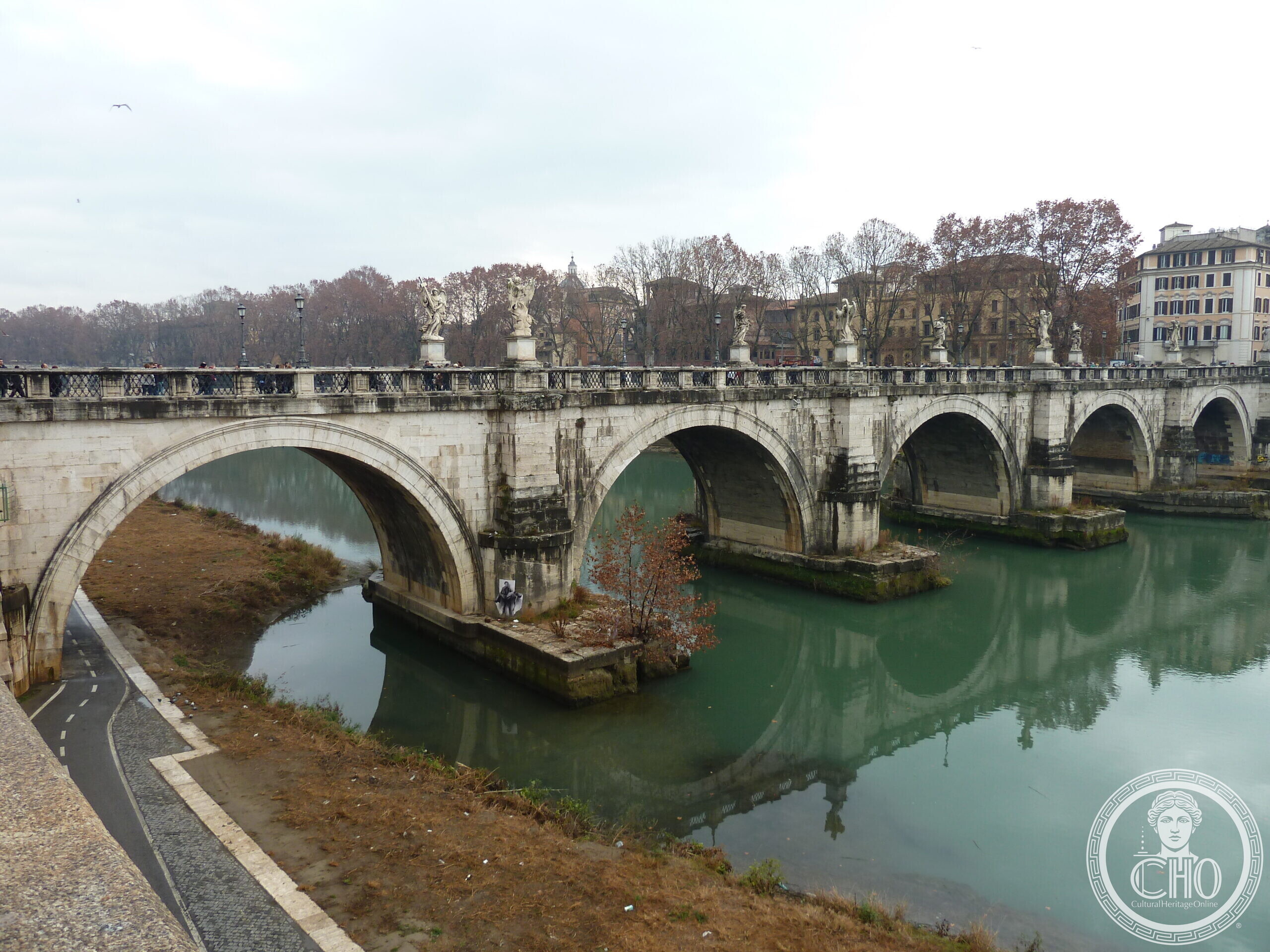
Hadrian built it to reach his tomb; the popes made it the road of the pilgrims to St Peter’s; Bernini lined it with ten angels carrying the instruments of the Passion. It is the most decorated bridge in Rome, and today it is for walkers only.
At a glance
The Pons Aelius was built by the emperor Hadrian in 134 AD to connect the Campus Martius with his mausoleum on the other bank, the building that became Castel Sant’Angelo. The ancient bridge of tufa and travertine had three main arches, which are still the central three of the five we see today. In 1668 Clement IX commissioned Gian Lorenzo Bernini to design ten angels for the parapets, each holding an instrument of the Passion; Bernini carved two himself, which the pope kept and which are now in Sant’Andrea delle Fratte, and his pupils made the others. The two end arches were rebuilt when the Lungotevere embankments were made at the end of the nineteenth century.
Key facts
- Built: 134 AD, by Hadrian (Publius Aelius Hadrianus), as the Pons Aelius
- Structure: three central arches of the Roman bridge, in tufa and travertine; five arches today
- 1450: the parapets gave way under the crowd of the Jubilee and many pilgrims drowned; Nicholas V restored and widened it
- 16th century: statues of Saints Peter and Paul placed at the city end under Clement VII
- 1668–1671: ten angels designed by Bernini for Clement IX; the two by Bernini’s own hand are in Sant’Andrea delle Fratte, replaced on the bridge by copies
- Late 19th century: the bridge was reshaped for the Lungotevere; pedestrian today
- GPS: 41.90190, 12.46645 · Open in Google Maps
History
For the Jubilee of 1300 Boniface VIII had to regulate the traffic of pilgrims on the bridge: Dante, who was there, describes the two lanes separated by a row of booths. In 1450 the parapets collapsed under the crowd and the disaster led to the rebuilding under Nicholas V. In the sixteenth century the bridge was also the place of executions, and the statues of Peter and Paul mark its entrance from the city.
The angels came in 1668, when Clement IX asked Bernini to turn the bridge into a Via Crucis in marble. Bernini drew all ten and carved the Angel with the Crown of Thorns and the Angel with the Superscription; the pope liked them too much to leave them in the open, and they went to Sant’Andrea delle Fratte, while copies took their place. When the Tiber was embanked after the flood of 1870 the bridge lost its towers and ramps and gained two new end arches, and took its present form.
What you see
Five arches in travertine over the green river, with the statues on the parapets standing out against the sky. The photograph is taken from the right bank below the castle, looking across to the city; the cycle path of the embankment runs along the bottom of the frame.
Nearby
- Castel Sant’Angelo — Hadrian’s mausoleum at the end of the bridge
Sources
- Turismo Roma — Ponte Sant’Angelo: the Pons Aelius and the mausoleum, Dante and the Jubilee of 1300, the statues of Peter and Paul, the angels of 1668 for Clement IX designed by Bernini and carved by his pupils, the works of the 1880s and the pedestrian bridge
- Ancient Rome Live — Pons Aelius: the date 134 AD, the tufa and travertine structure on three main arches with ramps, the collapse of the parapets in 1450 and the restoration under Nicholas V, Clement VII’s statues, Bernini’s two angels kept by the pope, the five arches of today
Find it on the map
See this place and what’s around it →📷 Become a Cultural Heritage Online photographer
Share your photos of places: they stay published under your name as the author. The more they're seen, the more you get noticed — and soon a contest will reward the most appreciated photos.
Log in or sign up free to add a photoIs this page about you?
This page is read by travellers and heritage enthusiasts who find it on Google. Tell us how you are connected to this place and we will take it from there.