
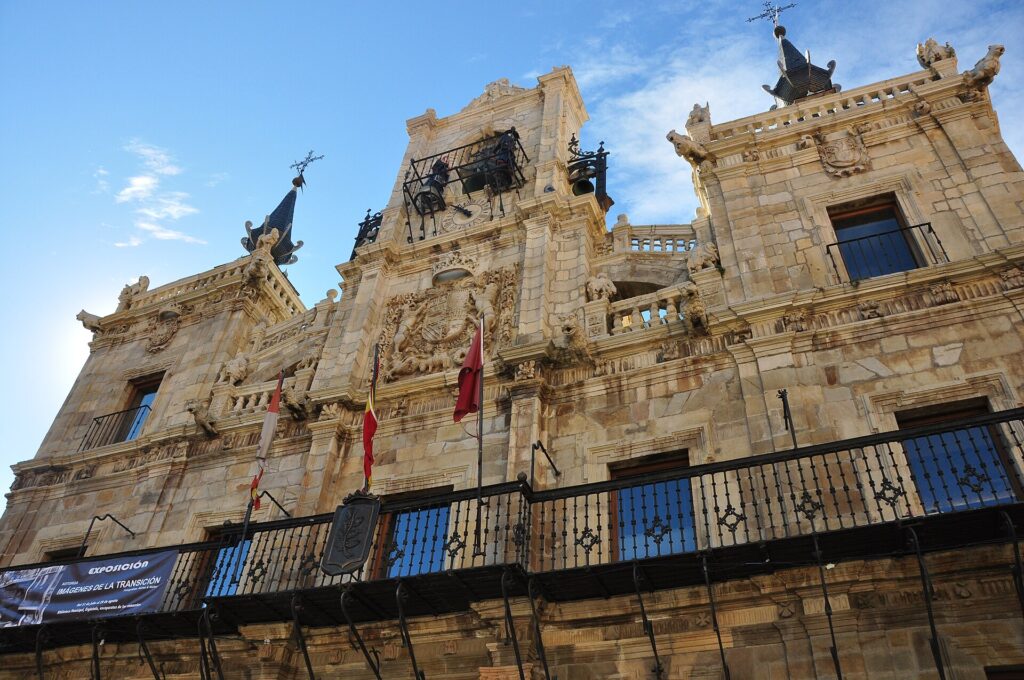

Begun in 1683 and finished in 1704, the town hall of Astorga closes one side of the arcaded Plaza Mayor, laid out over part of the Roman forum. Its stone front, with two spired towers, the royal arms and a clock, is known for the pair of automata in Maragato costume who have struck the hours since 1748.
At a glance
The Plaza Mayor of Astorga is a square surrounded by arcades, and it stands on part of the forum of the Roman city of Asturica Augusta. On one side is the town hall, built between 1683 and 1704 to the design of Francisco de la Lastra. The municipal description calls its front typical of the civil Baroque of the province of León, with an arrangement that echoes the front of the cathedral and spires of Flemish inspiration on its towers. The building was remodelled inside in 1994 by the architect Andrés Lozano, who kept the historic front. It is a protected monument, a Bien de Interés Cultural, since 1992.
Key facts
- Where: Plaza Mayor, Astorga (León)
- Built: 1683–1704, works directed by Francisco de la Lastra
- Clock and automata: clock by the clockmaker Bernardo Franco; the figures of Juan Zancuda and Colasa, in Maragato dress, strike the bell every hour since 1748
- Remodelling: 1994, by Andrés Lozano, keeping the original front
- Protection: Bien de Interés Cultural, declared on 2 July 1992 (register no. RI-51-0007288)
- Market: a weekly market is held on Tuesdays in the Plaza Mayor and the nearby squares, under a privilege granted by the Marquis of Astorga in 1471
- Coordinates: 42.454183, -6.052983 · open in Google Maps
History
The square in front of the town hall has been the centre of Astorga since antiquity: the Plaza Mayor sits over part of the forum of Asturica Augusta, whose eastern side survives a few steps away in the vaulted Roman gallery known as the Ergástula. In 1471 the Marquis of Astorga granted the town the privilege of a market every Tuesday in the Plaza Mayor and the surrounding squares, and the market is still held.
The present town hall was begun in 1683 under the direction of Francisco de la Lastra and completed in 1704. Some forty years later the clock received the feature that made it famous: from 1748 two automata dressed in the traditional costume of the Maragatería, the district around Astorga, have come out on the hour to strike the bell with their mallets. The town knows them as Juan Zancuda and Colasa. In 1992 the building was declared a Bien de Interés Cultural, and in 1994 it was remodelled by the architect Andrés Lozano, who remodelled it while keeping the Baroque front.
What you see
The photograph looks up at the front from the square. The whole is built of warm golden stone. A long balcony with a plain iron railing runs across the main floor, with tall windows opening onto it. Above, the front is richly carved: a large coat of arms at the centre, smaller shields on the towers, balustrades along the roofline, and projecting carved beasts at the corners. At the centre rises an open frame holding the bell, and on either side the two towers end in slate spires with curling iron ornaments and weather vanes.
According to the municipal description, the centre of the front carries the royal coat of arms and the clock by Bernardo Franco, with the two Maragato figures on either side, which move on the hour to strike the bell.
Practical information
- The building is the working town hall of Astorga; the front and the clock can be seen from the Plaza Mayor at any time.
- The automata strike the bell on the hour.
- On Tuesdays the square is taken over by the weekly market.
Getting there
The Plaza Mayor is in the middle of the walled old town, a few minutes on foot from the cathedral and the Episcopal Palace. Astorga lies about 50 km west of León, on the Camino Francés to Santiago.
Nearby
- The Ergástula, the Roman vaulted gallery of the forum, now the base of the Museo Romano, on the Plaza de San Bartolomé just beside the square.
- Astorga Cathedral and Gaudí’s Episcopal Palace, about 500 metres to the north-west.
- The Roman walls, which ring the old town.
Do you know more?
On this page we have published what the municipality of Astorga records about its town hall. We could not read the documents of the building works of 1683–1704 or of the 1748 clock, and we have no photograph of the automata at work that we are free to publish. If you know more — a study, an old photograph or postcard of the square, a document — write to Sofia, who looks after these pages.
Write to Sofia or send a message on WhatsApp
Please start your message with the title of this page, so it reaches the right file. Every contribution is checked against independent sources before it goes on the page, and we always say where a piece of information came from.
Sources
- Ayuntamiento de Astorga, Turismo de Astorga, «Ayuntamiento»: 1683–1704 and Francisco de la Lastra, the remodelling by Andrés Lozano in 1994, the front, the clock by Bernardo Franco, the automata Juan Zancuda and Colasa since 1748, the Plaza Mayor over the Roman forum, the market privilege of 1471.
- List of Bienes de Interés Cultural of the province of León (Wikipedia, es), from the register of the Spanish Ministry of Culture: Ayuntamiento de Astorga, RI-51-0007288, 2 July 1992.
- M. Á. Sevillano Fuertes, Boletín del Museo Arqueológico Nacional 35 (2017): the forum of Asturica Augusta and the Ergástula.
- OpenStreetMap / Nominatim: position, returned as Ayuntamiento de Astorga.
Find it on the map
See this place and what’s around it →📷 Become a Cultural Heritage Online photographer
Share your photos of places: they stay published under your name as the author. The more they're seen, the more you get noticed — and soon a contest will reward the most appreciated photos.
Log in or sign up free to add a photoIs this page about you?
This page is read by travellers and heritage enthusiasts who find it on Google. Tell us how you are connected to this place and we will take it from there.