
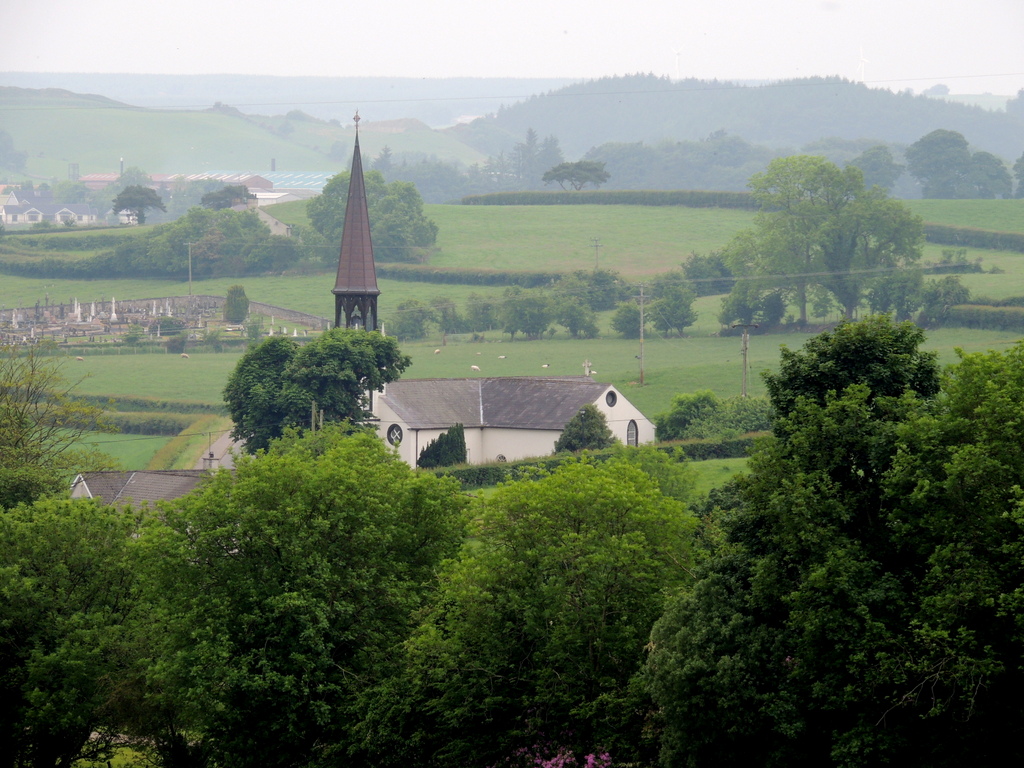

A plain country church that started as a rectangle, became a T and ended as a cross, with a timber belfry whose bell the parish remembers as the first to ring in the diocese after the penal times.
At a glance
St Eugene’s stands on the Plumbridge Road at Glenock, in the townland of Glenknock or Cloghogle, on the edge of Newtownstewart. It is the Catholic church of the parish of Ardstraw East. A first chapel was built here by private subscription around 1785; in 1823 it was remodelled into a T-shaped church with three galleries, and in 1834 a timber steeple and belfry were added. Northern Ireland’s Historic Environment Division lists it at Grade B+, calling it “an important and early catholic church which has an impressive external design and an intimate interior”. A two-year restoration funded by the National Lottery Heritage Fund ended in September 2026.
Key facts
- Where: Plumbridge Road, Glenock, Newtownstewart, County Tyrone BT78 4NR
- Built: first chapel about 1785; remodelled as a T-plan church in 1823; steeple and belfry 1834; sacristy wing 1860s, extended 1949
- Spire: timber belfry and spire of 1904 attributed to E. J. Toye; copper cladding 1909, re-clad 1977 and 2001
- Protection: listed building, Grade B+, reference HB10/05/003, listed 2 November 1989; extent of listing: church and boundary wall
- Current use: Catholic parish church, parish of Ardstraw East, Diocese of Derry
- Coordinates: 54.725993, -7.365766 · open in Google Maps
History
The Ordnance Survey memoirs of the 1830s describe a Roman Catholic chapel in the townland of Glenknock or Cloghogle, five furlongs from Newtownstewart, “built by private subscription about the year 1785 and repaired with additions in the year 1823 at an expense of 150 pounds”. By then it was a T-shaped building 72 feet long, with three galleries and twelve windows, holding 1,500 people. A local history of 1946 by John Hewitt Gebbie credits the remodelling to the parish priest, the Rev. Philip Porter, and says that much of the labour was given free and that Protestants helped. The National Churches Trust records the same parish tradition: Protestant farmers carted the building materials without charge.
In 1834 Father Porter put up a temporary wooden steeple and belfry on a square brick base and hung a bell of 330 pounds. Gebbie wrote that it was the first belfry in the Catholic diocese since penal times, rung before the bell of Armagh Cathedral; recent accounts tie it to the Catholic Emancipation Act of 1829. The church was remodelled again in 1861 at a cost of £807, and a south wing with meeting rooms and sacristy dates from the 1860s. The Stations of the Cross were bought in 1871.
The wooden spire was replaced in 1904, in a design that Alistair Rowan’s Buildings of Ireland gives to the Derry architect E. J. Toye, and clad in copper in 1909. A major campaign completed in 1949 brought a new roof, the marble altar and rails, and the enlarged sacristy. The spire was re-clad in 1977; after severe storm damage on Christmas Eve 1999 it was practically rebuilt and re-clad in 2001. In 2024 the National Lottery Heritage Fund awarded £812,575 towards restoration and heritage work, later reported at more than £1 million in total; the works uncovered stonework and frescoes that had been forgotten, and the church reopened with a Mass on 27 September 2026.
What you see
The photograph looks down on the church from higher ground, across a screen of trees. The body of the church is a low, white-rendered block under a grey slate roof, with a round window high in the gable end and an arched window below it. At the left rises the tower, its lower stages hidden by trees; above them stands the octagonal timber belfry and then the tall, dark copper-clad spire with a finial. Behind the church spreads the churchyard with rows of headstones, and beyond it open fields, hedgerows and scattered houses.
The listing describes what the distance hides: pointed windows with Y-tracery in painted sandstone surrounds, a Tudor-arched doorway in the tower, pinnacles at the corners of the parapet, and inside original plasterwork, timberwork and a queen-post roof structure over the galleries.
Practical information
- St Eugene’s is a working parish church; the National Churches Trust says it is open to visitors most days during the day, and access can be asked of the parish at other times.
- The Heritage Fund grant covers heritage events, guided tours, interpretation panels and walking guides; the parish announces the dates.
- The churchyard and the setting can be seen from the road at any time.
Getting there
The church is on the Plumbridge Road just outside Newtownstewart and is visible from the A5. Travelling from Omagh, turn right towards Plumbridge; the church is a short distance along that road on the left.
Nearby
- The Druid’s Altar, a Neolithic portal tomb in the same townland of Glenknock or Cloghogle, in state care and scheduled (TYR017:009).
- Newtownstewart Castle, the post-medieval castle and bawn in the town, in state care and scheduled (TYR017:047).
- St Eugene’s Church of Ireland, the Ardstraw parish church on Main Street, listed Grade B1 (HB10/04/003).
- Harry Avery’s Castle, a medieval castle and bailey outside the town, in state care (TYR017:012).
Sources
- Department for Communities, Historic Environment Division, Historic Building Details HB10/05/003, St Eugene’s RC Church, Plumbridge Road, Newtownstewart: grade B+, listed 2 November 1989; description, historical information quoting the OS memoirs, Gebbie (1946), Rowan (1979) and the parish; evaluation.
- National Churches Trust, Glenock St Eugene: building phases, E. J. Toye, the bell tradition, galleries and 1949 furnishings, opening times and directions.
- We Are Tyrone (Ulster Herald), 25 September 2026: reopening Mass on 27 September, Heritage Fund support of more than £1 million, uncovered stonework and frescoes.
- We Are Tyrone, 13 May 2024: National Lottery Heritage Fund award of £812,575.
- Department for Communities, Northern Ireland Sites and Monuments Record (open data): TYR017:009, 012, 047 for the monuments listed under Nearby.
- OpenStreetMap / Nominatim: position, returned as Saint Eugene’s (RC), Newtownstewart, BT78 4NE.
Find it on the map
See this place and what’s around it →📷 Become a Cultural Heritage Online photographer
Share your photos of places: they stay published under your name as the author. The more they're seen, the more you get noticed — and soon a contest will reward the most appreciated photos.
Log in or sign up free to add a photo