
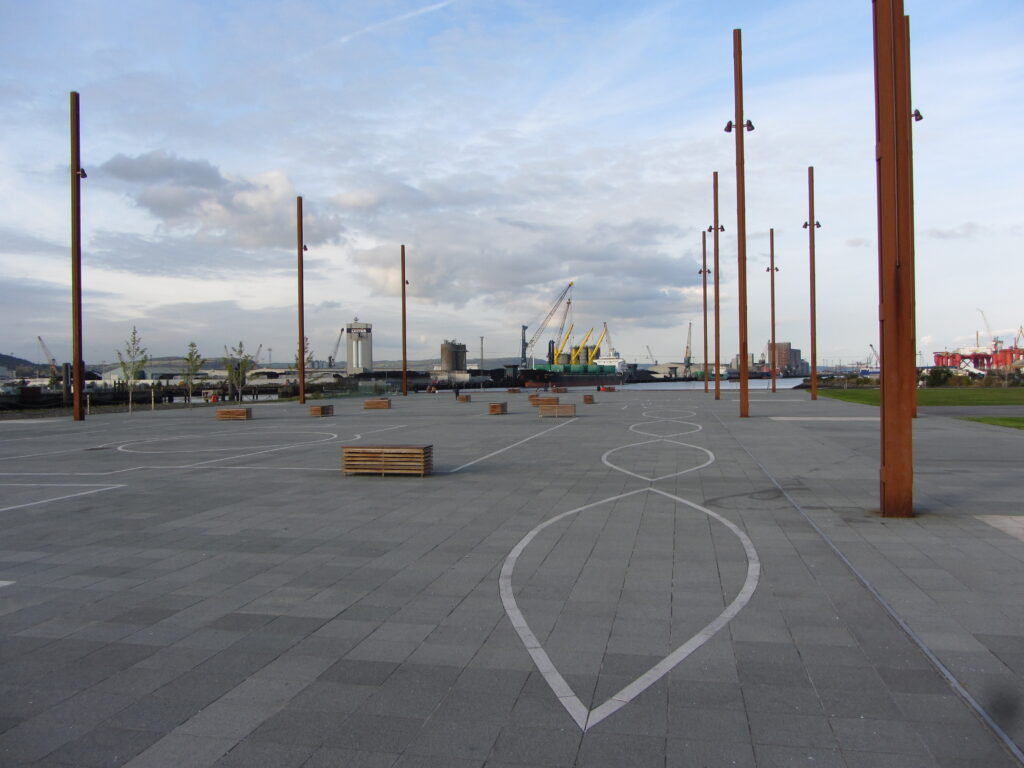

Two inclined beds of ground running down to the Victoria Channel, where Harland & Wolff built the hulls of Olympic and Titanic under a giant steel gantry. The gantry and the sheds have gone; the slipways are a scheduled monument, and the museum building stands at their head.
At a glance
On Queen’s Island, in the former North Yard of the Harland & Wolff shipyard, two parallel slipways lead down to the water. They were rebuilt in the years before 1911 to take the two largest ships of the time, Olympic and Titanic, and on 31 May 1911 Titanic slid down one of them into the Victoria Channel. The Northern Ireland Historic Environment Division records them as a scheduled monument, “Twin slipways of the Titanic and Olympic ships”. Since 2012 they have been an open public space: the Titanic slipway carries a plan of the ship’s deck inlaid in stone, the Olympic slipway a memorial garden. The Titanic Belfast building, opened in 2012, stands at the top of both.
Key facts
- Where: Queen’s Island, Titanic Quarter, Belfast BT3, beside Titanic Belfast (1 Olympic Way)
- What: twin shipbuilding slipways of the Harland & Wolff North Yard, remodelled from four earlier slips for the Olympic-class liners
- Launches: Titanic was launched from the slipways on 31 May 1911, then fitted out in the Thompson Graving Dock
- Protection: scheduled monument, Northern Ireland Sites and Monuments Record DOW004:503, “Twin slipways”; also Industrial Heritage Record 10486:11
- Restoration: developed as public space with the Titanic Belfast project, completed March 2012
- Coordinates: 54.609008, -5.909512 · open in Google Maps
History
Queen’s Island is land reclaimed from Belfast Lough in the nineteenth century, and the Harland & Wolff shipyard grew up on it. When the firm took on White Star Line’s order for the Olympic-class liners, the existing slipways in its North Yard, numbered 1 to 4, were not large or strong enough. Titanic Belfast’s history of the yard, drawing on the 1911 plans, records that they were re-engineered into two larger slipways, numbers 2 and 3, able to carry the huge, heavy hulls of Olympic and Titanic side by side. Over them Sir William Arrol & Co. of Glasgow built the Arrol Gantry, a steel structure of almost 6,000 tonnes that stayed in use until the 1960s.
Titanic’s launch is the best-documented moment in the slipways’ life. The standing ways were coated with twenty-three tons of tallow, train oil and soft soap; at 12.13 pm the hydraulic trigger was released, and in front of a crowd put at 100,000 the hull ran into the water and was brought to a stop by drag chains and anchors after about sixty-two seconds. The shipwrights then cleared the slip and recovered the launching cradle. The ship was warped into the Thompson Graving Dock for fitting out and left Belfast in April 1912.
The slipways were scheduled as a historic monument by the Northern Ireland heritage service; in its record of scheduled zones the area carries a date of 2001. They were restored as part of the Titanic Signature Project: an evaluation for Belfast City Council records the Titanic and Olympic slipways as completed in March 2012, the month Titanic Belfast opened, and developed as public space and an events ground.
What you see
The photograph stands on the Titanic slipway and looks down it to the water. The surface is a broad field of grey paving, and inlaid in it are thin lines of white stone: a long pointed outline in the foreground and a chain of smaller rounded shapes further on. Titanic Belfast describes these as a life-size plan of the ship’s deck, marking where the funnels and lifeboats stood, with benches placed where the deck benches were; the wooden bench blocks scattered across the paving are those seats.
Down both sides run tall, rust-brown steel posts carrying lamps. They stand for the stanchions of the Arrol Gantry that once framed the slip. At the far end the paving meets the channel, and across the water is a working port: cranes, a cargo ship at the quay and a row of silos.
Practical information
- The slipways are open public space and can be walked at any time; the deck plan is on the Titanic slipway, the memorial garden on the Olympic slipway.
- The memorial garden has four lawns alternating with timber decking to show the proportion of victims and survivors in each class and in the crew, and glass panels carrying the names of the dead.
- Titanic Belfast, the visitor attraction at the head of the slipways, also uses the site as an open-air events ground.
Getting there
The slipways are on Queen’s Island, on the east bank of the Lagan, and can be reached on foot from Belfast city centre by crossing the river and following the signs for Titanic Belfast. Titanic Quarter railway station and the Glider bus line serve the area.
Nearby
- The former Harland & Wolff administration and drawing office block on Queens Road, listed Grade B+ (HB26/07/009), a short walk away.
- Hamilton Graving Dock, a scheduled monument (DOW004:501), with the tender SS Nomadic, a few minutes’ walk away.
- Thompson Graving Dock, scheduled with the Alexandra Dock (DOW004:500/502), where Titanic was fitted out, and its pump house, listed Grade B1.
- Across the river, the Albert Memorial Clock and St Anne’s Cathedral.
Sources
- Department for Communities, Historic Environment Division, Northern Ireland Sites and Monuments Record and scheduled zones (open data service): DOW004:503, “Twin slipways of the Titanic and Olympic ships”, protection “Scheduled”, scheduled zone added 2001; DOW004:500, 501, 502; listed buildings HB26/07/009 and HB26/07/010.
- Titanic Belfast, A History of the Shipyard: Queen’s Island to Titanic Quarter: slipways 1–4 re-engineered into nos. 2 and 3, the Arrol Gantry, deck outlines inlaid in the stone.
- Titanic Belfast, The Man Who Launched Titanic and Belfast’s Graving Docks: launch procedure, time, crowd, launch date and fitting out in the Thompson Dock.
- Titanic Belfast, Slipways & Plaza: deck plan, benches, lamp posts as gantry stanchions, memorial garden.
- Deloitte for Belfast City Council, A New Story: Titanic Belfast, Evaluation of the First Three Years (2015): slipways completed March 2012 as public realm and event space; Titanic Belfast opened 31 March 2012.
- Maritime Mile, Slipways: slipways built for the Olympic class, scheduled and restored with Titanic Belfast.
Find it on the map
See this place and what’s around it →📷 Become a Cultural Heritage Online photographer
Share your photos of places: they stay published under your name as the author. The more they're seen, the more you get noticed — and soon a contest will reward the most appreciated photos.
Log in or sign up free to add a photoIs this page about you?
This page is read by travellers and heritage enthusiasts who find it on Google. Tell us how you are connected to this place and we will take it from there.