
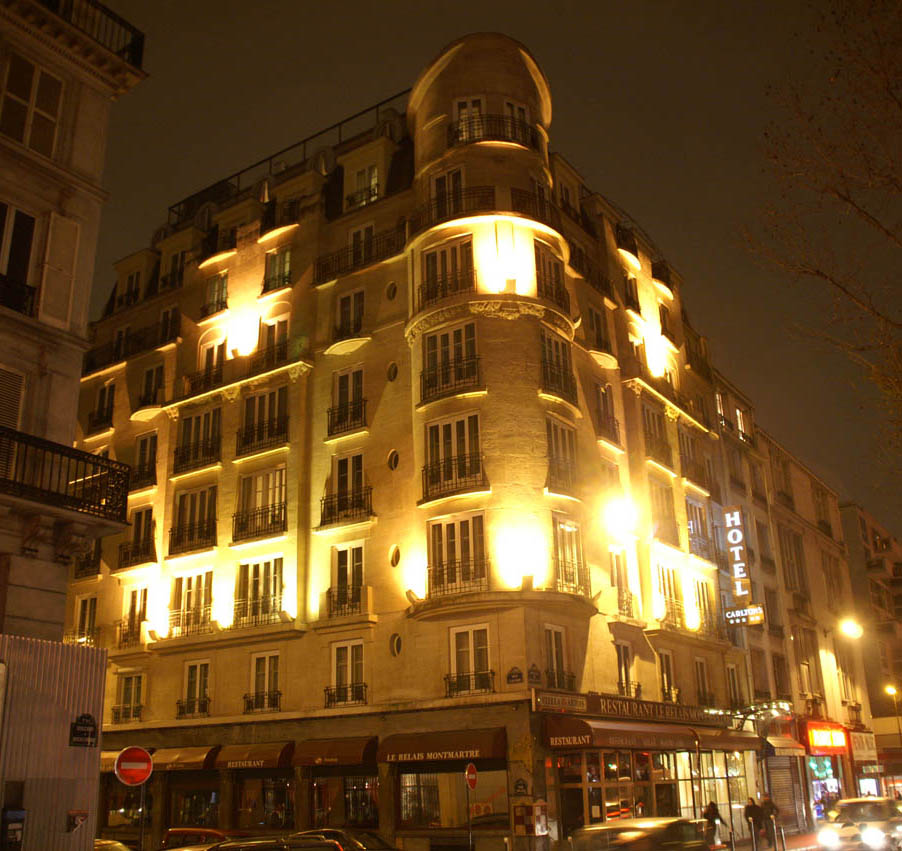

A hotel built in the mid-1920s on the boulevard below Montmartre, on the site of the painter Ernest Hébert’s house. It opened as the Charleston, became the Carlton’s, and has been the Hôtel Rochechouart since 2020. The City of Paris protects it for its Art Deco architecture and its place in the nightlife of the interwar years.
At a glance
Number 55 boulevard de Rochechouart stands on the southern, 9th-arrondissement side of the boulevard that separates the Paris of the Grands Boulevards from the slopes of Montmartre. The City of Paris heritage record describes it as a hotel building constructed in 1925 by the architect Jean Dechelette and names it among the protected buildings of its local urban plan, for its Art Deco treatment of volumes and of the rounded corner, for its sculpted frieze and entrance canopy, and for its role in the années folles. In its basement is the Mikado, a dancing room that has kept its name since the hotel’s early years. The building is not a listed historic monument; its protection is the municipal one.
Key facts
- Where: 55 boulevard de Rochechouart (officially boulevard Marguerite-de-Rochechouart), 75009 Paris
- Built: 1925 according to the City of Paris record; other accounts give 1928 or 1929 (see History)
- Architect: Jean Dechelette (born 1881), according to the City of Paris record
- Style: Art Deco
- Names: Hôtel Charleston, then Hôtel Carlton’s, then Hôtel Rochechouart since 2020
- Protection: protected building of the Paris local urban plan (PLU), protection no. 09-0715, type bâtiment protégé; not listed as a historic monument
- Renovation: 2018–2020, by the Festen studio
- Current use: hotel
- Coordinates: 48.882043, 2.340938 · open in Google Maps
History
Before the hotel, the plot held the house of the painter Ernest Hébert (1817–1908). The local history site Montmartre Secret describes it as his hôtel particulier, demolished to make way for the present building, and the French Wikipedia article on the hotel, citing the 2003 catalogue of the Musée Hébert, adds that the income from the building raised on the site went to the two museums dedicated to him, in La Tronche and in Paris. We have not seen that catalogue ourselves.
The City of Paris record dates the new building to 1925 and attributes it to Jean Dechelette. It opened as the Hôtel Charleston, named after the dance of the moment, and in the record’s words was renamed Carlton at the end of the 1930s. The sources do not agree on these dates. Montmartre Secret gives 1928 for the construction and 1950 for the change of name, and the hotel’s present owner writes that its façade has set the tone of the boulevard “since 1929”. We follow the municipal record and note the other dates here.
The record calls the hotel a place not to be missed in the années folles and names Maurice Chevalier, Joséphine Baker and Mistinguett among the people who frequented it. In the basement was the Mikado, a dancing room decorated in a Japanese taste where, according to a 2020 article in Vanity Fair cited by Wikipedia, jazz, charleston and tango were played. The same article reports that a second basement level held a clandestine gaming room. Wikipedia also records that the building was requisitioned for German naval officers during the Occupation and that in 1968 its original 150 rooms were reorganised into 111 rooms and apartments.
Between 2018 and 2020 the building was renovated by the Festen studio, which, according to the City of Paris, set out to bring back its Art Deco character. The hotel reopened as the Hôtel Rochechouart. The Mikado is still there, and the hotel now runs a restaurant and a rooftop terrace on the ninth floor.
What you see
The photograph above was taken at night in 2008, when the sign still read Carlton’s. It shows a corner block in pale stone, about eight storeys high, whose corner is not cut but rounded, rising as a curved bay to a small dome at the top. Each storey of the curve has a narrow iron balcony, and small round windows are set into the wall beside it. A carved band runs round the building on the upper floors, where the City of Paris record places a sculpted frieze at the fourth floor. The two long fronts repeat the same pattern of tall windows with iron balconies, and the top floors step back behind railings.
At street level the photograph shows the restaurant awnings of the time and, further along the front to the right, the hotel entrance under a glazed canopy. The municipal record describes the decoration as simplified, geometric and symmetrical, richer on the ground floor: carved work over the upper part of the bays and round the entrance door, where a canopy of wrought iron and glass marks the way in. The hotel’s signs and awnings have changed since 2008; the architecture of the corner and the frieze are the parts to look for.
Practical information
- The building is a working hotel, the Hôtel Rochechouart; rooms and interiors are for guests. It also has a restaurant, a rooftop bar and the Mikado dancing room in the basement.
- The façade and the rounded corner can be seen at any time from the boulevard and from the tree-lined central walk, which gives the best distance for looking at the upper floors.
- The boulevard is busy with traffic and, in the evening, with the crowds of the Pigalle music venues.
Getting there
The hotel is on the boulevard between the Métro stations Pigalle (lines 2 and 12) and Anvers (line 2), each about 300 metres away. Line 2 runs beneath the boulevard. From Anvers the streets to the north climb towards the Sacré-Cœur.
Nearby
- Nos. 57 and 57 bis, next door: artists’ studio buildings of the 1880s and 1920s, also protected by the City of Paris, where the municipal record places Renoir and Gustave Bourgain among the residents.
- Élysée Montmartre, across the boulevard, about 200 metres east: one of the oldest dance halls of Montmartre, with a façade of 1908.
- Abbesses Métro entrance, Hector Guimard’s glass-roofed entrance, about 350 metres up the hill.
- Sacré-Cœur Basilica, at the top of the Butte, about 600 metres north.
Sources
- Ville de Paris, PLU – Protections patrimoniales (Paris Data, dataset plub_pvp), protection 09-0715, 55 boulevard Marguerite-de-Rochechouart: construction in 1925, architect Jean Dechelette, the names Charleston, Carlton and Rochechouart, the Art Deco description, the Mikado, the guests of the 1920s, the 2018–2020 works by Festen; also protections 09-0720 (nos. 57–57 bis) and 18-2315.
- Wikipedia (fr), Hôtel Rochechouart: the Hébert house and the Musée Hébert (citing L. Hualt-Nesme, Ernest Hébert, 2003), the Occupation, the 1968 reorganisation of the rooms, the clandestine gaming room (citing P. Groppo, Vanity Fair no. 83, October 2020).
- Montmartre Secret, “Boulevard de Rochechouart (3), n° impairs” (2012): Hébert’s house, construction in 1928 to plans by Jean Dechelette, renaming in 1950, the Mikado’s Japanese décor. A local history blog, used here for the points it shares with the other sources and for the dates it gives differently.
- Orso Hotels, Hôtel Rochechouart, official site: current use, “since 1929”, the Festen renovation, the rooftop on the ninth floor, the Mikado.
- Wikidata, Q3145445, and OpenStreetMap / Nominatim: position, returned as 55, Boulevard Marguerite de Rochechouart, Paris 9e.
Find it on the map
See this place and what’s around it →📷 Become a Cultural Heritage Online photographer
Share your photos of places: they stay published under your name as the author. The more they're seen, the more you get noticed — and soon a contest will reward the most appreciated photos.
Log in or sign up free to add a photoIs this page about you?
This page is read by travellers and heritage enthusiasts who find it on Google. Tell us how you are connected to this place and we will take it from there.