
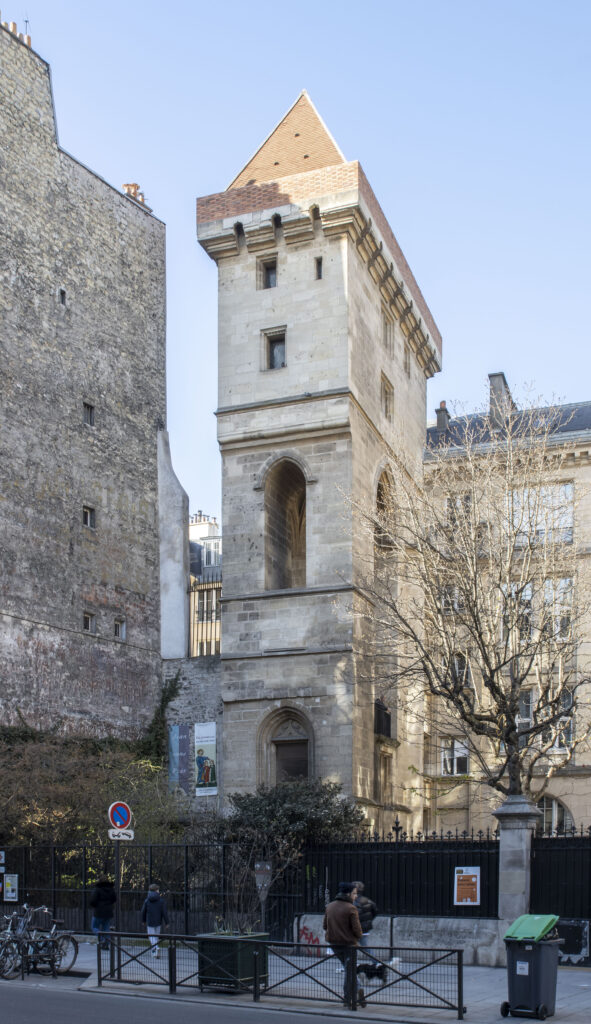

A fifteenth-century tower standing on its own between the buildings of the rue Étienne Marcel: all that remains of the Paris palace of the dukes of Burgundy, with a spiral staircase under a vault carved into a tree.
At a glance
The Tour Jean sans Peur stands at 20 rue Étienne Marcel, in the centre of Paris, backed against the line of the city wall of Philippe Auguste. Jean I, duke of Burgundy, called Jean sans Peur, John the Fearless, had it built in 1409–11 as part of his Paris residence, the hôtel de Bourgogne, formerly the hôtel d’Artois. The hôtel has gone; the tower is its last standing piece. Inside, a great spiral staircase climbs under a sculpted vault of about 1410 in which oak branches, hops and hawthorn grow out of a central pot. The tower belongs to the City of Paris and has been open to the public since 1999, run by the Association des Amis de la tour Jean sans Peur, which presents two temporary exhibitions a year on daily life in the Middle Ages alongside the five levels of the tower itself.
Key facts
- Where: 20 rue Étienne Marcel, 75002 Paris, France — Métro line 4 (Étienne Marcel), RER A, B or D (Les Halles), bus 29
- Built: 1409–1411 for Jean sans Peur, duke of Burgundy, after the assassination of Louis d’Orléans in 1407
- What it was: part of the hôtel de Bourgogne, the ducal residence, which had begun as the hôtel d’Artois built by Robert II d’Artois in the late thirteenth century
- Later: brought back to light when the rue Étienne Marcel was cut through in 1866–68; listed as a monument historique on 29 September 1884; restored in 1893 and again in 1991–92; open to the public since 1999
- Owner and manager: City of Paris; run by the Association des Amis de la tour Jean sans Peur (president Jean Leveau, director Agnès Lavoye, founder Rémi Rivière)
- Visit: five levels, two temporary exhibitions and a garden; about an hour and a half
- Coordinates: 48.864302, 2.348052 · open in Google Maps
History
The site belonged first to Robert II d’Artois, who built a residence here in the late thirteenth century, against the wall that Philippe Auguste had raised around Paris. By inheritance the hôtel d’Artois passed to the dukes of Burgundy and took their name. In November 1407 Jean sans Peur had his cousin and rival Louis d’Orléans murdered in Paris, and the conflict between the Burgundian and Orléans parties that followed shaped French politics for a generation. In 1409–11, in that climate, the duke added a tower to his Paris house: a display of power in the capital as much as a piece of architecture, with a staircase grand enough for a prince and, at the top, private rooms.
The hôtel de Bourgogne was later broken up and built over, and the tower was swallowed by the houses of the quarter. It came back into view when the rue Étienne Marcel was driven through the district in 1866–68, and the interest it aroused led to its listing as a monument historique on 29 September 1884 and to a restoration in 1893. A second restoration followed in 1991–92, before which the medieval archaeologist Marc Viré (died 2022) carried out a study of the fabric — the stages of construction, the stones used, the great vault — that the association still cites. Since 1999 the tower has been open to visitors, and the association that runs it has built a programme of exhibitions, lectures and guided visits around it.
What you see
From the street the tower is a tall square block of pale limestone, its top carried out on machicolations under a parapet, with a pyramidal roof above. One tall pointed window lights the staircase within. Inside, the visit climbs by stages: a room to see every fifteen or twenty steps, the steps themselves low, as a princely staircase demanded, with a handrail the whole way and chairs in each room. On the stones of the walls are the marks left by the masons who cut them.
The centrepiece is the vault over the great spiral staircase, carved about 1410: a central pot from which branches of oak rise, with hops climbing them and branches of hawthorn joining in, a canopy of stone foliage above the stairs. The reconstruction of the medieval latrines, one of the tower’s original conveniences, is among the things the visit shows, and the exhibitions on daily life in the Middle Ages — clothing, food, hygiene, the city — use the rooms of the tower as their setting.
Practical information
- Opening hours: Wednesday to Sunday, 1.30 pm – 6 pm, without booking for individual visitors; Tuesday 2 pm – 6 pm and Thursday and Friday 10 am – 1 pm for groups by booking
- Admission: 7 euros, reduced 5 euros, covering the tower and the temporary exhibitions; guided visits on Saturdays and Sundays at 3 pm, 12 euros, reduced 8 euros
- Exhibitions until 7 March 2027: La mode au Moyen Âge, on dress in the late Middle Ages, and La place du Louvre, on the history of the square by the Louvre
- Contact: by email in preference, as the association reports that its telephone line receives messages badly
- Access: the climb is by stages with low steps and a handrail; groups of up to eighteen people
Getting there
The tower is in the 2nd arrondissement, a few minutes on foot from Les Halles. Métro line 4 stops at Étienne Marcel, the RER lines A, B and D at Les Halles, and bus 29 at Turbigo – Étienne Marcel. The association publishes a downloadable walk through medieval Paris that starts from the tower.
Nearby
- Les Halles and the church of Saint-Eustache, to the south-west
- The Musée de Cluny, the national museum of the Middle Ages, on the Left Bank
- The place du Louvre, the subject of the tower’s second exhibition, by the Louvre colonnade and Saint-Germain-l’Auxerrois
Sources
- Association des Amis de la tour Jean sans Peur, official website tourjeansanspeur.com: address, opening hours, prices, programme, exhibitions, contacts and the tribute to Marc Viré (read 29 September 2026)
- Wikipédia (fr), Tour Jean-sans-Peur, citing Henry Gaillard (1877), Alfred Perrault-Dabot (1902), Jean Mesqui (1988) and Philippe Plagnieux (1988): construction 1409–11, the hôtel d’Artois, the rediscovery of 1866–68, the listing of 29 September 1884, the restoration of 1893, opening in 1999
- Wikimedia Commons, category Tour Jean-sans-Peur: photographs of the tower and of the masons’ marks; the print Percement de la rue Etienne Marcel avec la tour Jean-Sans-Peur, 1867
- OpenStreetMap Nominatim, for the coordinates
Find it on the map
See this place and what’s around it →Events here — now on & upcoming
- La mode au Moyen Âge — fashion in the late Middle Ages at the Tour Jean sans Peur, Paris, until 7 March 202729 Sep 2026 — 07 Mar 2027See the event →
📷 Become a Cultural Heritage Online photographer
Share your photos of places: they stay published under your name as the author. The more they're seen, the more you get noticed — and soon a contest will reward the most appreciated photos.
Log in or sign up free to add a photoIs this page about you?
This page is read by travellers and heritage enthusiasts who find it on Google. Tell us how you are connected to this place and we will take it from there.