
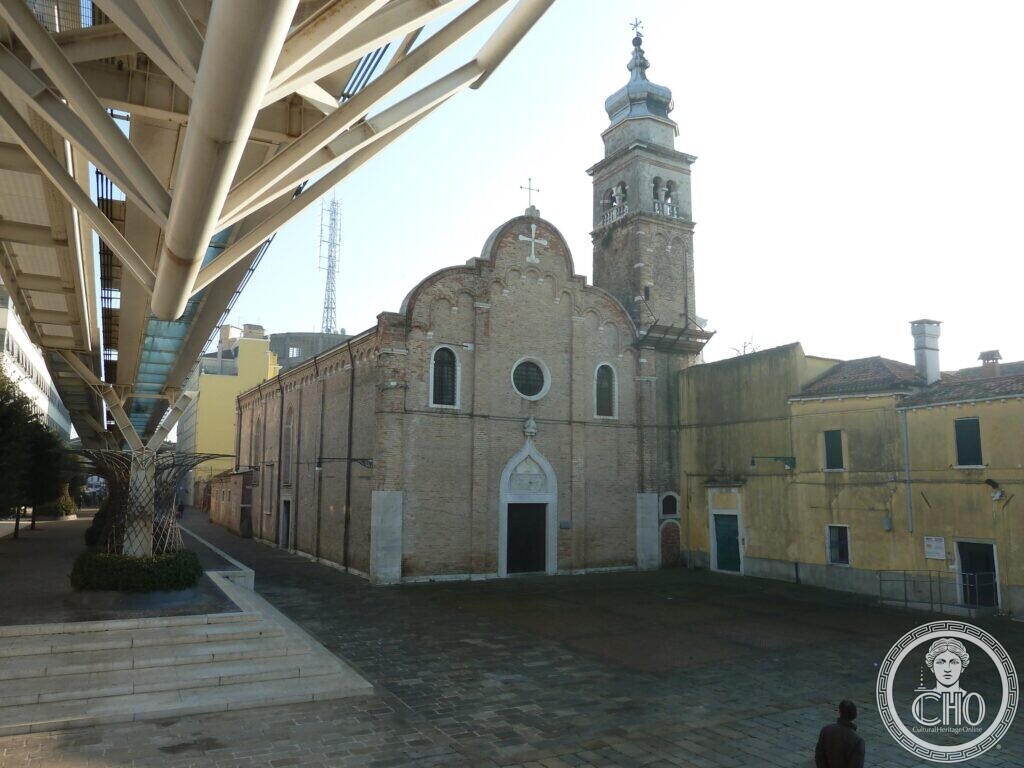
The church that once marked the edge of Venice now stands on a paved campo between the bus station and an elevated train. Its brick front is still the one the nuns of the fourteenth century knew.
At a glance
Sant’Andrea della Zirada stands at the western end of Santa Croce, on the edge of Piazzale Roma. It was the church of a convent founded here in the fourteenth century, at a point of the city then called Cao de Zirada. The convent has almost entirely gone; the church has kept its Gothic facade, and today it sits a few metres from the car park, the bus terminal and the People Mover that links them to the island of Tronchetto.
Key facts
- Founded: permission granted in 1329 to four Venetian noblewomen to found a religious house on the site
- Church: built in the first half of the fourteenth century, restored in depth in 1475
- Facade: Gothic, in exposed brick, divided by pilasters joined at the top by blind arches
- Portal: pointed, with reliefs in the lunette
- Today: a consecrated church, surrounded since the early twentieth century by the buildings of Piazzale Roma
- GPS: 45.43825, 12.31629 · Open in Google Maps
History
In 1329 four Venetian noblewomen obtained permission to found a religious house at the Cao de Zirada, the western tip of the city. The foundation began, as Chorus records, as an oratory attached to a shelter for poor women, and became a convent. The church went up in the first half of the fourteenth century and was restored in depth in 1475, when most of it was rebuilt; the facade is the part that survives from the Gothic building.
The convent was later suppressed and largely demolished. In the early twentieth century the new road and car park of Piazzale Roma were built right up against the church, and since 2009 the People Mover has run past it on its elevated track. The two sources used here spell one of the founders differently (Corraro in the Italian Wikipedia, Corner in Chorus), which is why this page does not name them.
What you see
A narrow brick front, divided into three by pilasters that meet under a row of blind arches, with a round window over a pointed portal of Istrian stone. The lunette of the portal carries two reliefs: the Calling of Peter and Andrew, the saint the church is named for, and Christ as the Man of Sorrows. A bell tower with an onion-shaped top rises on the right. On the left, almost touching the campo, are the white tubes and pillars of the People Mover: the most modern thing in the view, next to one of the oldest.
Nearby
- Ponte del Monastero — the green bridge on the Rio Novo, a short walk east
- Santa Chiara — the convent that opposed this foundation, now cut away
Sources
- Chorus, Associazione per le Chiese del Patriarcato di Venezia, Chiesa di Sant’Andrea de la Zirada: the 1329 foundation, the first use as a shelter for poor women, the facade and the portal reliefs
- Chiesa di Sant’Andrea della Zirada, Italian Wikipedia: Cao de Zirada, the 1475 restoration, the suppression of the convent, Piazzale Roma and the People Mover
Find it on the map
See this place and what’s around it →📷 Become a Cultural Heritage Online photographer
Share your photos of places: they stay published under your name as the author. The more they're seen, the more you get noticed — and soon a contest will reward the most appreciated photos.
Log in or sign up free to add a photoIs this page about you?
This page is read by travellers and heritage enthusiasts who find it on Google. Tell us how you are connected to this place and we will take it from there.