
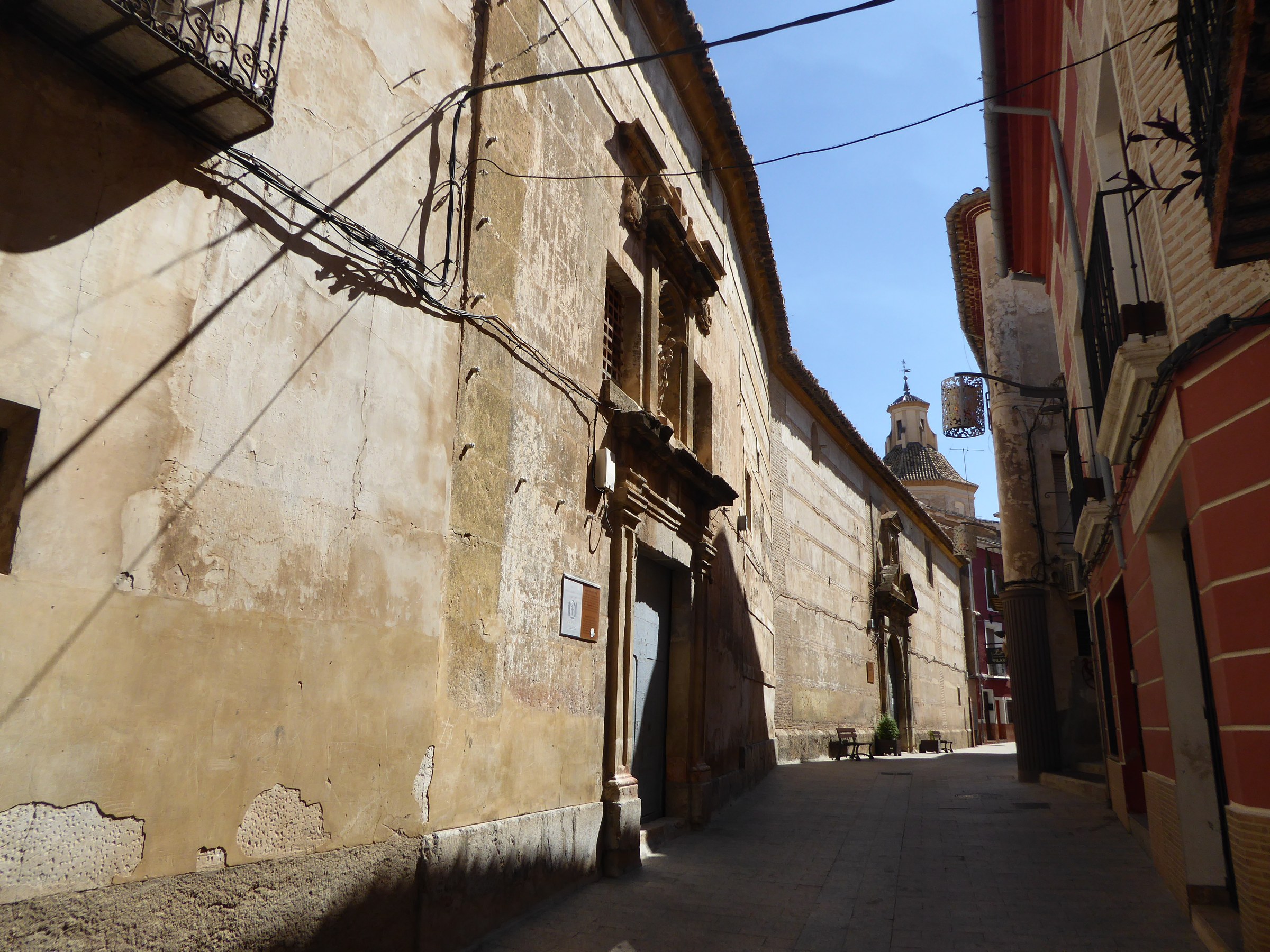

Teresa of Ávila founded this convent of Discalced Carmelite nuns in 1576, on what was then the edge of town. The church was rebuilt in the eighteenth century, the whole complex was listed in 2003, and the regional government bought it in 2021. After a restoration costing more than 1.4 million euros it opens to the public in October 2026, four hundred and fifty years after its foundation.
At a glance
The convent stands on Calle Mayor, in the old quarter below the castle and the basilica of the Vera Cruz. It was the twelfth of the seventeen houses of reformed Carmelite nuns that Teresa of Ávila founded or authorised in person, and the only one in the Region of Murcia. The complex is more than a church: it takes in the convent building, its walled garden, the Casa de las Mandaderas — the house of the women who ran errands for an enclosed community — and the Casa Fundacional on Calle Mayor, the house where the foundation began. The Autonomous Community of the Region of Murcia bought the site in 2021 for 800,000 euros and, with European Next Generation funds, has carried out a first phase of restoration so that the church can be visited, and used for exhibitions and concerts.
Key facts
- Where: Calle Mayor, 30400 Caravaca de la Cruz, Region of Murcia, Spain
- Founded: 1576, by Teresa of Ávila; the twelfth foundation of Discalced Carmelite nuns
- Built: the church was rebuilt in the eighteenth century
- The complex: convent, garden, Casa de las Mandaderas, church of San José, and the Casa Fundacional on Calle Mayor
- Protection: declared Bien de Interés Cultural in 2003
- Owner: the Autonomous Community of the Region of Murcia, which bought the site in 2021 for 800,000 euros
- Restored: first phase completed in 2026, more than 1.4 million euros from European Next Generation funds
- Coordinates: 38.106698, -1.860805 · open in Google Maps
History
Teresa of Ávila spent the last twenty years of her life travelling Spain to found houses of the reform she had begun at Ávila in 1562. The Caravaca foundation came in 1576, and the account she left of it turns on four young women of good family who, after hearing a Jesuit preach in March 1575, refused to go home until a monastery of the reformed order was founded in their town. The house was established on Calle Mayor, at that time outside the town walls.
The buildings that stand today are later than the foundation: the church was rebuilt in the eighteenth century, and the convent grew around it. In 2003 the whole complex was declared a Bien de Interés Cultural, the highest level of protection in Spanish heritage law; in 2021 the regional government bought it, with the intention of restoring it and opening it to visitors.
The first phase of that work, financed by the European Union’s Next Generation funds, cost more than 1.4 million euros. It restored the outer and inner facades, rebuilt the roofs of the church and of its bell-gable, conserved the mural paintings and the vaults, treated the altarpieces, improved access, and installed the services a public building needs — water, drainage, electricity, climate control, fire protection, lighting and security — so that the church can hold guided visits, exhibitions and concerts. Work also went to the paintings of the old church and to the facade of the Casa Fundacional on Calle Mayor. The church reopens on 3 October 2026, in the year of the four hundred and fiftieth anniversary of the foundation.
What you see
From Calle de las Monjas the convent reads as a long, high wall of ochre stone and render, broken only by two carved stone doorways and a few small grilled windows set high up: the architecture of an enclosed community, which turned inward and gave the street a surface rather than a facade. In the photograph the render has fallen away in patches, exposing the stone beneath, and cables run across the wall. Further along the street a tiled dome rises above the roofline.
The church doorway is Baroque: paired pilasters, a heavy cornice, coats of arms above it, and, higher up, a niche holding a stone figure of Saint Joseph with the Child, the patron the house is named for. Inside are the mural paintings and the altarpieces that the recent campaign conserved, and a bell-gable — an espadaña, a wall pierced for bells rather than a tower — rises over the church roof.
Visiting
- The church reopens to the public on Saturday 3 October 2026 with a concert; open days follow on 2, 3 and 4 October.
- The restoration was designed to allow guided visits, exhibitions and concerts; a regular visiting arrangement is expected to follow the reopening. Check with the municipal tourist office before travelling.
- Oficina Municipal de Turismo, Calle de las Monjas 19, telephone 968 702 424.
- This is the first phase of the restoration: the convent buildings and the garden are not yet part of the visit.
Getting there
Caravaca de la Cruz lies in the north-west of the Region of Murcia, about 70 km from the city of Murcia by the C-415. The convent is in the old town, a short walk below the basilica-sanctuary of the Vera Cruz in its castle, and near the town hall square.
Nearby
- The basilica-sanctuary of the Vera Cruz, inside the medieval castle above the town, which holds the relic that gives Caravaca its name and its status as one of the five cities in the world granted a perpetual jubilee.
- The Casa Fundacional on Calle Mayor, part of the same convent complex, whose facade was restored in the same campaign.
- Caravaca is one of the fourteen towns of the Huellas de Teresa network, the cultural route that links the places Teresa of Ávila chose for her reform.
Sources
- Región de Murcia Digital, Monasterio San José de Madres Carmelitas — Historia y Personajes: the 1576 foundation on Calle Mayor, then outside the walls, the twelfth foundation of Discalced Carmelite nuns, and Teresa’s account of the four young women.
- Ayuntamiento de Caravaca de la Cruz, on the start of the first phase of the restoration: the elements of the complex, the listing of 2003, the 2021 purchase for 800,000 euros, and the services installed for tourist and cultural use.
- Red Huellas de Teresa, Finaliza la primera fase de la rehabilitación del convento de San José de Caravaca de la Cruz: the works carried out — facades, church roofs and bell-gable, mural paintings, vaults, altarpieces, accessibility — the Casa Fundacional, the cost, and the 450th anniversary.
- murcia.com, La iglesia de San José reabre sus puertas tras su rehabilitación con un concierto de Cantoría: the reopening of 3 October 2026 and the open days.
- OpenStreetMap: coordinates of the convent and church of San José.
Find it on the map
See this place and what’s around it →Events here — now on & upcoming
- The church of the Convent of San José reopens — Caravaca de la Cruz, October–November 202602 Oct 2026 — 30 Nov 2026See the event →
📷 Become a Cultural Heritage Online photographer
Share your photos of places: they stay published under your name as the author. The more they're seen, the more you get noticed — and soon a contest will reward the most appreciated photos.
Log in or sign up free to add a photo