
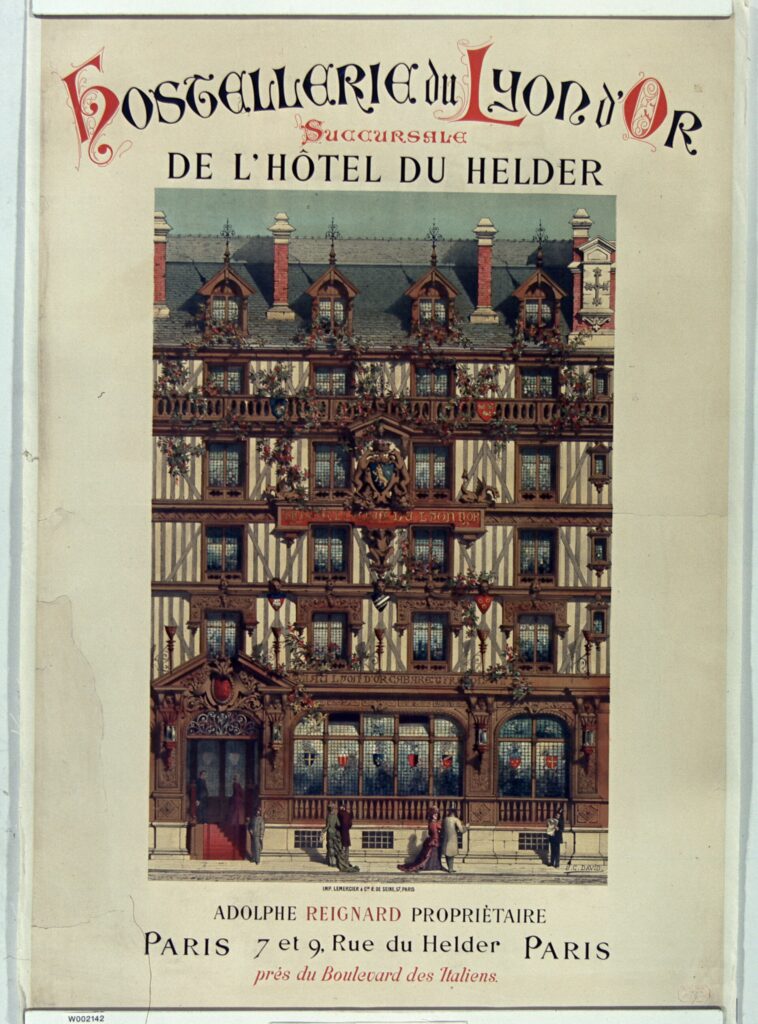

A carved wooden shopfront a few steps from the Grands Boulevards, made in 1881 for a hotel that was opening a restaurant and styling it as a sixteenth-century cabaret. The half-timbered front that once rose above it has gone. The shopfront has stayed, name and all, and the City of Paris protects it.
At a glance
Number 7 rue du Helder, in the Chaussée-d’Antin quarter, carries one of the more unusual shopfronts of nineteenth-century Paris. According to the City of Paris heritage record, it was commissioned in 1881 from the architect Claude David, for a project that extended an existing hotel and opened a restaurant called the Lyon d’Or. The dark neo-Renaissance joinery was originally part of a décor covering the whole street elevation, with half-timbering, carved window frames, cornices and escutcheons, and it was noticed at the time in the architectural press. The shopfront is protected under the Paris local urban plan, and the building is now a hotel.
Key facts
- Where: 7 rue du Helder, 75009 Paris (Quartier de la Chaussée-d’Antin)
- Shopfront: commissioned in 1881; neo-Renaissance, in carved wood
- Architect: Claude David, according to the City of Paris record
- Original business: the Lyon d’Or hotel, restaurant and cabaret, advertised as an annexe of the Hôtel du Helder at 7 and 9 rue du Helder; proprietor Adolphe Reignard
- Protection: protected element of the City of Paris local urban plan (PLU), protection no. 09-0540, type élément particulier protégé (commercial shopfront)
- Current use: hotel (Maison Albar – Le Vendome)
- Coordinates: 48.871768, 2.334836 · open in Google Maps
History
Rue du Helder is a short street, about 145 metres long, running from the boulevard des Italiens to the boulevard Haussmann. It was opened in 1775 and extended to the boulevard in 1799, and it takes its name from the fighting at Den Helder in the Netherlands in that year. In the nineteenth century it belonged to the Chaussée-d’Antin, the quarter of new money, and Balzac housed Anastasie de Restaud here in Le Père Goriot.
In 1881 the owners of a hotel in the street decided to extend it and to open a restaurant, the Lyon d’Or. The City of Paris record states that the shopfront was commissioned that year from the architect Claude David, and that it formed part of a larger scheme: the whole street front was dressed with half-timbering, framed windows, cornices, coats of arms and other carved work. The record adds that the design was noticed for its finesse and quality in architectural journals of the day, among them La Semaine des constructeurs and Le Moniteur des architectes.
The house advertised itself with some energy. A colour poster, dated 1883 in the collections of the Bibliothèque nationale de France, calls it the “Hostellerie du Lyon d’Or, succursale de l’Hôtel du Helder”, names Adolphe Reignard as proprietor and gives the address as 7 and 9 rue du Helder, near the boulevard des Italiens. An illustrated trade card in the Musée Carnavalet describes it as a “cabaret François du XVIe siècle” and a first-class restaurant, the annexe of the Hôtel du Helder. The Carnavalet also keeps menus and invitation cards for dinners held there, among them an etched invitation by Henri Guérard for a “dîner Dentu”, named after the publisher Édouard Dentu.
At some later date the upper décor was stripped and the front above the ground floor was given a plain rendered finish; we have not found when. The wooden shopfront survived, with the name of the Lyon d’Or still lettered on its band, and the City of Paris now protects it as a distinct heritage element. The building is today a hotel, which presents the Lyon d’Or as part of its own story.
What you see
The poster shows the building as its owner wanted it to be seen in the 1880s. Above a carved wooden ground floor rise four storeys of half-timbering, the dark timbers set against pale infill, with heraldic shields hung between the windows and a larger carved coat of arms at the centre. A red signboard reading “Hostellerie du Lyon d’Or” runs across the middle of the front, garlands of flowering plants trail over the front, and the roof is a slate slope with four gabled dormers and tall brick chimneys. At street level the entrance, on the left, sits under a carved pediment with a shield, and two wide round-headed bays glazed in small panes, some carrying painted arms, stand over a balustrade of turned wooden balusters. Men in top hats and women in bustles walk past.
Today’s street, as it appears in a 2021 photograph by Chabe01 on Wikimedia Commons and in the hotel’s own pictures, keeps that ground floor almost exactly: the dark carved frame, the arched doorway with a wrought-iron fanlight, the two round-headed bays now fitted with iron grilles, the row of turned balusters beneath them and small lanterns on the piers. The band above still reads “Au Lyon d’Or, Cabaret François”. Above it the façade is now smooth, pale and plain, with simple windows and iron balconettes, so the shopfront is the only part of the 1881 scheme left to see.
_-_2021-06-28_-_2.jpg)
Practical information
- The building is a hotel, Maison Albar – Le Vendome; the interiors are for guests.
- The protected shopfront faces the street and can be seen at any time from the pavement of rue du Helder.
- The street is narrow and short: a few minutes are enough to look at the shopfront and at the listed houses at numbers 1 and 3.
Getting there
Rue du Helder links the boulevard des Italiens to the boulevard Haussmann. The Métro stations Chaussée d’Antin – La Fayette (lines 7 and 9), at the Haussmann end, and Opéra (lines 3, 7 and 8) are each a few minutes’ walk away, as is Richelieu – Drouot (lines 8 and 9) along the boulevard des Italiens. The RER A stops at Auber, near the Palais Garnier.
Nearby
- Nos. 1 and 3 rue du Helder, two houses at the boulevard end of the street, both inscribed as historic monuments since 1977.
- Palais Berlitz, on the boulevard des Italiens at the southern end of the street, a couple of minutes away.
- Salle Favart, home of the Opéra-Comique, a short walk east across the boulevard.
- Palais Garnier and Galeries Lafayette Haussmann, both about five minutes to the west and north.
Sources
- Ville de Paris, PLU – Protections patrimoniales (Paris Data, dataset plub_pvp), protection 09-0540, 7 rue du Helder: shopfront commissioned in 1881 from Claude David, the Lyon d’Or restaurant and hotel extension, the original décor of the whole elevation, the notices in La Semaine des constructeurs and Le Moniteur des architectes.
- Bibliothèque nationale de France, poster Hostellerie du Lyon d’Or, succursale de l’Hôtel du Helder (Gallica btv1b9016667p, via Wikimedia Commons): date 1883, printer Lemercier, proprietor Adolphe Reignard, address 7 and 9 rue du Helder.
- Musée Carnavalet – Histoire de Paris, Adresse illustrée du restaurant Au Lyon d’Or (Paris Musées, via Wikimedia Commons), and Henri Guérard, Invitation au dîner Dentu au Cabaret du Lyon d’Or, inv. G.23451.
- Ministère de la Culture, Mérimée PA00088954 and PA00088955: the listed houses at 1 and 3 rue du Helder (inscribed 1977).
- Maison Albar – Le Vendome, official site: current use as a hotel; the owner’s account of the Lyon d’Or and of Claude David’s façade.
- Wikipedia (fr), Rue du Helder: length, opening in 1775 and extension in 1799, origin of the name, Balzac.
- OpenStreetMap / Nominatim: position, returned as 7, Rue du Helder, Quartier de la Chaussée-d’Antin, Paris 9e.


Find it on the map
See this place and what’s around it →📷 Become a Cultural Heritage Online photographer
Share your photos of places: they stay published under your name as the author. The more they're seen, the more you get noticed — and soon a contest will reward the most appreciated photos.
Log in or sign up free to add a photoIs this page about you?
This page is read by travellers and heritage enthusiasts who find it on Google. Tell us how you are connected to this place and we will take it from there.